
 Back
Back





HIGH COURT OF JUDICATURE AT ALLAHABAD
SALIL KUMAR RAI, AJAY KUMAR-II, JJ.
Pawan Kumar – Appellant
Versus
State of U.P. – Respondent
Criminal Appeal No. 4280 of 2011
Decided On : 26-05-2026
| Table of Content |
|---|
| 1. summary of prosecution case, investigation procedures, and initial trial court conviction. (Para 1 , 2 , 3 , 4 , 5 , 6 , 7 , 8 , 9 , 10 , 11) |
| 2. parties' contentions regarding evidentiary sufficiency and classification of offense. (Para 12 , 13 , 14 , 15) |
| 3. analysis of witness testimonies and evidentiary record. (Para 16 , 17 , 18 , 19 , 20 , 21 , 22 , 23 , 24 , 25 , 26 , 27) |
| 4. principles regarding the admissibility, reliability, and sole evidentiary value of dying declarations. (Para 28 , 29 , 30 , 31 , 32 , 33 , 34 , 35 , 36 , 37 , 38 , 39 , 40 , 41 , 42 , 43 , 44 , 45 , 46) |
| 5. assessing charges (trespass, molestation) based on witness credibility and documentary corroboration. (Para 47 , 48 , 49 , 50 , 51 , 52) |
| 6. distinction between murder and culpable homicide (section 304 part ii) considering lack of premeditation. (Para 53 , 54 , 55 , 56 , 57) |
| 7. final acquittal on specific charges, conviction reduction, and sentencing order. (Para 58 , 59 , 60 , 61 , 62) |
JUDGMENT :
AJAY KUMAR-II, J.
1. The instant Criminal Appeal has been directed against the judgment and order dated 07.07.2011 / 11.07.2011 passed by Additional Sessions Judge / Special Judge (S.C./S.T. Act), Etawah in Sessions Trial No.394 of 2008 (State Vs. Pawan Kumar) arising out of Case Crime No.90 of 2008, under Sections 452, 354, 302 IPC, Police Station - Ekdil, District Etawah convicting and sentencing the appellant under Section 302 I.P.C. for life imprisonment and a fine of Rs. Rs.10,000/- with stipulation of default clause, under Section 452 IPC for seven years rigorous imprisonment and a fine of Rs.5000/- with stipulation of default clause and under Section 354 IPC for two years rigorous imprisonment and a fine of Rs.2000/- with stipulation of default clause. All the sentences were directed to run concurrently.
2. Prosecution story, in nutshell, as unfolded in written report (Ex.Ka.-1), is as follows:
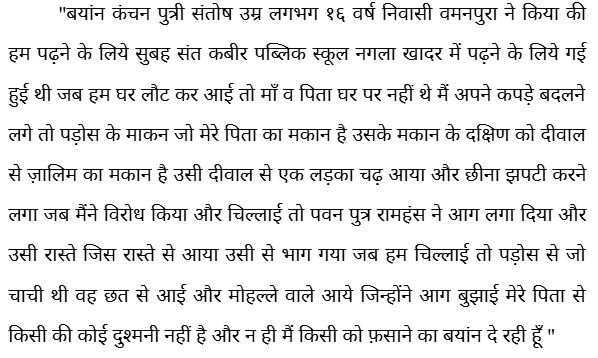
On 02.04.2008 at about 12:00 Noon, when Kanchan, daughter of the complainant Santosh Kumar, aged about 16 years and a student of class XI returned home from school, kept her bag and was changing her clothes and the younger son of the informant namely, Vikas aged about 13 years was at home, the accused Pawan Kumar entered into the house of the complainant through the roof of the neighbour and started outraging the modesty of the daughter of the complainant. On being objected, he became annoyed. The son of the informant, who was outside the house came inside, to which the accused Pawan picked the kerosene container, poured it on Kanchan, lit the matchstick, set her ablaze and fled away from the roof of the house. The son of the informant, who witnessed the incident, started shrieking, on which the neighbour Smt. Urmila came at the spot and extinguished the fire that broke out in the roof of the house. At the time of incident, the complainant was working as a labourer along with his wife. Urmila told that he had seen Pawan Kumar running from the place of incident.
3. On the basis of written report (Ex.Ka.-1), on 02.04.2008 at 16:30 hours, Chik First Information Report (Ex.Ka-5) as Case Crime No.90 of 2008, under Sections 354, 452, 307 IPC was registered against the accused at Police Station - Ekdil, District Etawah.
4. The complainant immediately took his daughter in burnt condition to Moti Jheel Hospital, Etawah by rickshaw and got her admitted there, where she was medico legally examined. On 02.04.2008 itself, the statement / dying declaration of the victim (Ex. Ka.3) was recorded by the Tehsildar. He also took her signature over the same. Victim was conscious at the time of statement. On the very next day her daughter was referred to Kanpur Ursala Hospital, where she remained admitted for 6 - 7 days and during treatment, she took her last breath.
5. On 10.04.2008 at 3:20 P.M., the autopsy of the deceased Kanchan was performed by Dr. V.P. Chaturvedi, who found following injuries on her person :
(i) Superficial to deep burn injuries all over the body except
AI



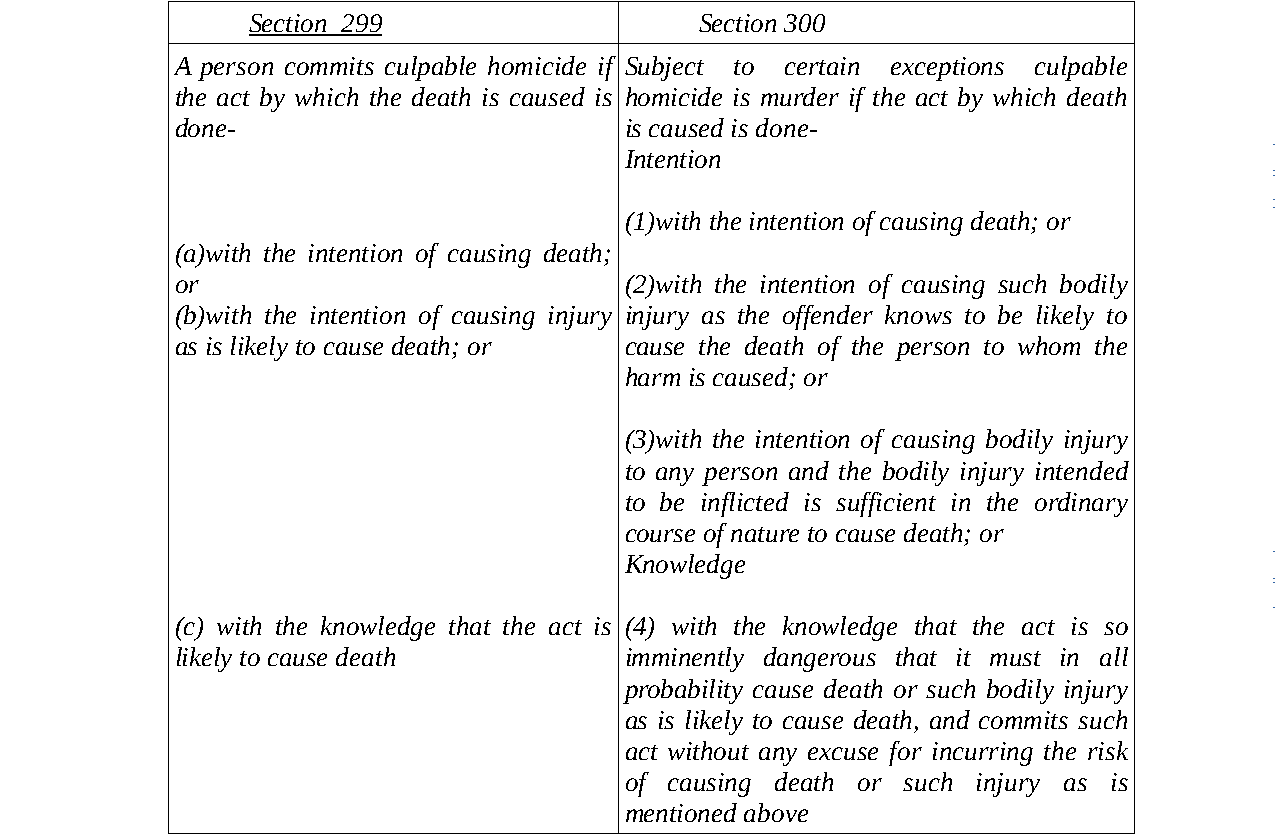
Murder – Factor which distinguishes culpable homicide from murder is presence of special mens rea which consists of mental attitudes indicated in Section 300 IPC and unless one of it is attributable ....
The judgment established the distinction between culpable homicide and murder under the IPC, and applied recent legal principles allowing for reduced incarceration periods for similar offenses.
The dying declaration was the sole basis for conviction, and the distinction between 'murder' and 'culpable homicide not amounting to murder' under Section 299 and 300 of the Indian Penal Code was cr....
The main legal point established in the judgment is the reliance on dying declaration as a sole basis for conviction under Section 302/34 of IPC, the interpretation of Section 498A of IPC, and the ap....
The dying declaration, if found to be true, voluntary, and reliable, can be the sole basis for conviction without the need for corroboration. The court may rely on the dying declaration as the primar....

The voluntary and truthful nature of dying declaration and the competency of a child witness to depose are crucial in establishing guilt and determining the appropriate criminal offense.

Dying declarations are admissible as sole evidence for conviction if credible; mere acquittal by trial court can be overturned if found perverse.



An indispensable Tool for Legal Professionals, Endorsed by Various High Court and Judicial Officers
Please visit our Training & Support
Center or Contact Us for assistance

Scan Me!
India’s Legal research and Law Firm App, Download now!


For Daily Legal Updates, Join us on :



 Back to top


