



1. Second bail application seeking release for effective defence preparation after prosecution evidence closed. (Para 1 , 2 )
 Back
Next 


2025 Supreme(All) 3985
HIGH COURT OF JUDICATURE AT ALLAHABAD
AJAY BHANOT, J.
Vikash Kanjad - Applicant
Versus
State of U.P. - Opposite Party
Criminal Misc. Bail Application No. - 11032 of 2025, Criminal Misc. Bail Application No. - 11724 of 2025, Criminal Misc. Bail Application No. - 13193 of 2025, Criminal Misc. Bail Application No. - 18831 of 2025, Criminal Misc. Bail Application No. - 26735 of 2025, Criminal Misc. Bail Application No.- 11558 of 2025, Criminal Misc. Bail Application No.- 12136 of 2025, Criminal Misc. Bail Application No.- 13551 of 2025, Criminal Misc. Bail Application No.- 14246 of 2025, Criminal Misc. Bail Application No.- 14453 of 2025, Criminal Misc. Bail Application No.- 14785 of 2025, Criminal Misc. Bail Application No.- 15795 of 2025, Criminal Misc. Bail Application No.- 16313 of 2025, Criminal Misc. Bail Application No.- 17134 of 2025, Criminal Misc. Bail Application No.- 6702 of 2025, Criminal Misc. Bail Application No.- 8473 of 2025, Criminal Misc. Bail Application No.- 9600 of 2025, Criminal Misc. Bail Application No.-19170 of 2025
Decided On : 14-10-2025
Advocates Appeared:
For the Applicant : Yadavendra Dwivedi
For the Opposite Party : G.A.
For the Applicant : Yadavendra Dwivedi
For the Opposite Party : G.A.
Preparation of a defence strategy and gathering defence evidence is a valid ground for granting bail, particularly after prosecution evidence concludes, to ensure a fair trial under Article 21, provided the court exercises judicial discretion based on specific case factors rather than a mechanical approach.
Headnote:(A) Constitution of India - Article 21 - Code of Criminal Procedure, 1973 - Sections 233, 313, 439 - Bharatiya Nagarik Suraksha Sanhita, 2023 - Sections 256, 351 - Right to fair trial and effective defence - The right to a fair trial is an irrevocable guarantee under Article 21, which includes the right to a fair opportunity for defence and the ability to adduce evidence to prove innocence (Paras 38, 44). The principle of "bail not jail" remains a guiding light to ensure that an accused is not punished prior to conviction and has every opportunity to look after their own case (Paras 29, 67).
(B) Grant of Bail for Defence - Preparation of a defence strategy and gathering of defence evidence is a valid ground for the grant of bail at the appropriate stage of a trial, particularly after prosecution evidence has concluded or is nearing conclusion (Paras 61, 82). This acts as a critical safeguard to ensure equal and fair justice, especially for accused persons from socio-economically marginalized sections who lack resources to effectively prosecute their defence while incarcerated (Paras 59, 61).
(C) Parameters for Exercise of Judicial Discretion - The grant of bail for defence is not a matter of course and cannot be applied mechanically (Paras 89, 91). The court must consider factors such as: (i) the heinousness of the offence and its impact on society; (ii) the criminal history and conduct of the accused; (iii) whether there was pro-prosecution bias in the investigation leading to the neglect of exculpatory evidence; (iv) the need of the accused to obtain quality legal advice and collect evidence; and (v) whether continued detention has become punitive (Paras 85-88).
Facts of the case:
This is a second bail application filed by the applicant in a case involving serious charges under the penal code. The prosecution evidence has concluded, and the trial is at the stage of proceedings for the accused's statement and subsequent defence evidence. The applicant contends that the investigation was biased and neglected critical exculpatory evidence, including CCTV footage from a commercial establishment, which is essential to refute the theory of the prosecution. The applicant further cites a lack of financial resources to engage effective legal counsel and the absence of family support to manage the defence while in custody.
Findings of Court:
The court found that since the prosecution evidence is closed, the possibility of influencing material witnesses is no longer a primary concern. The applicant's need to gather specific evidence to break the chain of circumstantial evidence and the socio-economic barriers preventing an effective defence make his continued incarceration detrimental to the norms of fairness in criminal jurisprudence.
Issues: Whether the gathering of defence evidence, preparation of a defence strategy, and the necessity of effectively prosecuting the defence case in a trial can be valid grounds for granting bail, and if so, what are the parameters for such a grant.
Ratio Decidendi: An accused has a fundamental right to a fair trial under Article 21, which necessitates a meaningful opportunity to present a defence. Once the prosecution's evidence is concluded, the risks typically associated with bail (such as witness tampering) are significantly reduced. In such circumstances, providing the accused liberty to secure legal resources and collect exculpatory evidence is essential to prevent the trial from becoming a mere formality and to ensure that the legal process is not used as a tool for punitive pre-trial detention.
Result: Bail application allowed.
Legal Category Hierarchy
- practice and procedure
- constitutional law
-
crime and sentencing
-
offences against the person
- murder (Para 101)
-
offences against the person
Table of Contents
2. Applicants argue bail for defence is a fair trial right; State argues no absolute ground for bail exists. (Para 5 , 6 )
3. Courts can grant bail for defence at appropriate stage, considering socio-economic realities and processual fairness. (Para 89 , 56 , 60 , 82 )
4. Preparation and conduct of defence is a valid, non-mechanical ground for bail at prosecution's conclusion. (Para 82 , 89 , 61 )
5. Bail granted to applicant for effective conduct of defence, with conditions to prevent abuse of liberty. (Para 104 , 105 , 106 , 107 , 108 )
6. Is preparation of defence a valid ground for granting bail?
Yes, conceptualising defence strategy, gathering, and adducing defence evidence is a valid ground for bail at the appropriate stage. (Para 82 , 61 )
7. What are the parameters for granting bail for defence?
Parameters include heinousness of crime, conduct of accused, criminal history, need to gather evidence, and pro-prosecution bias in investigation. (Para 84 , 85 , 86 , 87 , 88 )
8. Does the right to a fair trial under Article 21 support granting bail for defence?
Yes, the right to a fair trial, rooted in Article 21, includes the right to prepare an effective defence, which bail can facilitate. (Para 38 , 59 , 60 )
9. Is there an absolute rule against granting bail once a trial has commenced?
No, there is no absolute rule; bail for defence can be considered at the appropriate stage, especially after prosecution evidence closes. (Para 77 , 82 )
10. Can bail for defence be granted mechanically in all cases?
No, bail for defence cannot be granted mechanically; it requires consideration of facts, conduct, and evidence in each case. (Para 89 , 91 )
JUDGMENT :
AJAY BHANOT, J.
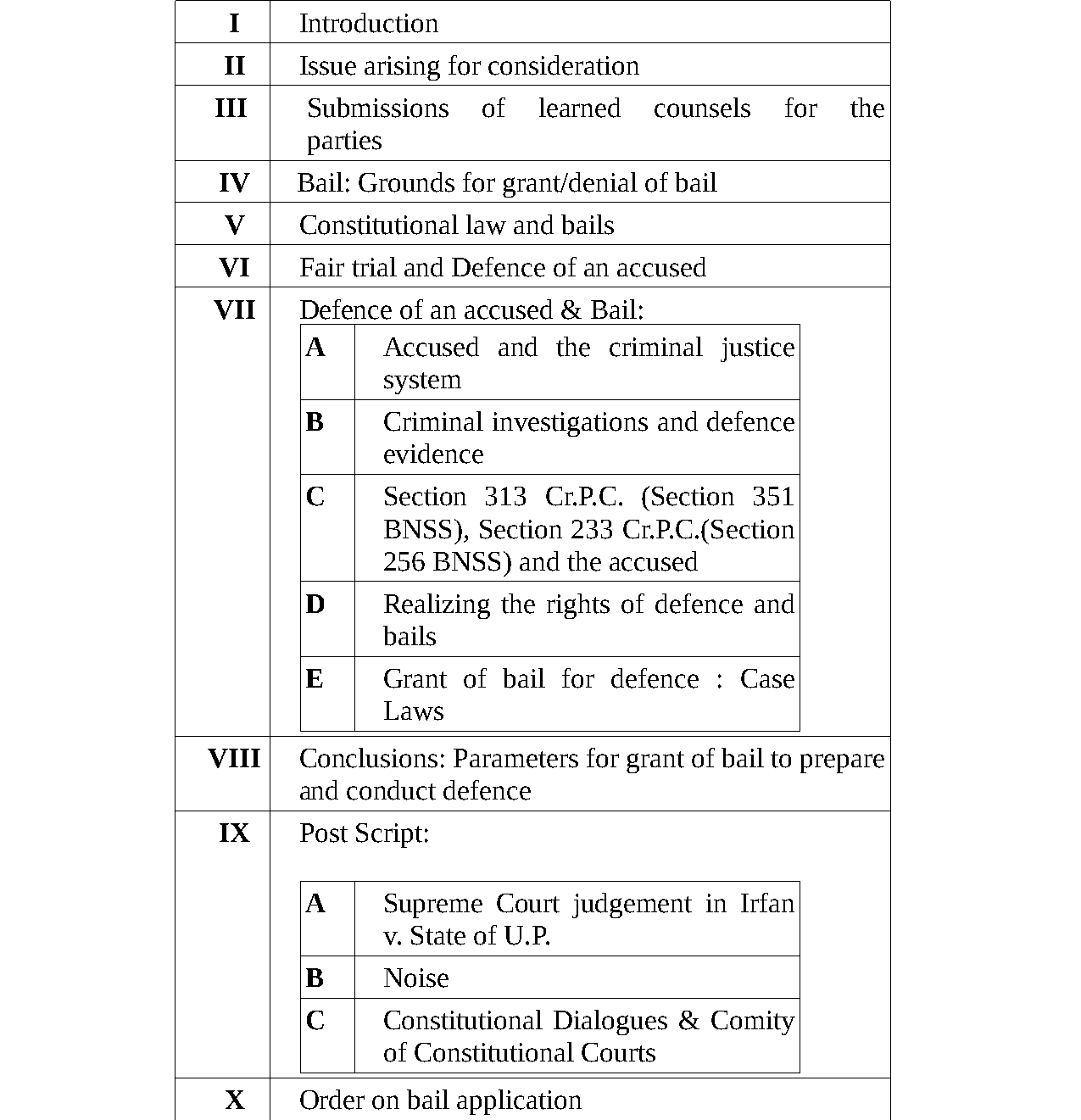
1. The judgment is being structured in the following conceptual framework to facilitate the discussion:
I. Introduction:
2. In this bail application and all companion bail applications prosecution evidence is near conclusion or has closed. Proceedings under Section 313 Cr.P.C. will be shortly set in motion, and thereafter defence evidence will be received. These are second bail applications. In all bail applications the primary ground for grant of bail is to conduct effective defence of the case.
II. Issue arising for consideration:
3. The issue that has arisen for consideration in this bail application and the connected bail applications is whether gathering of defence evidence, preparation of defence strategy and effectively prosecuting the defence case in a trial can be a ground for granting bail? If the answer is in the affirmative, what are the parameters on which the bail can be granted for framing a defence strategy, collecting defence evidence and conduct of defence and at what stage?
4. Heard Shri N.I. Jafri, learned Senior Counsel assisted by Shri Sadrul Islam Jafri, learned counsel, Shri Dharmendra Singhal, learned Senior Counsel assisted by Shri Shivendra Singhal, learned counsel, Shri Rajiv Lochan Shukla, learned counsel, Shri Sheshadri Trivedi, learned counsel, Shri Vikrant Rana, learned counsel, Shri Madhu Ranjan Pandey, learned counsel, Shri Irshad Ahmad, learned counsel, Shri Aishwarya Pratap Singh, learned counsel assisted by Shri Amiruddin Siddique, learned counsel, Shri Tripurari Pal, learned counsel, Shri M.P. Srivastava, learned counsel, Shri Shailesh Pandey, learned counsel, Shri Mohit Kumar Jaiswal, learned counsel, Shri Shashi Kumar Mishra, learned counsel, Shri Nasiruzzaman, learned counsel, Shri Gireesh Chandra Sharma, learned counsel, Shri Yadvendra Dwivedi, learned counsel, Shri Rahul Saxena, learned counsel, Shri Bharat Singh, learned counsel, Shri Sandeep Pandey, learned counsel, Shri Narendra Singh, learned counsel, Shri Azhar Hussain, learned counsel, Shri Jitendra Singh, learned counsel, Shri Saket Jaiswal, learned counsel and Shri Samrat Vikram Singh, learned counsel for the applicants.
Shri Rajiv Lochan Shukla, learned counsel for the applicant (as Hon’ble Rajiv Lochan Shukla, J. then was) has since been elevated to the Bench of this Court.
4.1. Shri Ashok Mehta, learned Additional Advocate General assisted by Shri Paritosh Kumar Malviya, learned A.G.A.-I and Shri Chandan Agrawal, learned A.G.A.-I for the State.
III. Submissions of learned counsels for the parties:
5. The hearings on the common legal issue arising in all the companion bail applications happened on various dates. Learned counsels for the applicants in all matters have made the following submissions on the common legal issue that has arisen for consideration:
I. The right of bail is sourced to statute, however, it has deep roots in Article 21 of the Constitution of India. The Court should adopt a liberal approach while considering bail applications. “Bail not jail” is the guiding principle of the law of bails.
II. The defence of an accused is a primary ingredient of a fair trial.
III. The prosecution has concluded its evidence. In some connected cases prosecution evidence is nearing closure. There is no possibility of the applicant(s) influencing witnesses. Cooperation of the applicant(s) in the investigations and his/her conduct during the trial is a relevant factor to be considered.
IV. The police investigations were incompetent and overlooked evidences which established the innocence of the applicant(s).
V. The applicant(s) had cooperated in the investigations and faithfully joined the trial proceedings.
VI. The applicant(s) did not tamper with the evidence nor influence witnesses.
VII. Denial of bail for defence in the circumstances and at this stage of the trial in all these cases will compromise the defence and result in miscarriage of justice. The refusal to grant bail for gathering defence and to conduct effec







