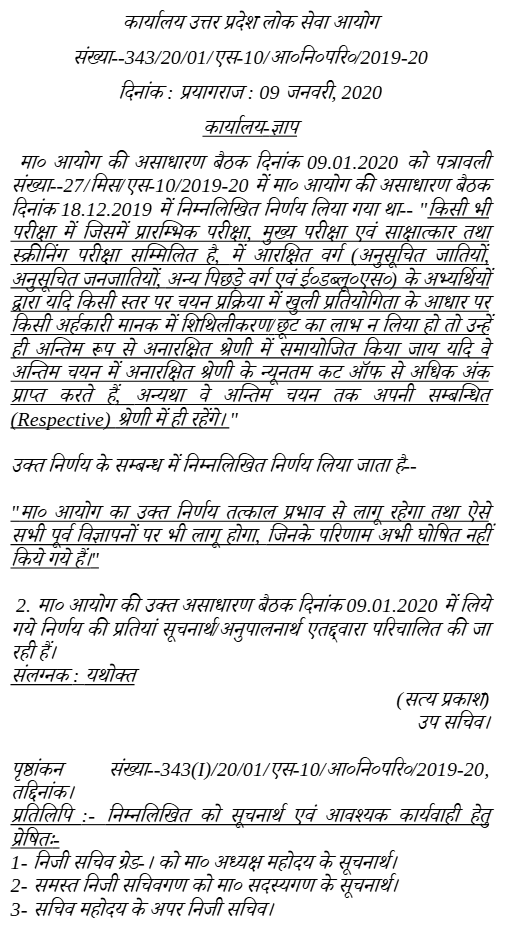
1. Challenge to a migration policy restricting reserved category candidates to unreserved category only at final selection stage. (Para 3 , 4 , 5 , 8 , 9 , 10 )
 Back
Next 


2026 Supreme(All) 1444
HIGH COURT OF JUDICATURE AT ALLAHABAD, LUCKNOW
Rajan Roy, Manjive Shukla, JJ.
Bhavna Yadav and others - Appellants
Versus
State of U.P. Thru. Prin. Secy. Deptt. Appointment and Personnel Lko. and others - Respondents
Special Appeal No. - 233 of 2026
Decided On : 29-09-2026
Important Points
Reserved category candidates who score above the unreserved cut-off must be adjusted in the unreserved category at the screening stage if those marks contribute to the final merit. Availing age or fee concessions does not bar such merit-based migration.
Subject
Service Law - Reservation in Public Employment
Act Referred
ALLAHABAD HIGH COURT RULES: R.5
CONSTITUTION OF INDIA: Art.14, Art.16, Art.309, Art.320(1)
UTTAR PRADESH PUBLIC SERVICES RESERVATION FOR SCHEDULED CASTES, SCHEDULED TRIBES AND OTHER BACKWARD CLASSES ACT: S.2(c), S.3, S.8
UTTAR PRADESH STATE PUBLIC SERVICE COMMISSION REGULATION AND PROCEDURE ACT: S.11
CONSTITUTION OF INDIA: Art.14, Art.16, Art.309, Art.320(1)
UTTAR PRADESH PUBLIC SERVICES RESERVATION FOR SCHEDULED CASTES, SCHEDULED TRIBES AND OTHER BACKWARD CLASSES ACT: S.2(c), S.3, S.8
UTTAR PRADESH STATE PUBLIC SERVICE COMMISSION REGULATION AND PROCEDURE ACT: S.11
Headnote
(A) Constitution of India - Articles 14, 16, 309, 320; U.P. Public Services (Reservation for Scheduled Castes, Scheduled Tribes and Other Backward Classes) Act, 1994 - Sections 3(6) and 8 - Migration of reserved category candidates to the unreserved category - Right of candidates to be treated as unreserved based on merit at the preliminary/screening stage - Where marks obtained in the preliminary/screening test are added to the final merit list, such candidates must be treated as unreserved candidates at the screening stage if they secure marks equal to or above the unreserved cut-off, as the process is a substantive part of final selection and not a mere shortlisting exercise. (Paras 20, 31, 40)
(B) Concessions in fees or relaxation in the upper age limit under the Act - Such concessions are meant to enable reserved category candidates to compete and are not relaxations in the standard prescribed for qualifying the written examination - These do not deprive a reserved category candidate of the right to be considered as a general category candidate on the basis of merit in the competitive examination. (Paras 46, 48)
(C) Jurisdiction of the recruitment Commission - The recruitment body has the duty to conduct examinations but lacks the authority to frame conditions of service or reservation policies, which fall exclusively within the domain of the State under Articles 16(4) and 320(4) of the Constitution. (Paras 67, 69, 70)
(D) Estoppel and maintainability - The principle of estoppel does not prevent a candidate from challenging the unconstitutionality or illegality of recruitment conditions even after applying for the post, provided the challenge is made before the selection process concludes, as a candidate only accepts the prescribed procedure and not the illegality in it. (Paras 76-81)
Facts of the case:
Candidates applying for public service posts challenged a condition in the recruitment advertisement and an office memorandum which stipulated that the migration of reserved category candidates to the unreserved category would occur only at the final selection stage. In the specific recruitment process, 75% of the final merit was determined by the screening test and 25% by the interview, making the screening test marks cumulative. The candidates argued that restricting migration to the final stage was unconstitutional and violated their right to fair consideration.
Findings of Court:
The court found that the blanket restriction on migration at the screening stage was unreasonable and contrary to law, especially when the screening marks are additive to the final result. The office memorandum issued by the recruitment body was found to be a result of non-application of mind to different recruitment structures and an encroachment upon the State's policy-making authority.
Issues: Whether migration of reserved category candidates to the unreserved category can occur at the preliminary/screening stage; whether availing concessions in age or fee bars such migration; and whether the recruitment body has the jurisdiction to issue blanket policies on reservation independent of the State Government.
Ratio Decidendi: Merit-based adjustment must be applied at every stage where merit is determined, particularly when the preliminary stage is a substantive component of the final score. Concessions in age and fee are entry-level facilitators and not reductions in merit standards. The authority to determine reservation policies rests exclusively with the State Government under the Constitution, and the recruitment body must follow state policy.
Result: The special appeal and the writ petition are allowed in the aforesaid terms.
Legal Category Hierarchy
- constitutional law
- administrative law
- practice and procedure
- public employment
- statutory interpretation
Advocates Appeared:
For the Appellant : Navneet Yadav, Aahuti Agarwal, Abhishek Khare, Chhote Lal Yadav, Jitendra Kumar, Mohd. Yasir, Vijay Nandan Mani Tripathi
For the Respondent: C.S.C., Raj Kumar Upadhyaya (r.k.upadhyaya)
For the Appellant : Navneet Yadav, Aahuti Agarwal, Abhishek Khare, Chhote Lal Yadav, Jitendra Kumar, Mohd. Yasir, Vijay Nandan Mani Tripathi
For the Respondent: C.S.C., Raj Kumar Upadhyaya (r.k.upadhyaya)
Table of Contents
2. Petitioners: policy violates Articles 14, 16. Commission: screening test only shortlists, migration not needed at preliminary stage. (Para 14 , 15 )
3. Marks of preliminary test are added to final selection; policy is unreasonable and violates Section 3(6) of the Reservation Act. (Para 16 , 17 , 19 , 20 , 21 , 22 , 23 , 24 , 25 , 26 , 27 , 31 , 32 , 33 , 34 , 39 , 40 , 41 , 66 )
4. Reserved category candidates, if meritorious at the preliminary stage without availing qualifying relaxations, must be adjusted in the unreserved category at that stage. (Para 40 , 65 , 82 , 84 )
5. Appeal allowed; condition no. 10 set aside; Commission directed to revisit the impugned OM in light of settled law. (Para 82 , 83 , 84 , 85 )
6. Can a reserved category candidate be adjusted against unreserved vacancies at the preliminary/screening stage?
Yes, if marks of that stage are added to final marks and no relaxation in qualifying standards was availed, as per Section 3(6) of the Reservation Act. (Para 16 , 21 , 22 , 23 , 40 )
7. Does availing relaxation in age or fee under Section 8 bar migration to the unreserved category?
No. The Supreme Court in Jitendra Kumar Singh held such relaxations do not affect merit determination and cannot bar migration. (Para 46 , 47 , 48 )
8. Does the Public Service Commission have the authority to decide reservation policy and conditions of recruitment?
No. Reservation policy is the domain of the State under Article 16(4); the Commission only conducts examinations per Article 320 and cannot encroach on this domain. (Para 67 , 68 , 69 , 70 )
9. Does participating in a selection process bar a candidate from challenging its legality?
No. Participating accepts procedure but not illegality; a candidate can challenge constitutional or statutory violations even after applying. (Para 76 , 77 , 78 , 79 , 80 )
10. Is the principle in Chattar Singh applicable when preliminary examination marks count toward final merit?
No. Chattar Singh applied where preliminary marks were not counted; it is distinguishable when they form a substantive part of final assessment. (Para 32 , 33 , 34 , 35 )
JUDGMENT :
Rajan Roy, J.
1. Heard learned counsel appearing on behalf of the parties.
2. This is an Appeal under Chapter VIII Rule 5 of the Allahabad High Court Rules, 1952 filed by the appellants challenging the judgment and order dated 01.05.2026 passed by the learned Single Judge in Writ-A No. 4502 of 2026 (Bhavna Yadav and others Vs. State of U.P. & Others).
3. By a very detailed order dated 13.05.2026 we have already held that the writ Court had erred in dismissing the writ petition as not maintainable. The relevant extract of the said order is quoted below:
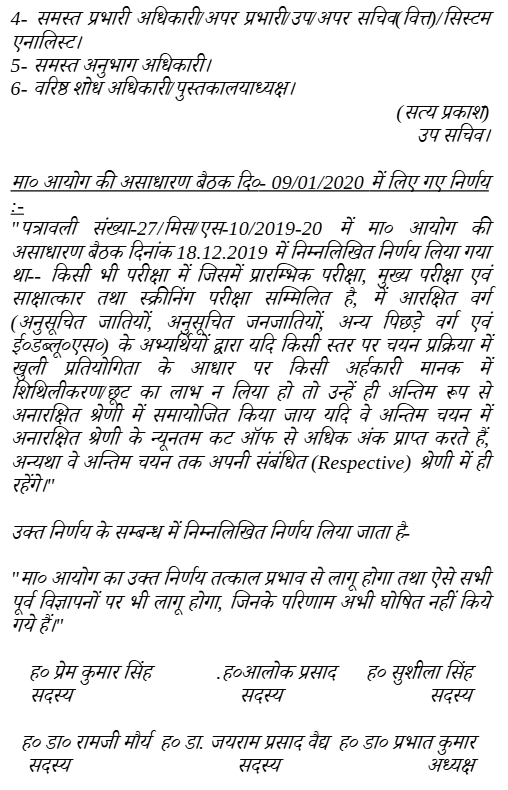
“4. As is evident from the relief clause the notification dated 09.01.2020, by which the Commission decided that migration from the Reserved category to the Unreserved/Open category based on the marks secured on merit will be done only at the stage of final selection and not at the preliminary stage. This notification was under challenge. The other challenge was to the advertisement dated 22.12.2025 wherein similar stipulation, as is contained in the notification dated 09.01.2020, was incorporated at Item No. 10. The other relief sought was to hold this recruitment strictly in accordance with the constitutional scheme of reservation and to treat the Reserved category candidates who secured equal or more marks, as an Unreserved / Open category candidate.
5. The appellants-petitioners filled the form for being considered for recruitment to the post which were advertised by the Commission vide impugned advertisement dated 22.12.2025 but before appearing in the selection, they filed the aforementioned Writ-A No. 4502 of 2026 seeking the aforesaid reliefs.
6. The learned Single Judge has dismissed the writ petition on the ground that at that stage, the appellants-petitioners did not have any right to challenge the aforesaid notification / advertisement and that the petition was pre-mature, as, it was still a contingency whether such a situation, as has been alleged in the writ petition, would arise or not. The writ petition according to learned Single Judge was based merely on apprehension, however, while dismissing it on the ground that it is pre-mature, he also observed that it was devoid of merit, as no actionable cause has arisen.
7. With respect, we find the reasoning given by the Writ Court as erroneous in law. The very notification dated 09.01.2020 and the advertisement containing Item No. 10 clearly prohibiting, treatment of a Reserved candidate as an Open category at the preliminary stage and allowing the same only at the final stage, were specifically under challenge. There was already a decision by the Commission to that effect, therefore, obviously, the recruitment would be held in terms of the stipulation contained in the office order dated 09.01.2020 and Item No. 10 of the advertisement. There could be no presumption that contrary to its own decision and advertisement, the Commission would hold the selection otherwise. The conditions of recruitment could be challenged if they were contrary to law and the Constitution. We are of the considered opinion that the appellants-petitioners approached the Writ Court at the right time, before the selection had actually commenced in the sense that before the examinations took place, as, this would avoid complications in future.
8. We wanted to dispose of the the appeal and remand the matter back to the learned Writ Court for consideration on merits, however, on being asked, learned counsel appearing for the Commission stated that he would like to file counter affidavit in the matter, therefore, we entertain the appeal and keep the matter pending.”
4. We reiterate and affirm the observations contained in the above quoted order.
5. In fact, by the order dated 13.05.2026 we had granted interim relief by which Condition no. 10 of the advertisement dated 22.12.2025 and the decision of the Commission dated 09.01.2020 impugned in the writ petition were stayed till the next date of listing.
6. In fact, we wanted to dispose of the writ peti