


1. Appeal against order rejecting final report and treating protest petition as complaint in custodial torture case. (Para 2 , 3 , 4 , 5 , 6 , 7 )
 Back
Next 





2026 Supreme(All) 1557
HIGH COURT OF JUDICATURE AT ALLAHABAD
SANTOSH RAI, J.
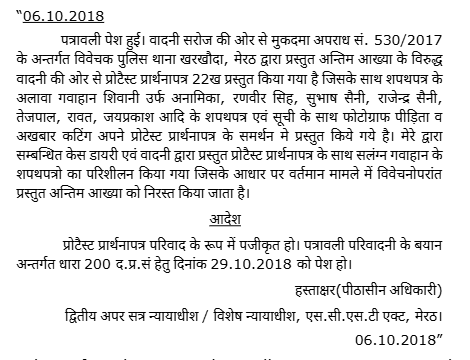
Bhuvnesh Kumari and others - Appellants
Versus
State of U.P. and another - Respondent
CRIMINAL APPEAL No. - 7399 of 2026
Decided On : 15-09-2026
Important Points
Orders taking cognizance or rejecting final reports are "intermediate orders" appealable under Section 14-A of the SC/ST Act. Such orders must be reasoned, comply with Section 197 CrPC sanction requirements for public servants, and follow Sessions Court trial procedures rather than Magistrate's warrant case procedures.
Subject
Criminal Law - Criminal Procedure / SC-ST Act
Act Referred
Headnote
(A) SC/ST (Prevention of Atrocities) Act, 1989 - Section 14-A and 14(1); Code of Criminal Procedure, 1973 - Sections 190(1)(a), 197, 200, 202, 227, 244 and 245 - Order treating protest petition as complaint - Maintainability of appeal - Cognizance of offence - Application of judicial mind - Sanction for prosecution of public servants - Procedural irregularities - Special Court acting as Court of Session. (Paras 13-21, 42-55)
(B) Maintainability of Appeal: The expression "order" in Section 14-A(1) of the SC/ST Act includes "intermediate orders." An order taking cognizance of an offence and summoning an accused, while passed at an intermediate stage, is not a purely interlocutory order because if reversed, it terminates the proceedings. Such orders are amenable to the statutory appellate jurisdiction of the High Court. (Paras 14-21)
(C) Cognizance on Protest Petition: Rejection of a final report (closure report) and treating a protest petition as a complaint requires a reasoned judicial order. Mechanical reliance on affidavits, photographs, or newspaper cuttings without examining the case diary or recording specific reasons for disagreeing with the Investigating Officer’s conclusion is legally unsustainable. (Paras 31-38, 41)
(D) Essential Ingredients of SC/ST Act: To attract the Act, the insult or intimidation must be on account of the victim belonging to a Scheduled Caste or Scheduled Tribe. Mere membership of such a caste is insufficient; there must be a specific intention to humiliate the person because of their caste identity. (Paras 25-26) (E) Protection of Public Servants: Under Section 197 CrPC, no court shall take cognizance of an offence alleged to have been committed by a public servant while acting or purporting to act in the discharge of official duty without previous sanction. Where acts have a reasonable nexus with official duty, the lack of sanction vitiates the cognizance. (Paras 42-50) (F) Procedure before Special Court: A Special Court constituted under the SC/ST Act remains a Court of Session. It must follow the procedure prescribed in Chapter XVIII of the CrPC (e.g., Section 227 for discharge) and cannot adopt the procedure for warrant cases before a Magistrate (e.g., Sections 244 and 245 CrPC). (Paras 52-55)
Facts of the case:
Police personnel were accused of committing caste-based atrocities and assault against a complainant within a police station. The Investigating Officer filed a final report recommending closure, noting that the allegations were a counterblast to a separate case registered against the complainant on the same day for assaulting police personnel. The Special Court rejected the final report and treated the protest petition as a complaint, relying on affidavits and newspaper cuttings.
Findings of Court:
The order of cognizance was non-speaking and lacked judicial reasoning. The Special Court failed to consider the mandatory sanction under Section 197 CrPC and adopted an incorrect procedural framework by using Magistrate's warrant case procedure instead of Sessions Court procedure. Furthermore, the allegations did not disclose the essential caste-based motive required under the SC/ST Act.
Issues: Whether the order treating a protest petition as a complaint is an "interlocutory order" blocking appeal; whether the Special Court properly applied its mind in rejecting the final report; whether sanction under Section 197 CrPC was required; and whether the adopted trial procedure was legally permissible.
Ratio Decidendi: An order taking cognizance/rejecting a final report is an intermediate order and thus appealable. Cognizance based on a protest petition must be a reasoned decision following statutory procedures under Sections 200/202 CrPC. Prosecution of public servants for acts reasonably linked to official duty requires prior sanction under Section 197 CrPC. Special Courts under the SC/ST Act must strictly adhere to the trial procedure of a Court of Session (Chapter XVIII CrPC).
Result: Appeal allowed; impugned order set aside; consequential proceedings quashed; appellants discharged.
Legal Category Hierarchy
- crime and sentencing
- practice and procedure
- evidence
- constitutional law
Advocates Appeared:
For the Appellant :Mohd Raghib Ali, Sr. Advocate
For the Respondent: G.A., Sanjay Kumar Srivastava
Table of Contents
2. Appellants challenge order on grounds of procedural illegality including lack of sanction and improper conversion of protest petition into complaint. (Para 8 , 9 , 10 , 11 , 12 )
3. The impugned order is non-speaking, lacks application of judicial mind, and relies on extraneous material like affidavits and newspaper cuttings. (Para 22 , 23 , 24 , 25 , 26 , 27 , 31 , 32 , 33 , 34 , 35 , 36 , 37 , 38 , 39 , 40 , 41 , 48 , 49 , 50 , 53 , 54 , 55 )
4. An order rejecting final report and treating protest petition as complaint is an intermediate order appealable under Section 14-A of the SC/ST Act. (Para 14 , 15 , 16 , 17 , 18 , 19 , 20 , 21 )
5. Appeal allowed. Impugned order set aside. All consequential proceedings quashed. Appellants discharged. (Para 67 , 68 , 69 , 70 , 71 )
6. What is the legal status of an order rejecting a final report and treating a protest petition as a complaint under the SC/ST Act?
It is an intermediate order, not a purely interlocutory order, and is appealable under Section 14-A of the SC/ST Act. (Para 14 , 15 , 16 , 17 , 18 , 19 , 20 , 21 )
7. What constitutes the essential ingredients for an offence under the SC/ST Act regarding caste-based insults?
The insult or intimidation must be on account of the victim belonging to a Scheduled Caste or Tribe. Mere reference to caste status is insufficient. (Para 25 , 26 )
8. Can affidavits, photographs, and newspaper cuttings be the sole basis for rejecting a final report and taking cognizance?
No. Such material is not substantive evidence and cannot mechanically form the basis for rejecting a final report without proper judicial scrutiny. (Para 32 , 33 , 34 , 35 , 36 , 37 , 38 )
9. Is it mandatory to consider Section 197 Cr.P.C. sanction before taking cognizance against public servants for acts done in official duty?
Yes. If the alleged acts have a reasonable nexus with official duty, previous sanction is a condition precedent for taking cognizance. (Para 42 , 43 , 44 , 45 , 46 , 47 , 48 , 49 , 50 )
10. What procedure must a Special Court under the SC/ST Act follow when a protest petition is treated as a complaint?
The Special Court must follow the procedure under Sections 200, 202 Cr.P.C. and thereafter proceed under Chapter XVIII as a Court of Session. (Para 51 , 52 , 53 , 54 , 55 )
JUDGMENT :
SANTOSH RAI, J.
1. Heard Sri Saghir Ahmad, learned Senior Counsel assisted by Sri Mohd. Raghib Ali, learned counsel for the appellants; Sri Sanjay Kumar Srivastava, learned counsel for opposite party no.2; Sri Shyam Narayan Rai, learned AGA for the State and perused the material on record.
2. The present criminal appeal has been filed by the appellants with a prayer to set aside the impugned order dated 6.10.2018 passed by IInd Additional Session Judge/Special Judge, SC/ST Act, Meerut in Criminal Misc. No.203 of 2018 (Smt. Saroj vs. Station House Officer Sandeep Kumar Singh and 15 others), arising out of Case Crime No.530 of 2017, under Sections 323, 332, 351, 354B, 376B, 392, 406, 499, 504, 506, 509, 120B IPC and Sections 3(2)(1), 7, 3(XI) of the Scheduled Castes and Scheduled Tribes (Prevention of Atrocities) Act, 1989, P.S.- Kharkhoda, District- Meerut, whereby the trial court has rejected the final report and treated protest petition as complaint case.
3. The brief contents of the complaint/FIR involve allegations by the complainant, Smt. Saroj, that after she demanded the repayment of a loan of Rs.20,000/- from one Sonu, Sonu colluded with the Station House Officer (SHO) Pradeep Kumar Singh and other police personnel of Police Station Kharkhoda, Meerut. The complainant states that on June 18, 2017, she was summoned to the police station where she faced severe caste-based slurs, physical assault, brutal custodial torture, and humiliation by the named police officers and other individuals. Furthermore, she alleges that valuables and cash were missing following the incident, that she was coerced under threats during her production before the magistrate, and that local authorities failed to take timely action on her initial complaints, leading her to seek legal remedy under relevant sections of the IPC and the SC/ST (Prevention of Atrocities) Act.
4. The Investigating Officer has submitted final report concluding that the case (Crime No.530/2017) was registered against the SHO and 15 others pursuant to a court order under Section 156(3) CrPC lacked supporting evidence during the course of the investigation, which included reviewing statements, site inspections, and affidavits. The officer noted that the allegations made by the complainant were not substantiated by eyewitnesses and appeared to be a counterblast to Case Crime No.299/2017. Consequently, due to this complete lack of evidence, the final report recommended closing the investigation and requested the court's approval to accept the closure.
5. After submission of final report by the I.O, the compainant has filed protest petition supported by affidavits of Shivani @ Anamika, Ranbir Singh, Subhash Saini, Rajendra Saini, Tejpal, Rawat and Jay Prakash alongwith newspaper cutting, photographs etc in order to support the ‘contents of protest petition’.
6. The trial court vide order dated 6.10.2018 has treated the protest petition into complaint case and passed following order:-
7. Thereafter the accused appellants were summoned by the trial court under Sections 323, 504, 506, 354B, 509, 120B and Sections 3(2)(7), 3(1)(r), 3(2)(va) SC/ST Act on the basis of evidence available on record during the course of inquiry proceeding.
8. In brief the grounds of appeal are that the application under Section 156(3) CrPC was entertained despite the complainant having allegedly failed to comply with the mandatory requirement of Section 154(3) CrPC, thereby vitiating the initiation of the proceedings. After a full-fledged investigation culminating in the Final Report dated 24.01.2018, the learned court rejected the Final Report and treated the protest petition as a complaint without exercising jurisdiction in accordance with Section 190(1)(a) Cr.P.C., rendering the impugned order dated 6.10.2018 legally unsustainable. The appellants, being police officials posted at Police Station Kharkhauda at the relevant time, were alleged to have acted in the discharge of their official duties, and









