Back
Back





2025 Supreme(Chh) 478
HIGH COURT OF CHHATTISGARH AT BILASPUR
Narendra Kumar Vyas, J.
Shri Kaushik Kumar Katta, S/o Shri Kishore Kumar Katta - Appellant
Versus
Madhukar Rao Dani (Died) Through Lrs. – Respondent
FA No. 170 of 2006
Decided On : 16-07-2025
For the Appellant :Mr. Prafull N. Bharat, Sr. Advocate with Mr. Mayank Chandrakar, Advocate
For the Respondent:Mr. Anurag Singh and Mr. Sandeep Patel, Advocate
Establishment of easementary rights requires substantiation through historical use or necessity; bona fide purchasers must prove good faith and due diligence.
Headnote:(A) Code of Civil Procedure, 1908 - Section 96 - Indian Easements Act, 1882 - Sections 4, 13, and 21 - Civil suit regarding easementary rights and sale deed - Trial Court declared the sale deed executed in favor of defendant No.1 null and void as it was executed without authority over the common courtyard which is considered as joint family property - Court emphasized that easements can be established by necessity or prescription and that the plaintiff substantiated his right to use the courtyard with historical evidence from a partition in 1895. (Paras 1-42)
(B) Bonafide Purchaser - The burden is on the subsequent purchaser to prove that he acted in good faith and has made necessary inquiries before purchasing property, failure to do so negates the protection typically afforded to bona fide purchasers. (Paras 38-41)
Facts of the case:
The plaintiff sought to declare a sale deed as null and void, contending that it related to a common courtyard that had not been partitioned among family members. The defendant claimed to be a bona fide purchaser without knowledge of the joint ownership.
Findings of Court:
The trial Court ruled in favor of the plaintiff, agreeing that the sale deed was executed without legal authority and reaffirmed the plaintiff’s easementary rights.
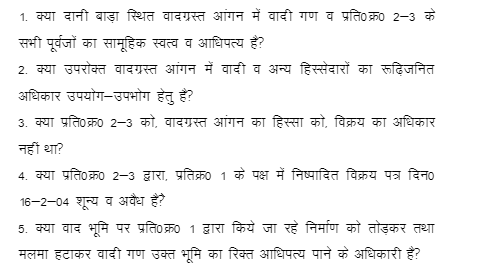
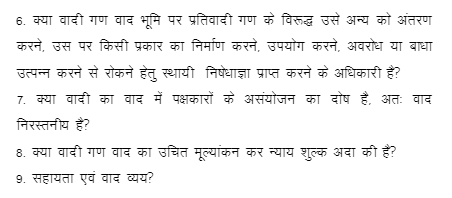
Issues: The key issues included whether the plaintiff established the easementary right, if the suit lacked necessary property descriptions, and whether the defendant was a bona fide purchaser.
Ratio Decidendi: The Court ruled that the plaintiff demonstrated his easementary rights through historical evidence and statements, while the defendant could not substantiate his claim as a bona fide purchaser due to lack of inquiry about the joint property status.
Result: Appeal dismissed.
JUDGMENT :
Narendra Kumar Vyas, J.
1. This first appeal under Section 96 CPC has been filed by appellant/defendant No.1 assailing the judgment and decree dated 18.08.2006 passed by learned 10th Additional District Judge, (FTC) Raipur in Civil Suit No. 102-A of 2004, by which the trial Court has allowed the suit filed by the plaintiffs and declared the sale deed dated 16.02.2004 executed in favour of defendant No.1 to be null and void.
2. For the sake of convenience, the parties shall be referred to in terms of their description in Civil Suit No. 102-A/2004.
3. Brief facts as mentioned in the plaint are that plaintiff has filed a civil suit before the learned trial Court mainly contending that;
(a) That from genealogy of the family as mentioned in the plaint, it is quite vivid, that Gangaji was the forefather of the plaintiff and he has two sons namely Ramchandra and Chhatroba. Ramchandra has one son Ganpatrao who has one son Baburao and Baburaon has one son Ganpartro Dani. Ganpartrao Dani has two sons namely Balasahab/defendant No.2 and Chandrakant/defendant No.3. Similarly, Chhatroba has three sons Narayan Rao, Keshav Rao and Nathoba. Narayan Rao has one son Viththalrao. Viththalrao has three sons Madhukar Rao/plaintiff No.2, Santosh Rao/plaintiff No.1 and Pratap Rao. Similarly, Keshav Rao has two sons, Jagannath Rao and Gopal Rao.
(b) It is contended that between Baburao, Narayan Rao and Keshavrao a partition of properties situated at Budhapara ward Raipur has taken place on 29.10.1895 which is known as Dani Bada. The map of the said property has also been annexed with the suit. It is also the case of the plaintiff that after partition the legal heirs of Ganpatrao Dani, Viththalrao Dani and Jagannathrao Dani were in possession of the suit property described in the plaint. The legal heirs of these persons are in possession of their respective shares in Dani Bada.
(c) It is also contended that there was common courtyard in the North side of the compound which is connected with Danibada from main road. The courtyard was used by all the persons residing in the compound as it was excluded from partition deed of 1895 and every family member is entitled to use it. However, none of shareholders or their successors have any right to transfer the above mentioned courtyard or its share to anyone else, therefore, none of its successor have any right or interest in the said courtyard or they have sole ownership over the courtyard, as such it could not have been sold out at the instance of any party, therefore, the plaintiff had acquired customary right over the said courtyard.
(d) It is contended that late Ganpatrao Dani had partitioned his shares in between himself and his three sons through a registered partition deed dated 20.05.1971 and the shareholders were enjoying their possession. It was contended that the courtyard was never partitioned among the family members but the defendant No. 2 and 3 have sold some of the lands of the courtyard to the defendant No.1 through registered sale deed dated 16.02.2004 measuring 8x10x16 feet for sale consideration of Rs. 50,000/-. The aforesaid land was described as A,B,C, and D in the map enclosed with the plaint.
(e) It is contended that the defendant No. 2 and 3 have no legal right or authority over the aforesaid portion of the courtyard and they have sold same without consent of the other family members, as such the sale deed was executed without any authority or title over the joint courtyard which is being possessed by all the family members. The said sale done by them is unauthorized which is not permissible in the eye of law and prayed for declaration that said registered sale deed be declared as null and void and is not binding on the plaintiff. It has also been pleaded that defendant No.1 started construction of a house on the disputed land unauthorizedly, the plaintiff went to stop construction work but he did not stop construction work which has necessitated the plaintiff to file a suit for de