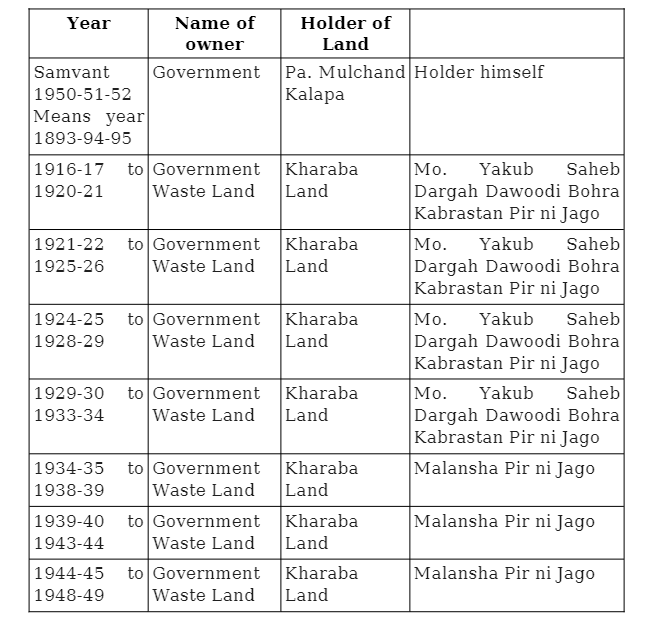
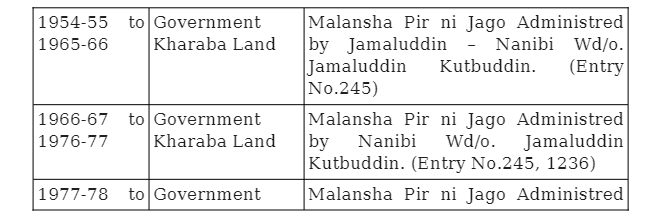
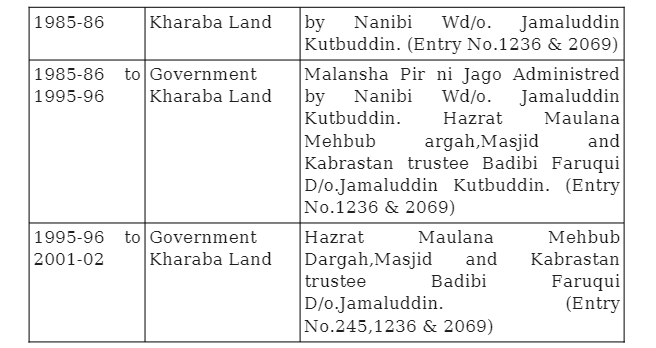
1. Dispute concerning the historical identity, denominational character, and management rights of an ancient Muslim religious shrine and burial ground following its disputed registration under the Waqf Act, 1995. (Para 4 , 5 )
 Back
Next 





2026 Supreme(Guj) 2131
IN THE HIGH COURT OF GUJARAT AT AHMEDABAD
J.C. DOSHI, J.
Kutubuddin Fakruddin Faruqui & Ors. - Appellants
Versus
The Gujarat State Waqf Board & Ors. - Defendants
R/First Appeal No. 1002 of 2026 With Civil Application (For Stay) No. 1 of 2026
Decided On : 14-09-2026
Important Points
A Mujawar's status as a caretaker does not confer proprietary or hereditary rights to a Waqf property; registration obtained via fraud is void ab initio and correctable by the Waqf Board, and a quasi-judicial inquiry does not necessitate a mandatory oral hearing.
Subject
Civil Law - Waqf Law
Act Referred
WAQF ACT: S.27, S.32(2), S.64, S.68, S.69, S.83, S.83(5)
BOMBAY PUBLIC TRUSTS ACT: S.18
CIVIL PROCEDURE CODE: O.7 R.11
Gujarat State Waqf Regulations: Reg.5
Headnote
(A) Waqf Act, 1995 - Sections 3, 32(2)(n), 40, 41, 50, 63, 64 - The Board possesses statutory power to investigate and determine the nature and extent of Waqf property and to amend the register. An inquiry under Section 40 is a fact-finding exercise and not a full-fledged trial; thus, it does not necessitate a mandatory oral hearing or the adjudication of preliminary issues like jurisdiction and maintainability in the manner of a civil suit. (Paras 93-112)
(B) Muslim Law - Concept of Mujawar and Mutawalli - A Mujawar is a servant or caretaker of a shrine who performs customary services and does not possess any proprietary right or hereditary interest in the Waqf property. Such status cannot be converted into that of a Mutawalli without valid appointment by a competent authority or the community. (Paras 37-44, 71-81)
(C) Principles of Natural Justice - The requirements of fairness depend on the circumstances of the case and the framework of the law. In a quasi-judicial inquiry by the Board, the submission of written representations satisfies the requirement of a fair opportunity of hearing. A personal hearing is not an absolute right in such proceedings. (Paras 102-106)
(D) Doctrine of Fraud - Fraud vitiates all judicial and administrative acts. Where registration of a trust is obtained by suppressing material facts or manipulating records, such registration is void ab initio and can be recalled by the Board. (Paras 84-87) (E) Places of Worship (Special Provisions) Act, 1991 - Section 3 - The bar on conversion of places of worship does not apply when the proceedings are directed towards determining the original identity and character of a property based on historical and revenue records, rather than converting an existing place of worship from one sect to another. (Paras 116-119)
Facts of the case:
A dispute arose between a family claiming to be hereditary managers of a holy shrine and a religious community regarding the identity, denominational character, and administration of the site. The family had registered the shrine as a trust, claiming the status of caretakers (Mujawar), but later asserted they were trustees (Mutawalli). The religious community challenged the registration, asserting the site belonged to their community based on historical revenue records and ancient inscriptions. The Board and the Tribunal upheld the religious community's claim and directed the family to hand over possession.
Findings of Court:
The court found that the family members were merely caretakers (Mujawar) and had no hereditary right to the office of Mutawalli. The registration of the trust was obtained through fraud and manipulation of records. The revenue records from the Gaekwad State era and ancient inscriptions conclusively proved the identity of the shrine as belonging to the religious community.
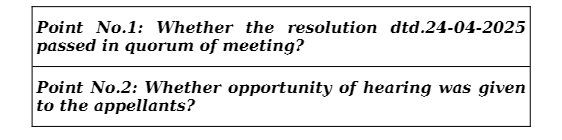
Issues: The main issues were whether the family was afforded a fair opportunity of hearing, whether the Board had the jurisdiction to amend the register and change the name of the shrine, and whether the provisions of the Places of Worship (Special Provisions) Act, 1991 were violated.
Ratio Decidendi: The court ruled that the Board's inquiry is a fact-finding process and does not require a full trial. The status of a caretaker does not confer proprietary rights. Fraud vitiates registration, allowing the Board to correct the register under Section 41. The Places of Worship Act is not applicable when the original character of the site is being determined using historical evidence.
Result: Appeal dismissed.
Legal Category Hierarchy
- administrative law
- property law
- practice and procedure
Advocates Appeared:
For the Appellant : Saquib S. Ansari.
For the Defendants : Jigneshkumar P. Pandav, Meet R. Modi, Mr. Manish S. Shah, Mr. Rajesh N. Modi, Mr. S.P. Majmudar, Viral R. Agrawal.
Table of Contents
2. Appellants claim hereditary management rights based on historical Sunni-Hanafi-Barelvi status, while respondents argue the shrine belongs to the Dawoodi Bohra community and that registration was obtained by fraud. (Para 7 , 8 , 9 , 10 , 11 )
3. The court found the shrine's registration as a Trust was procured by a caretaker without valid Waqf documentation and that the appellants' claim to hereditary management was legally unsubstantiated. (Para 17 , 27 , 28 , 29 , 30 , 31 , 32 , 33 , 34 , 35 , 54 , 59 , 60 , 63 , 87 )
4. A 'Mujawar' or caretaker lacks hereditary proprietary or management rights over Waqf property, and fraud in obtaining original Waqf registration vitiates all subsequent changes and appointments. (Para 38 , 39 , 40 , 41 , 42 , 44 , 84 , 85 , 86 )
5. Appeal dismissed; the Waqf Board's resolution and Tribunal's order confirming the correction of Waqf records are upheld, and the appellants' claim to hereditary trusteeship is rejected. (Para 129 , 130 )
6. Can a person claiming the status of 'Mujawar' effectively claim hereditary rights to manage a Waqf?
No, a 'Mujawar' is merely a caretaker or servant of a shrine. Under principles of Muslim law, such status does not confer any proprietary interest, hereditary right, or entitlement to act as a Mutawalli. (Para 38 , 39 , 40 , 41 , 42 , 43 , 44 )
7. Does fraud in the initial registration of a public trust, subsequently designated as a Waqf, invalidate later mutations and appointments?
Yes. Fraud vitiates all judicial and quasi-judicial acts. If a Waqf registration record is established as fraudulent or based on suppression of material facts, subsequent derived rights, such as change reports for Mutawalliship, are void ab initio. (Para 84 , 85 , 86 , 87 )
8. Is the inquiry process conducted by the Waqf Board under Sections 32 and 40 of the Waqf Act equivalent to a full-fledged adversarial trial?
No, the Waqf Board's power to determine the nature and extent of Waqf property constitutes a quasi-judicial inquiry, not a trial. It focuses on fact-finding to ascertain the religious and property status, and does not require adherence to standard procedural trials. (Para 95 , 96 , 97 , 98 , 100 , 114 )
9. Does the Places of Worship (Special Provisions) Act, 1991, bar an inquiry aimed at determining the original nature or character of a property as Waqf?
No. The Act prohibits the conversion of a place of worship from one religious denomination to another. However, an inquiry by the Waqf Board to ascertain the historical identity and original religious character of the property is not a 'conversion' and is permissible under the Waqf Act. (Para 117 , 118 , 119 )
JUDGMENT :
J.C. Doshi, J.
1. Draft Amendment is allowed. Necessary amendment to be carried out forthwith.
2. By order dated 21.04.2026, notice was issued for final hearing. Consequently, the learned counsels appearing for the respondents have waived service of notice.
2.1. Admit.
3. With consent of learned counsels appearing for the parties, the present First Appeal is taken up for final hearing.
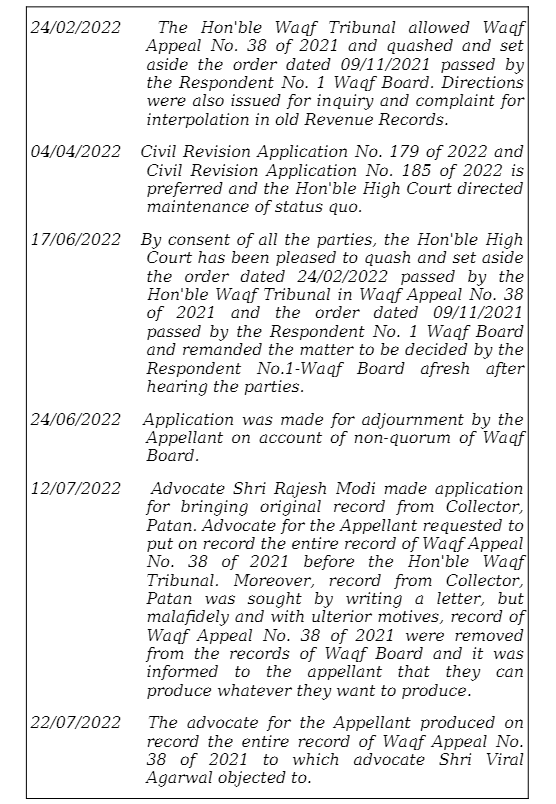
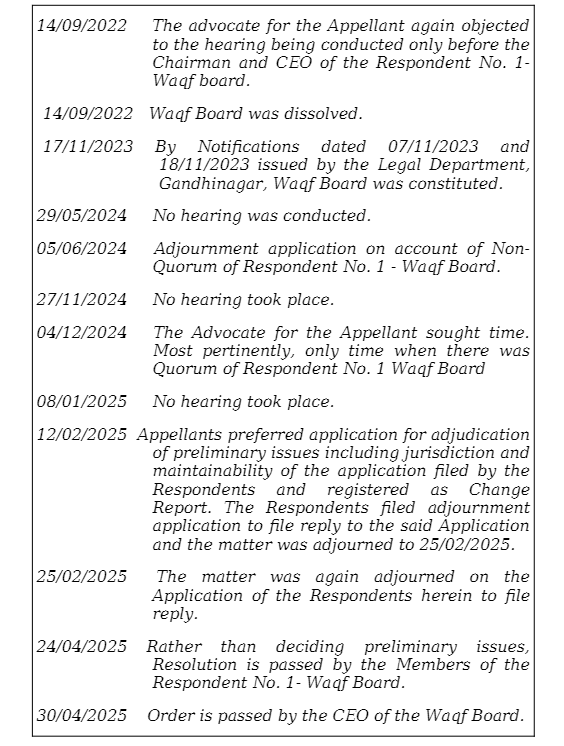
4. This appeal under Section 83 of the WAQF ACT , 1995, has been preferred by the appellants assailing the judgment and order dated 09.02.2026 passed by the Gujarat State Waqf Tribunal, Gandhinagar (for short “the Waqf Tribunal”) in Waqf Appeal No. 15 of 2025, whereby the Waqf Tribunal was pleased to reject Waqf Appeal No.15 of 2025 and confirm the order dated 24.04.2025 passed by the Waqf Board, passing Resolution No.11A, as well as the order dated 30.04.2025 passed by the Chief Executive Officer (for short “CEO”) of the Waqf Board assigned the reasons to Resolution No. 11A.
FACTUAL MATRIX
5. The facts born out from the impugned judgment and order as well as from the record and proceedings, are summarized as under:
5.1 The dispute concerns the holy shrine/property known as “Maulana Mehbub Dargah Masjid and Kabrastan” (per appellants)/ “Maulana Yaqub Saheb Dargah and Dawoodi Bohra Kabrastan” (per respondents), bearing Registration No.B-97/Mehsana, situated in Survey No.935 of village Anavada, Taluka and District, Patan, admeasuring about 1 Acre 21 Gunthas.
5.2 According to the appellants, in 1377 A.D. (798 A.H.), Hazrat Maulana Mehbub died in village Anavada and was buried in the land bearing Survey No. 935. A Dargah was thereafter constructed over his grave, along with the graves of his family members, who were “Mujawar”, and other “Sufi Saints”. The holy shrine has historically been known as “Maulana Mehbub Dargah Masjid and Kabrastan”, has followed the Hanafi-Sunni-Barelvi creed, and has been managed by the predecessors of the appellants. This assertion regarding its 14th-century origin and denominational character has been disputed by the respondents.
5.3 Nanibai, widow of Jamaluddin Qutbuddin, in her capacity as “Mujawar”, submitted an application under Section 18 of the BOMBAY PUBLIC TRUSTS ACT , 1950, (for short “the Act”) to the Charity Commissioner for registration of the public trust. The said application was made after the Act, came into force in the State of Gujarat, pursuant to the process of registration of holy shrines that had been in existence for a long period.
5.4 At the time of registration of the public trust, Nanibai, widow of Jamaluddin Qutbuddin, described/named the holy shrine as “Maulana Mehbub Dargah Masjid and Kabrastan”, showing Revenue Survey No.935 of village Anavada and admeasuring approximately 1 Acre and 21 Gunthas as trust’s immovable property. The registration referred to religious activities such as Urs, Fatehawani, Namaz and other related observances.
5.5 The Deputy Charity Commissioner, Ahmedabad, initiated an inquiry in Application No. 236 and appointed assessors, namely, S.M. Faruki, A.A.Maulvi and M.S. Kadri . By order dated 22nd January, 1953, the Deputy Charity Commissioner registered the public trust as B-97/Mehsana.
5.6 Upon the Wakf Act, 1995 coming into force, the registration of the trust was transferred to the Gujarat State Waqf Board.
5.7 Upon the death of Nanibi, her daughter, Badibi Jamaluddin Faruqui,claimed and succeeded her as “Mujawar”. Nanibi died on 11th February, 1960. Thereafter, Badibi, daughter of Nanibi, succeeded to the office of “Mujawar”. The record reflects that the change was recorded in favour of Badibi as “Mujawar” on the basis of her statement dated01.03.1960 and the change was approved on 10.03.1960.
5.8 On 20.12.2001, Badibi Jamaluddin Faruqui filed Change Report No.286 of 2002 before the Wakf Board, seeking deletion of her name and inclusion of the names of Kutubuddin Fakruddin Faruqui, Asrafuddin Fakruddin Faruqui, Jamaluddin Fakruddin Faruqui and Muniruddin Fakruddin Far