
 Back
Back





IN THE HIGH COURT OF JUDICATURE AT MADRAS
V.LAKSHMINARAYANAN, J.
Karuppanan – Appellant
Versus
Raju (Deceased) – Respondent
S.A.Nos.713 & 714 of 2000 In S.A.No.713 of 2000
Decided On : 12-11-2025
| Table of Content |
|---|
| 1. overview of appeals and parties' representations. (Para 1 , 3) |
| 2. nature of the property and claims of the plaintiffs. (Para 4 , 6 , 10) |
| 3. defendants' arguments against plaintiffs' claims. (Para 8 , 12 , 13) |
| 4. judicial observations on possession and rights. (Para 21 , 31) |
| 5. legal principles on partition rights and auction sales. (Para 37 , 39 , 53) |
| 6. final judgments and conclusions laid down by the court. (Para 55 , 56 , 57) |
JUDGMENT :
V.LAKSHMINARAYANAN, J.
1. These second appeals arise out of the common judgment passed by the learned II Additional District Judge at Erode in A.S.Nos.227 & 228 of 1998 dated 29.06.1999, in reversing the judgment and decree of the Court of District Munsif cum Judicial Magistrate at Perundurai in O.S.No.187 of 1995 and O.S.No.197 of 1996 dated 15.09.1998.
2. For the sake of convenience, the parties shall be referred to as per their ranks in the suit in O.S.No.197 of 1996.
3. O.S.No.197 of 1996 is a suit for partition. It was originally presented as O.S.No.349 of 1992, on the file of the Sub Court at Erode. Initially, it was decreed declaring the plaintiffs' 2/6th share. Aggreived by the same, the defendants 2 and 3 preferred an appeal. The appeal was allowed and the matter was remanded to the trial court for fresh consideration. Thereafter, the defendants 2 and 3 as plaintiffs, presented O.S.No.1568 of 1994 before the District Munsif Court at Erode. In this suit, the defendants 2 to 3, as plaintifffs, sought for a declaration that they are the absolute owners of the property, and also sought for permanent injunction restraining the defendants therein, from interfering with their peaceful possession and enjoyment of the property. Subsequently, both the suits were transferred to the file of the learned District Munsif cum Judicial Magistrate at Perundurai for disposal and renumbered as O.S.No.197 of 1996 and O.S.No.187 of 1995.
The facts leading to the appeal
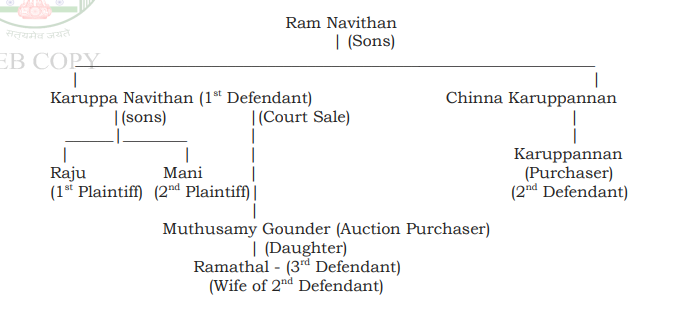
4. It was the case of the plaintiffs that the suit schedule mentioned property belonged to one, Rama Navithan. The property was his ancestral property. Rama Navithan had two sons, namely, Karuppa Navithan and Chinna Karuppan. Plaintiffs are the sons of Karuppa Navithan, the first defendant. On the death of Rama Navithan, Karuppa Navithan and Chinna Karuppan succeeded to the estate. Chinna Karuppan sold his half share in the suit property in favour of Karuppannan, the second defendant. The plaintiffs claimed that, the suit property being a coparcenary property, and as they are the sons of Karuppa Navithan, they are entitled to 2/6th share of the suit properties in common. The plaintiffs further alleged that the first defendant, their father, had left the family in and about 1969 and had gone to Mysore for eking out his livelihood, leaving the plaintiffs and their mother in lurch. It was only recently, the first defendant had returned to his native village. They alleged that for the sake of convenient enjoyment, they were in possession of the eastern portion of the suit property, while the purchaser, second defendant, was in enjoyment of the western portion. The third defendant is the wife of the second defendant. She claimed that the property came to her through her father, one Muthusamy Gounder. They alleged that the third defendant is not in peaceful possession and enjoyment of the property and that she is an utter stranger to the family. As they found it inconvenient to enjoy the properties in common, and since the second defendant was not amenable to an amicable partition outside the Court, they came forth with the suit in O.S.No.197 of 1996.
5. Summons were served on the defendants. The first defendant, Karuppa Navithan remained exparte. The second defendant filed a written statement, which was adopted by the third defendant.
6. In the said statement, the second defendant conceded the fact that Karuppa Navithan and Chinna Karuppan were entitled to equal moieties. However, it was denied that the joint title and possession of the br
Sons are liable for father's antecedent debts, making their shares in ancestral property subject to court auction sales. Adverse possession must show clear, continuous, and hostile possession to succ....

The legal principle established is that in cases involving the sale of joint family property, the burden of proving legal necessity lies with the purchaser only if the plaintiffs have properly pleade....

Point of law: “Conduct of indifference or Acquiescence and held that, it is settled law that an estoppel may arise as against persons who have not willfully made any misrepresentation, and whose cond....
The main legal point established in the judgment is the importance of evidence in establishing the nature of the suit property and the entitlement to seek relief by way of partition, as well as the i....
In joint family property disputes, a guardian may transact on behalf of minors without court sanction, provided sales serve family interests.

The absence of evidence proving the joint family status of properties allows a presumption that they are individual assets; thus, plaintiffs' claim for partition is dismissed.
Ancestral properties must be proven to remain joint family properties post-partition; otherwise, they are deemed separate and not subject to partition claims.
The burden of proof lies on the person claiming property as self-acquired to establish that it was acquired without the aid of joint family funds.
A claimant must prove the ancestral nature of properties to claim entitlement under the amended Hindu Succession Act; mere assertions without evidence are insufficient.



An indispensable Tool for Legal Professionals, Endorsed by Various High Court and Judicial Officers
Please visit our Training & Support
Center or Contact Us for assistance

Scan Me!
India’s Legal research and Law Firm App, Download now!


For Daily Legal Updates, Join us on :



 Back to top


