Rules for the establishment and working of Distilleries, Warehouses and Excise Depots
In exercise of the powers conferred by clauses (c), (g), (h), (i), (j), (k) & (n) of Section 29 of the Abkari Act 1 of 1077 and of all other powers hereunto enabling and in supersession of the Rules for the power working of Distilleries, Warehouses and Excise Depots issued under Section 29 of the Act, the Government of Kerala hereby make the following rules for the establishment and working of Distilleries, Warehouses and Excise Depots, for regulating the issue and transport of spirits to and therefrom and for the inspection and supervision thereof.
Special Bond to be executed for the Extra Neutral Alcohol (Neutral Spirit)/Grape Spirit/Malt Spirit without Payment of Duty. Know all men by these presents I/We ..................................................................................................... (herein after called the bounder/s) and Sri ....................................... (herein after called the surety) are bounden to the Governor of Kerala (hereinafter called the Government) in a sum of Rs.............................(Rupees...............................) to be paid to the said Government for which pa
S.FORM D-1
FORM D-1 REGISTER OF WASH BACKS IN THE .........................DISTILLERY
No Wash back.
Table of dimensions
Conse Depth cutive number
FORM D-3 Distiller’s Account of Materials Used
Materials
Wash
Weak spirits issued for
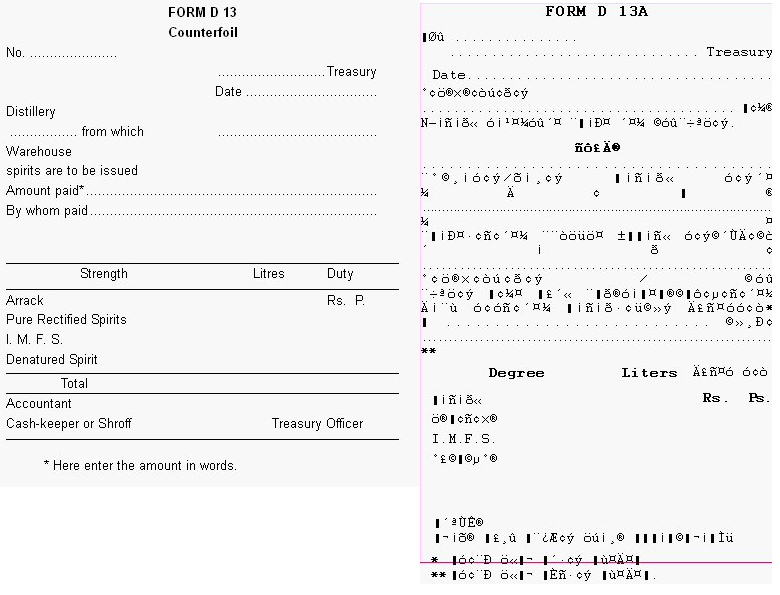
S.FORM D-3 (a)
FORM D3- (a) Distillers Declaration of wash
I hereby declare that the gravity of the wash made this day in the ....................Distillery is, according to the prescribed Saccharometer corrected for temperature, as shown below, that the total quantity is ............litres and that the quantity of materials used is as follows:-
S.FORM D-3 (b)
FORM D - 3(b) Statement of wash made and spirit obtained therefrom in the ................. Distillery for the month of.................
Date when set up
Number of wash back
Materials used
Litres
S.FORM D-3 (c)
FORM D 3 (c) Statement showing the quantities and price of raw materials used in distillation at the .............. distillery for the month of...............
Raw materials
Quintal
Rate
Value
S.FORM D 5
FORM D 5 Distiller’s /Warehouse-keeper’s Account of Warehouse Transactions
FORM D 6 (a)
Note Book of gauges and proofs at the..........................................................................
Distillery ------------------------ Warehouse
Vat or receiver number
Dip ---------------- Centimeter
S.FORM D 8
FORM D8
Register of spirits received into and issued from each Vat in The ..............................
Distillery -------------------- Warehouse
Vat No.
FORM D 8 (a)
Statement showing the particulars of blending and reducing operations in the
Distillery -------------------------- Warehouse
during the quarter ended........................
FORM D 9
Compilation Register of spirits stored,etc., in terms of proof strength in the warehouse of the ..................
Distillery ------------------- Warehouse
S.FORM D-9 (a)
FORM D 9 (a)
Extract from the Compilation Register of spirits stored,etc., in terms of proof Strength in the .........................
Distillery Warehouse
S.FORM D 10
FORM D 10
Compilation register of the weekly abstracts of the register of spirits (in terms of proof strength) in hand stored issued etc., for the month of ..................................in the.......................distillery/warehouse
S.FORM D 11
FORM D 11 Statement showing the result of stock taking (terms of proof strength) in the ............distillery/warehouse for the quarter ended............................................date of stock taking.
Received
Issued
S.FORM D 11A
FORM D 11A Register showing the result of the Quarterly Stock taking (in proof litres) in the .............................Distillery/Warehouse
Receipts
Issues
<
S.FORM D 12
FORM D 12
Chalan for payment of duty on spirits to be issued from the ....................
Application for issue of permits for transport of spirits
To
The Officer-in-charge of .....Distillery/ Warehouse
S.FORM D 16
FORM D 16 Register or permits issued from the .....................Distillery /Warehouse
Application
Permit
Quantity issued
<
S.FORM D 17
FORM D 17 Extract from the Register of permits issued from the .........................Distillery /Warehouse on the
Application
Permit
Quantity issued
S.FORM D 18
FORM D 18
(See Rule 77 of Part II)
Register of issues of country spirits and of the duty paid thereon in the .........Distillery /Warehouse
Name of
}
Range
or
.
S.FORM D 18A
FORM D 18A
Extract from the register of issues of country spirits and of the duty paid thereon in the month of..................................................from the..............................Distillery /Warehouse
Range
Quantity of country spirits issued
FORM D 19 Register of issues of Foreign, Denatured, etc, spirits and of the duty paid thereon in the........... Distillery /Warehouse
Name of Vendor .................................................. Whether consigned under bond .....................................
Pure rectified spirits
FORM D 19A Extract from the register of issues of Indian made Foreign Spirits Denatured, etc., spirits and of the Duty paid thereon in the quarter ended.........................................from the .......................Distillery /Warehouse
Pure rectified spirits
S.FORM D 20
FORM D 20 Comparative Statement of Consumption of Country Spirit in the Several Arrack Vend Areas....................................for the month of .................20.................
Particulars of spirits purchased from Distilleries, Warehouses and Excise Depots
FORM D 21 A
Diary of the Officer-in-charge of the.................................................Distillery/ Warehouse
Date
Serial number of transaction
Hour
S.FORM D 21A_1
EXCISE DEPARTMENT OF KERALA STATE FORM D 21 A
Diary of the officer of the .......................................................
Distillery --------------------- Warehouse
for
the week ended ...............................................................................................
S.FORM D 24
FORM D 24 Register of Bonds executed by Distillers /Warehouse-keepers and other for the export and transport of spirits from...............................................................Distillery/Warehouse
FORM D 25 Register showing the particulars of spirits removed on account of public service From the .......................................... Distillery / Warehouse......................................during the year.
S.FORM D 26
FORM D 26
FORM D 26
No .........
Verification Certificate
S.FORM D 27
FORM D 27
(See Rule 67 of Part II)
Register of issues of spirits the duty on which has been paid in advance
Balance of advance brought forward Amount paid in advance as per.
Da
S.FORM D 29
FORM D 29
Register of persons employed by licensed. Distiller/Warehouse-keeper
at the .................
Distillery ------------------- Warehouse
S.FORM D 31
FORM D 31 Register of verification of consignments of liquor received..........................at the.......................Distillery/Warehouse
Permit
Date of
Cask
As
S.FORM D 31 (b)
FORM D 31 (b) ULLAGE TABLES FOR LYING CYLINDRICAL STEEL DRUMS
Quotient
Equivalent
Quotient
Equivalent
Quotient
.305
.258165
.353
.315566
.401
.374778
S.FORM D 31 (b)_2
D 31 (b) - Contd.)
Quotient
Equivalent
Quotient
Equivalent
D 31 (b) - Contd.)
Quotient
Equivalent
Quotient
Equivalent
Quotient
S.FORM D 31 (b)_4
D 31 (c) - Contd.)
Quotient
Equivalent
Quotient
Equivalent
<
S.FORM D 32
FORM D 32
Memorandum of overtime fees payable to the under-mentioned Officers of the ......................................Distillery /Warehouse for the month of ...................................20...........................
Name of Officer
Designation
<
S.FORM D 33
FORM D 33 See Rule 76 of Part II Register of denaturing operations in the ............................Distillery
Denaturing materials
Spirits denatured
Date
Description
S.FORM D 34
FORM D-34
Hypothecation deed to be executed by distillers and Warehouse-keepers
This instrument made the. ....... ... .......day of .................. ........20 ............. between ..................................................... (hereinafter called the mortgagors) of the one part and the Governor of Kerala (hereinafter called the mortgagee) of the other part. Whereas by licences or Instruments in writing under the hand of the Commissioner of Excise and bearing date the ......... ...... day of .......................... 20......................... the said Commissioner being duly authorised under the provision of the Abkari Act, 1 of 1077 appointed, the mortgagors to manufacture country spirits in the ............... Taluk and to supply the same for consumption in any of the contract supply area ..................... from the............... day
S.FORM D 35
FORM D 35 See Rule 7(2) of Part II Distiller’s notice to set up wash at night
I hereby give notice that on the ......... day of ........ 20 ..... at ........ O’clock 1 intend to begin set up of wash in the wash room and expect to present declaration for same at.................O’clock.
..........................Dated this the ............................day of ................20.........
S.1
Explanatory Note
(This does not form part of the notification, but is intended to indicate its general purport.)
In the Abkari policy for the year 2023-2024, announced vide G. O. (Ms.) No. 79/2023/Taxes, dated 27th July, 2023, Government have inter alia decided to enhance the fine to Rupees 50,000 (Rupees Fifty Thousand only) in case of violation of licence conditions by the holder of license under the Kerala Distillery and Warehouse Rules, 1968. In order to carry out the above decision, amendments have to be made in the Kerala Distillery and Warehouse Rules, 1968.
The notification is intended to achieve the above object.
S.Kerala Distillery and Warehouse (Amendment) Rules, 2023 All Amendments Incorporated at Appropriate place
In exercise of the powers conferred by Sections 24 and 29 of the Abkari Act, 1 of 1077, the Government of Kerala hereby make the following rules further to amend the Kerala Distillery and Warehouse Rules, 1968 issued by notification under G. O. (Ms.) No. 75/1968/RD dated 1st February, 1968 and published as S.R.O. No. 112/69 in the Kerala Gazette Extraordinary No. 11 dated 18th March, 1969, namely:--
RULES
FORM I (See Rule 4 of Part I) Licence to Manufacture Spirits in the Distillery
I, Commissioner of Excise, Kerala State under the provisions of the Rules prescribed for the establishment of distilleries under the Abkari Act 1 of 1077 as subsequently amended, hereby licence you to manufacture spirits in the .............. Distillery from the First day of April upto the last day of March (both days inclusive) subject to the following conditions to be observed by you, the said licensee.
S.FORM II
FORM II (See Rule II(b) of Part I) Licence for the compounding and blending of Indian made foreign liquor and imported foreign liquor for the purpose of sale.
The Commissioner of Excise, Kerala State under the provisions of the Rules prescribed for the establishment of distilleries under the Abkari Act 1 of 1077 as subsequently amended hereby licence you................................................................................... ......................................................................to compound or blend locally made liquor and imported Foreign Liquor within the premises attached to the ...........................................
S.FORM III
FORM III [See Rule II (d) of Part I] Licence for the bottling of foreign liquor for the purpose of sale
The Excise Commissioner, Kerala State under the provisions of the Rules prescribed for the establishment of distilleries under the Abkari Act 1 of 1077 as subsequently amended hereby licence you ................................................. ............................................. to bottle Foreign Liquor for the purpose of sale within the premises attached to the ................... 18(Distillery) from the first day of April.................. to the
S.FORM IV
FORM IV (See Rule 16 (a) of Part 1) WAREHOUSE LICENCE Licence to establish a warehouse for the deposit and keeping of spirits without payment of duty at
I........... Commissioner of Excise, Kerala State under the provisions of the Rules prescribed for the establishment of distilleries and warehouses under the Abkari Act 1 of 1077 as subsequently amended hereby licence you ........... to establish a warehouse for the deposit and keeping of spirits w
S.FORM IVA
40[FORM IVA [See Rule 47A (2) under Part 1]
Licence for the possession and use of non-duty paid imported/transported Extra-Neutral Alcohol (neutral spirit for alcoholic drinks) Grape Spirit/Malt Spirit in a Bonded Warehouse. The Commissioner of Excise, Kerala hereby licence you, ....................................................................................................................... to possess and use imported/transported Extra Neutral Alcohol (neutral spirit for alcoholic drinks) Grape Spirit/Malt Spirit on which duty has not been paid to the Government, in your Bonded
S.FORM V
FORM V 23[See Rule 51, Part I] Form of general bond to be executed on the removal of spirits from distilleries for transport without payment of duty.
Know all men by these presents that I/We (......) (hereinafter called the bounden/boundens) and Shri.................. (hereinafter called the surety) are bounden to the Governor of Kerala (hereinafter called the Government) in the sum of Rupees..... to be paid to the Government for which payment. We bind ourselves and our legal representatives
Dated this .........................
S.FORM VI
FORM VI 24[(See Rule 51, PART I)] Form of special bond to be executed on the removal of spirits from distilleries for transport without payment of duty
Know all men by these presents that I/We (........... ) (hereinafter called the bounden/boundens) and Shri ......... (hereinafter called the surety) are bounden to the Governor of Kerala (hereinafter called the Government) in the sum of Rs ........... to be paid to the said Government for which payment we bind ourselves and our legal representatives.
"Punishment for Section" - The material sources focus on penalties for non-compliance (e.g., improper wastage accounting, non-payment of duties, non-compliance with bonds) and may include penalties via compounding or court-imposed remedies; specific penalties appear in various cases under the Abkari Act and Rules, including mandatory duties and potential imprisonment for contraventions in certain statutes. See discussions around compounding and penalties in Karnataka/Uttar Pradesh contexts cited in sources. [015000557?], [MURUGAN AND CO. VS STATE OF MYSORE - 1974 0 Supreme(Kar) 20], [State of Kerala vs T.R. Vijayakumar - 2025 0 Supreme(Ker) 1233]
"Legal comments from the given sources with references" - See bullet points below (formatted as: "Keyword" - Summary - [Source Reference])
"Imported spirit wastage applicability" - Under Rule 7(5) of the Kerala Foreign Liquor (Compounding, Blending and Bottling) Rules, 1975, wastage allowance applies to imported spirit, and is regulated by the Kerala Distillery and Warehouse Rules 1968; the rate is determined by R.55, even for imported stock - [Circle Inspector of Excise VS Super Star Distilleries - 2004 0 Supreme(Ker) 165]
"Exclusive privilege tenders and discretion" - In Uttar Pradesh and similar contexts, tender processes for exclusive wholesale rights are constrained by statutory conditions (Conditions 13-15, Rule 417) and are subject to judicial review; winners must meet statutory criteria and cannot be arbitrarily favored - [Sir Shadi Lal Distillery and Chemical Works, Muzaffarnagar VS State of U. P. - 1977 0 Supreme(All) 96]
"Procedural due process in licence renewals" - Courts emphasize that license renewal requires valid existing licences; retrospective renewal or equity relief depends on compliance with procedural rules and statutory discretion of licensing authorities; improper renewal can be quashed - [DURGA DISTILLERY VS EXCISE COMMISSIONER - 1989 0 Supreme(Kar) 330]
"Liability focus — duty on production vs. issue" - Kerala/ Karnataka line of cases holds excise duty is primarily a levy on the finished article produced or issued from distilleries/warehouses; levy can be assessed at or after production/issuance, including post-production stages per decisions like Mis. Shinde Brothers and related Kerala/Karnataka authorities. [“00900011458” (contextual), “THIRUMALA DISTILLERIES, TUMKUR VS STATE OF KARNATAKA - 2002 0 Supreme(Kar) 213”]
"Bonded/removal framework" - Rule 47 (removal of spirits from distilleries/warehouses under bond) and Rule 50/52 establish movement under bond and payment of duty before removal; bonds/indemnities secure duty payment. [“State Of Kerala VS Maharashtra Distilleries LTD. - 2005 4 Supreme 435”]
"Overtime/remuneration context" - Amendments to rules (e.g., Kerala 1984/Rules) and related jurisprudence discuss overtime/remuneration and their enforceability; while not central to gauge/proof, these illustrate regulatory breadth around distillery operations. [“Kerala State Excise Staff Association VS State of Kerala - 1998 0 Supreme(Ker) 666”]
"Verification and time limits" - Time limits for production of verification certificates in export/verification contexts are directory rather than mandatory, with duties challenged if misapplied; echoes the principle that procedural timings in excise can be directory. [“STATE OF KERALA VS MC. DOWELL & CO. LTD. - 1988 0 Supreme(Ker) 97”]
"Judicial test – vires and interpretation" - Courts strike down rules that overstep statute (e.g., Rule 67 ultra vires in AP case); ensure rule-making stays within Section 71 powers and the Act’s Schedule. [“DURGA DISTILLERY VS EXCISE COMMISSIONER - 1989 0 Supreme(Kar) 330”]
"Duty on transit losses – presumption and rebuttal" - The law recognizes a presumption that excess transit wastage implies import into the state, which the importer can rebut by presenting materials to show non-import or non-detrimental transit; if not rebutted, duty may be recoverable. [“Circle Inspector of Excise VS Super Star Distilleries - 2004 0 Supreme(Ker) 165”]
"Notable Scope Point - packaging vs manufacture" - In packaging-service debates (e.g., packaging charges under Rule 65(76)(b) as service tax), courts clarified that packaging activities could fall outside traditional "manufacture" and may attract service tax, illustrating boundary between manufacturing duty and ancillary services; relevant to gauge/proof discourse by highlighting the substance of transactions. [“Vindhyachal Distilleries Pvt. Ltd. VS State of Madhya Pradesh - 2006 0 Supreme(MP) 594”]
"Consistency with statutory framework" - The Kerala Abkari Act, Distillery and Warehouse Rules (1968) and the Kerala Foreign Liquor Rules (1975) together authorize wastage allowances and the tariff-duty regime; amendments (1984) unify wastage rates across imported and domestic, aligning Rule 7(5) with Rule 55; court interpretations uphold consistency with Art. 14 and substantive due process in taxation within Excise framework [Circle Inspector of Excise VS Super Star Distilleries - 2004 0 Supreme(Ker) 165], [015000WL references].
"Format note" - References are provided in square brackets after each bullet to indicate examples listed as [Source Identifier].
S.RECEIVERS
Kerala Distillery and Warehouse Rules, 1968 — Receivers
The Kerala Distillery and Warehouse Rules, 1968 govern how distilleries, warehouses and excise depots are established and run in Kerala. Within this scheme, the 'Receivers' provision deals with the handling of spirit — the raw alcohol used to make Indian-made foreign liquor — from the moment it is received into a distillery or warehouse until it is accounted for in excise records. This page explains who a receiver is, what the rules expect of them, how receipt of spirit is documented, and what happens when stock does not tally. Because the notified heading 'Receivers' functions as a cross-cutting part of the Rules rather than a single self-contained rule, this page reads it alongside the Rules' licensing, supervision, gauging and accounts provisions, and the Kerala Abkari Act, 1 of 1077 (ME) that empowers them.
Bare Act text
The repository record for this section carries the heading 'RECEIVERS' without rule text. The exact current wording of the relevant sub-rules should be verified against the official Kerala Gazette or the Rules as amended before it is relied upon.
What the 'Receivers' part of the 1968 Rules means in practice
In plain terms, a receiver in this framework is the person on the licensee's side through whom spirit enters the distillery or warehouse system. Every litre of spirit received must be accounted for: it must come with the right permit or pass, be measured (gauged) in the presence of excise staff, be entered in the prescribed storage and receipt registers, and be kept in tanks or vessels that the excise department can inspect and seal. If the stock is found short beyond the wastage allowances the Rules permit, the licensee — and anyone handling the receipt — faces a duty demand, and possibly enforcement action, unless the shortfall is satisfactorily explained. The wider backdrop is that trade in liquor is not a guaranteed fundamental right; it exists only by licence, so the excise department holds strong powers of supervision and audit over everyone in this chain, including receivers.
Key definitions
Spirit
Alcohol produced by distillation (for example, rectified spirit or extra-neutral alcohol) that is stored in a distillery or warehouse and used to manufacture potable liquor.
Receiver
In the context of these Rules, the person or point of receipt through which spirit is taken into a distillery, warehouse or excise depot, and by whom the receipt is measured, recorded and accounted for under the Rules.
Warehouse
Under the Kerala Abkari Act, that part of a distillery, brewery, winery or other manufactury where liquor intended for issue is kept, and includes a licensed warehouse for storing spirit.
Gauging
The official measurement of the quantity and strength of spirit in tanks, vats or casks, carried out with or in the presence of excise officers so that duty can be computed and stock verified.
Wastage allowance
The percentage of loss in spirit that the Rules permit without attracting duty, with duty payable on wastage exceeding the prescribed limit.
Abkari Officer
An excise official empowered under the Kerala Abkari Act to supervise distilleries and warehouses, verify accounts, and take enforcement action for breaches of the Act and Rules.
Where the 'Receivers' provision sits in the 1968 Rules
'Receivers' operates as a heading within the Rules' scheme for establishing and working distilleries, warehouses and excise depots, and is best read together with the supervision, gauging and accounts rules rather than in isolation.
The 1968 Rules were made under the Kerala Abkari Act to regulate the establishment and working of distilleries, warehouses and excise depots. Their structure runs from licensing of distilleries and warehouses, through supervision by excise officers posted on the premises, to day-to-day operating rules: receipt of spirit, storage in vats and tanks, gauging, registers and accounts, and removal under pass.
The 'Receivers' entry is connected to this operating core: it governs how spirit coming into the premises is received and taken on charge. Related rules commonly cited in litigation include the supervision rule for warehouses within a distillery, the storage register in which verified stock is entered, and the rule on wastage allowances and duty on excess wastage.
Because the notified section carries only the heading 'Receivers' without rule text on this record, readers should treat the discussion below as an explanation of the receiver's function under the Rules, and consult the officially amended rule text for exact wording.
The parent framework: the Kerala Abkari Act and the licensing chain
The 1968 Rules are subordinate legislation made under the Kerala Abkari Act, 1 of 1077 (ME), which gives the State near-total control over manufacture, storage and sale of liquor through licences.
The Kerala Abkari Act defines a warehouse as the part of a distillery or other manufactury where liquor intended for issue is kept, and empowers the Government to establish and control distilleries and warehouses. The Act's licensing scheme is backed by rule-making powers that produced the Distillery and Warehouse Rules, 1968.
Under the Rules, a licensee must hold a licence in the prescribed form — for example, a licence to manufacture spirit in a distillery, or a licence to establish a warehouse for keeping spirit — and pay the notified licence fee. Excise officers are posted to the premises for supervision, and the licensee bears the cost of that establishment.
The receiver operates inside this chain. Spirit cannot lawfully enter the premises without the permit or pass the system requires, and once it enters, the whole stock becomes accountable to the excise department. The receiver is thus the first link in the audit trail on which duty assessment and shortage enforcement depend.
Remember
Who is a receiver, and what the Rules expect
A receiver is the person or designated point through which spirit is received into a distillery or warehouse; the role carries duties of verification, storage in approved vessels, and immediate recording in the prescribed registers.
The receiver's function is to take charge of spirit arriving at the premises — whether produced in the distillery itself or imported from elsewhere — and to bring it into the excise accounting system. This means checking the accompanying documents, examining the condition of casks, containers and seals, and having the consignment measured before it merges with existing stock.
Once received, spirit must be stored in tanks or vessels that the excise department has approved and, where directed, gauged. Kerala High Court litigation has confirmed that the department can insist on gauging of spirit storage tanks within distilleries, since unmeasured tanks make the stock unverifiable. The receiver must ensure that nothing is added to or taken from the stock except in the manner the Rules allow.
The receiver should be distinguished from the licensee, who holds the licence and bears ultimate responsibility, and from the excise officer-in-charge, who supervises on behalf of the department. In practice the receiver may be a person employed or designated by the licensee, but irregularities in receipt are attributed to the licensed business.
Receiver compared with related roles
Role
Who it is
Core responsibility
Licensee
The company or person holding the distillery or warehouse licence
Overall compliance, duty payment, answering for shortages
Receiver
The person or point of receipt designated to take spirit into the premises
Verifying permits, gauging/measurement, entering receipts in registers
Receipt procedure: permits, gauging, registers and returns
Spirit must be received only under the prescribed permit or pass, measured on receipt, entered in the storage register of spirits, and reconciled through periodic stock verification and accounts.
The working pattern under the Rules and the linked excise practice is as follows. Spirit moving into a distillery or warehouse must be covered by the permit or pass issued by the appropriate excise authority. On arrival, the receiver checks the documents against the consignment and the condition of seals. The consignment is then gauged — measured for quantity and strength — and the actual stock found on verification is entered in the storage register of spirits kept in the prescribed form.
The licensee must maintain the registers and accounts the Rules prescribe, produce them for inspection when required, and account for opening balances, receipts, transfers between vats or tanks, issues for redistillation or bottling, and closing balances. Stock is taken at intervals and in the manner the Excise Commissioner directs, and duty becomes payable on wastage in excess of the allowance the Rules permit.
Reporting timelines for particular events (such as shortages detected at gauging) should be confirmed from the current rule text and any departmental instructions, since these details have been amended over the years.
Typical receipt workflow
Check documents:
Confirm the consignment is covered by the required permit or pass and that particulars match.
Inspect condition:
Examine casks, containers and seals for damage or tampering before acceptance.
Gauge the spirit:
Have the quantity and strength measured, with excise supervision where required.
Enter the receipt:
Record the verified stock in the storage register of spirits and related accounts immediately.
Store in approved vessels:
Move the spirit only into approved, gauged and, where directed, sealed tanks.
Reconcile:
Account for the stock in period verification and returns; report any shortfall at once.
Shortages, duty demands and enforcement
If verified stock falls short of the books beyond the permitted wastage allowance, the department raises a duty demand and can pursue enforcement; unexplained shortages expose the licensee, and those handling stock, to serious consequences.
Excise control over distilleries and warehouses rests on a simple principle: every drop of spirit must be accounted for. When a stock verification finds a shortage exceeding the wastage allowance, the department treats the excess as unaccounted-for spirit and demands duty on it. One Kerala High Court decision questioned whether duty could be levied on wastage beyond a small percentage under the relevant rule, illustrating that the scope of such demands has been actively litigated; the current position should be checked against later rulings.
Beyond duty, unaccounted spirit can trigger prosecution for abkari offences, including possession of spirit without lawful cover, and licence-level consequences such as suspension or cancellation. Procedural safeguards matter here: Kerala courts have insisted on strict compliance with statutory requirements for search, seizure and preparation of inventories, and have acquitted accused persons where mandatory procedures were not followed.
Because liquor trade exists only by licence, courts have generally upheld strong regulatory control, subject to the requirement of fair procedure. Adverse orders such as licence cancellation must be preceded by notice and a hearing.
Practical compliance for receivers and licensees
Most disputes in this area come down to documentation: receivers who verify seals, gauge on receipt, and record everything contemporaneously are far better placed to answer a shortage demand.
The recurring failure points are familiar: accepting consignments without checking seals, storing spirit in ungauged or unapproved tanks, late entries in registers, and failing to report a shortfall the moment it is found at gauging. Each of these converts an explainable loss into an unexplained one, which is precisely what duty demands and prosecutions target.
A disciplined routine — joint verification with the excise officer, immediate entry of verified stock, prompt written intimation of any shortage, and retention of permits, passes and gauging records — is the practical answer. Licensees should also track amendments to the Rules, which have been amended repeatedly, most recently in 2020 and 2025, so that current forms, fees and allowances are applied.
Remember
Practical checklist
Verify every consignment's cover
Confirm the permit or pass and match particulars before accepting spirit into the premises.
Inspect seals before acceptance
Note the condition of casks, containers and seals; record any defect before the spirit is taken on charge.
Gauge on receipt
Have quantity and strength measured and verified with the excise officer where required.
Enter stock immediately
Record verified stock in the storage register of spirits and maintain running accounts of receipts, transfers and issues.
Use only approved, gauged vessels
Keep spirit in tanks and vats the department has approved and gauged; do not move spirit outside the sanctioned system.
Report shortages at once
If gauging reveals a shortfall, intimate the excise authority in writing immediately with supporting records.
Track amendments
Check the current amended Rules for forms, fees, allowances and timelines before relying on older practice.
Frequently asked questions
Who can act as receiver of spirit in a Kerala distillery or warehouse?
The receiver is the person or designated point on the licensee's side through which spirit is received into the premises. The licensee designates this function, but ultimate responsibility for compliance stays with the licensee under the licence.
Is the receiver personally liable if stock is found short?
Duty demands and licence consequences run against the licensee, and enforcement can extend to those shown to have handled the stock. Responsibility depends on the facts and on how the Rules and the Abkari Act attribute the shortage.
What documents must accompany spirit brought into a warehouse?
Spirit must be received only under the prescribed permit or pass issued by the appropriate excise authority; receiving spirit without lawful cover is itself an offence.
Which register must record each receipt of spirit?
The actual stock found on verification is entered in the storage register of spirits kept in the prescribed form, alongside the general accounts of receipts and issues the licensee must maintain.
Can the excise department suspend a licence because of a receiver's lapse?
Yes. Because the licence is a privilege and the licensee is answerable for operations on the premises, irregularities in receipt or storage can support suspension or cancellation, subject to fair procedure.
Is running a distillery or warehouse a fundamental right in India?
No. Trade in liquor is treated as a privilege the State may permit, regulate or refuse; a licensee has no fundamental right to trade in intoxicants.
What should I do if I find a shortage at gauging time?
Do not adjust the records. Intimate the shortage to the excise authority in writing immediately, with the gauging records and documents for the affected consignment, so the loss can be examined against the permitted wastage allowance.
Do excise officers have to be present when tanks are gauged?
Gauging is meant to be verifiable by the department, and courts have upheld directions requiring gauging of spirit storage tanks in distilleries. Follow the supervision arrangements prescribed for your premises.
ഡിസ്റ്റിലറി, വെയർഹൗസ് നിയമങ്ങളിലെ 'റിസീവർ' എന്നത് എന്താണ്?
1968-ലെ കേരള ഡിസ്റ്റിലറി ആൻഡ് വെയർഹൗസ് റൂൾസ് പ്രകാരം സ്പിരിറ്റ് (തനി മദ്യം) ഡിസ്റ്റിലറിയിലേക്കോ വെയർഹൗസിലേക്കോ സ്വീകരിക്കുന്ന വ്യക്തിയെയോ സ്ഥാനത്തെയോ ആണ് 'റിസീവർ' എന്ന് വിളിക്കുന്നത്. എല്ലാ സ്പിരിറ്റും അനുവദനീയമായ പെർമിറ്റ്/പാസിന്റെ അടിസ്ഥാനത്തിൽ മാത്രം സ്വീകരിക്കണം; സീൽ പരിശോധിച്ച്, ഗേജിംഗ് (അളവ് നിർണയം) നടത്തി, നിശ്ചിത രജിസ്റ്ററിൽ ഉടനടി രേഖപ്പെടുത്തണം. അനുവദനീയ നഷ്ടപരിധിയിൽ കൂടുതൽ കുറവ് കണ്ടാൽ എക്സൈസ് വകുപ്പിനെ ഉടനടി എഴുതി അറിയിക്കണം.
സ്പിരിറ്റ് സ്റ്റോക്ക് കുറവാണെങ്കിൽ ആർക്കാണ് ഉത്തരവാദിത്തം?
ലൈസൻസ് ഉടമയാണ് പ്രധാന ഉത്തരവാദിത്തക്കാരൻ; സ്റ്റോക്ക് കൈകാര്യം ചെയ്ത വ്യക്തികൾക്കും സാഹചര്യമനുസരിച്ച് പ്രത്യാഘാതങ്ങൾ ഉണ്ടാകാം. കുറവ് ഉടനടി രേഖപ്പെടുത്തി റിപ്പോർട്ട് ചെയ്യുന്നതാണ് ഏറ്റവും സുരക്ഷിതം.
ഓരോ സ്പിരിറ്റ് റിസീപ്റ്റും ഏത് രജിസ്റ്ററിൽ രേഖപ്പെടുത്തണം?
പരിശോധനയിൽ കണ്ടെത്തിയ യഥാർത്ഥ സ്റ്റോക്ക് നിശ്ചിത ഫോമിലുള്ള സ്പിരിറ്റ് സ്റ്റോറേജ് രജിസ്റ്ററിൽ രേഖപ്പെടുത്തണം.
Pipes in Distilleries and Warehouses under the Kerala Distillery and Warehouse Rules, 1968
In any licensed distillery, spirit moves between stills, receivers, stores and the bonded warehouse largely through fixed pipes. Because pipe-lines are invisible carriers of dutiable liquor, excise law everywhere treats them as a high-risk point for diversion, and the Kerala Distillery and Warehouse Rules, 1968 are part of that regime. This page explains the pipe-related requirements under the 1968 Rules as issued by notification dated 1st February 1968, how they fit within the Kerala Abkari Act, 1077, what excise officers look for, and what a licence holder should do to stay compliant. Readers should note an important limitation: the exact verbatim text of the pipe provision was not available for verification at the time of writing, so this page describes the regime in general terms rather than reproducing rule text.
Bare Act text
The verbatim text of the pipe provision of the Kerala Distillery and Warehouse Rules, 1968 was not supplied in the input and could not be verified from the available material. The Rules were issued under notification No. G.O. (Ms.) 75/68/RD dated 1st February 1968 and published as S.R.O. No. 112/69, and have since been amended several times, including amendment rules in 2020, 2022 and 2025. Readers should consult the current official text before relying on any specific wording.
Why the rules police the pipes that carry spirit
Think of a distillery as a flow of liquid money: every litre of spirit that passes through a pipe is liquor on which excise duty is owed. If a pipe is hidden under the floor, fitted with an unmarked valve, or left unsealed, spirit could be siphoned off without anyone knowing. That is why excise rules across India, including Kerala's 1968 Rules, follow a common pattern: pipes carrying spirit should be visible along their length, joints and openings should be secured, and locks or seals approved by the excise authority should be used so that nothing can be drawn off without official knowledge. In Kerala, the whole distillery and warehouse system runs under the Kerala Abkari Act, 1077, with the Commissioner of Excise at the top of the controlling hierarchy, and excise officers deputed to watch operations on the ground. For a licence holder, the practical lesson is simple: never lay, alter or open a pipe-line carrying spirit without the knowledge of the excise officer in charge, and report any broken seal immediately.
Key definitions
Distillery
A licensed premises where liquor is manufactured by distillation. In Kerala, distilleries operate under licences issued under the Abkari Act and the 1968 Rules, with government-level approval involved in granting licences.
Warehouse
Under the Abkari Act, 1077, the part of a distillery, brewery, winery or other manufactury where liquor intended for issue is kept, including warehouses established under special provisions. Spirit stored here remains under excise control until duty is paid or lawful issue occurs.
Spirit
Liquor containing alcohol obtained by distillation, whether denatured or not — the substance that pipe-lines in a distillery carry and that the excise regime tracks from still to warehouse.
Excise seal/lock
An official lock or seal placed by or under the authority of excise officers on apparatus such as receivers, vats and pipe connections, so that the apparatus cannot be opened without breaking the seal and revealing the fact.
The pipe provision within the 1968 Rules
The 1968 Rules are the operative rulebook for distilleries and bonded warehouses in Kerala, and pipe requirements sit within their general apparatus and security provisions.
The Kerala Distillery and Warehouse Rules, 1968 were issued by the State government on 1st February 1968 and published as S.R.O. No. 112/69. They regulate everything from licensing of distillers and warehouse keepers to storage, gauging, wastage allowances and the physical apparatus used on the premises.
The exact rule number and verbatim wording of the pipe provision could not be confirmed from the material available for this page. The provisions on the physical layout of a distillery — stills, receivers, vats and the pipes connecting them — are typically grouped with the rules on construction and security of the premises, and readers should locate the pipe-specific text in a current consolidated copy of the Rules before citing it.
Verify the current text
Where the pipe rules sit in Kerala's abkari framework
The 1968 Rules are subordinate legislation under the Kerala Abkari Act, 1077, which governs the manufacture, storage, transport and sale of liquor in the State.
The Abkari Act, 1 of 1077 is the parent statute. Section 14 empowers the government to establish and control distilleries, breweries and warehouses, including authorising private warehouses where liquor may be deposited and kept. The 1968 Rules are made under that rule-making power and give operational detail to licences granted under the Act.
Administration runs through the Excise department: all distilleries and warehouses are under the control of the Commissioner of Excise, with subordinate officers exercising day-to-day supervision. Excise officers are in fact deputed to distillery and warehouse premises, and the Kerala High Court has confirmed that licensees must bear the full pay and allowances of officers so deputed. This on-site presence is what makes the pipe and sealing regime enforceable in practice: an officer stationed at the premises can see how spirit is being moved and whether seals are intact.
Kerala Distillery and Warehouse Rules, 1968 — operational rules including apparatus, storage and accounts
Commissioner of Excise — overall control of all distilleries and warehouses
Deputed excise officers — daily supervision, checking of seals, gauging and stock reconciliation on the premises
What pipe requirements are designed to achieve
The object of pipe provisions in excise rules is uniform across India: make every pipe carrying spirit visible, controllable and incapable of being used for undetected removal.
Although the Kerala pipe provision's exact wording was not verifiable here, the standard pattern in Indian distillery rules — which Kerala's regime follows in structure — imposes a handful of core requirements. Every pipe used for conveying spirit or feints must be so fixed and placed as to be visible along its entire length; buried or concealed runs are not permitted. Where the excise authority so directs, pipes may need to be painted or distinctly marked so they can be identified at a glance.
Spirit is to be conveyed from stills to receivers and from receivers to the store-room or warehouse through closed pipes, with joints and flanges kept in a secured state. Cocks, valves and openings on pipe-lines are expected to carry fastenings for official locks, or to be sealed where they are not likely to be opened for long periods. The purpose of each element is the same: ensure that no spirit can leave the duty-paid control chain without being measured, accounted for, or detected.
Typical pipe requirements in Indian distillery rules
Requirement
Purpose
Visibility along entire length
Prevent concealed take-off points or underground diversions
Closed pipes for spirit movement
Stop open handling and spillage of dutiable spirit
Official locks on cocks and valves
Ensure spirit can only be drawn when excise control is present
Sealing of flanges and openings not in regular use
Detect any unauthorised opening after the fact
Branch pipes only as approved
Prevent unauthorised diversion of spirit into other receivers
How Kerala compares with other states' pipe rules
Kerala's pipe regime belongs to a family of near-identical requirements used across Indian states, with minor variations in wording and detail.
State distillery rules around India share the same DNA. Provisions in the Assam Excise Rules, 2016, for example, require every pipe used for conveying spirit or feints to be visible throughout its entire length, to be painted if the Excise Commissioner so directs, and to be supported by approved locks on stills, receivers and related apparatus; flanges on pipes are to be kept sealed. The Punjab Distillery Rules, 1932 require spirit meant for bottling to be measured out and brought into bottling rooms through a permanently fixed pipe bearing a cock and fastening for an excise lock. The Tamil Nadu Distillery Rules, 1981 require openings and locks in stills, receivers, vats or connecting pipes that are unlikely to be opened for long periods to be secured by official seals.
Kerala's 1968 Rules operate on the same principles within their own licence-conditions framework. The practical difference for a distiller is less in the pipe rule itself and more in how Kerala administers it — through the Commissioner of Excise's control of all distilleries and warehouses and the deputed-officer system confirmed by the Kerala High Court. A distiller used to one state's rules should find Kerala's expectations familiar, but should always work from the Kerala text and licence conditions rather than assume equivalence.
Enforcement: inspection, seals and the cost of a breach
Excise officers enforce the pipe regime through on-site supervision, gauging and stock checks, and breaches can attract both administrative action against the licence and criminal liability under the Abkari Act.
Because excise officers are deputed to distillery and warehouse premises, enforcement of pipe requirements is largely continuous rather than episodic. Officers can examine the condition of pipes, joints and seals, gauge stocks in receivers and vats, and compare physical stock with the accounts the licensee must maintain. The Commissioner of Excise also has power under the Rules to direct gauging where there is doubt about stocks.
Where loss of spirit is found, the Rules allow for wastage up to prescribed limits, with duty charged at tariff rates on excess wastage that cannot be accounted for — a scheme the Kerala High Court has dealt with in disputes between the State and distilleries. A pipe found altered, unsealed or unauthorised is a serious matter: it can indicate diversion of spirit, and depending on the facts it may attract offences under the Abkari Act, including provisions dealing with unlawful manufacture, possession or transport of liquor and with tampering with official marks or seals. Administrative consequences can follow separately, since the Abkari Act contemplates suspension or cancellation of licences for breach of conditions.
Seals are evidence
The judicial view on the 1968 Rules
Kerala courts have regularly dealt with disputes under the 1968 Rules, mostly over duty, wastage and supervision costs, confirming that the Rules bind licensees strictly.
Litigation under the 1968 Rules has largely centred on financial consequences of the excise regime — duty on excess wastage, security deposits, and the pay of excise officers deputed to distilleries — rather than on pipe clauses specifically. The consistent judicial message is that the Rules and licence conditions create enforceable obligations on licensees, and that deficiencies and losses must be accounted for within the scheme the Rules provide.
For a licence holder, this means pipe discipline is not just an administrative nicety: unaccounted losses traced to pipe irregularities translate directly into duty demands, and challenges to those demands have generally been tested against the text of the Rules. See the case summary in the judgments list on this page for a representative Kerala High Court decision involving distillery operations under these Rules.
A practical compliance guide for licence holders
Pipe compliance in a Kerala distillery or warehouse is about visibility, permission, records and immediate reporting of anything unusual.
Pipe compliance checklist
Map every pipe run:
Maintain a layout plan of all pipes carrying spirit or feints, from stills to receivers to the warehouse, and keep it available to the deputed officer.
Keep runs visible:
Ensure no pipe carrying spirit is buried or concealed; route pipes so their entire length can be inspected.
Fit approved fastenings:
Cocks, valves and openings on spirit pipes should carry fastenings for official locks, and flanges and unused openings should be sealed.
Take permission before changes:
Do not lay a new pipe, add a branch, or alter an existing run without informing the excise officer in charge and obtaining any approval required under the licence and Rules.
Reconcile stocks:
Keep gauging and account books current so that any loss can be explained within the wastage allowance rather than becoming an unexplained deficiency.
Report seal incidents immediately:
If a seal or lock is found broken, inform the deputed officer at once and preserve the scene until official inspection is complete.
A Kerala High Court decision involving a licensee operating under the Kerala Distillery and Warehouse Rules, 1968 framed under the Abkari Act, illustrating how courts approach disputes between licensed distilleries and excise authorities under this regime.
Practical checklist
Obtain the current Rules text
Get the latest consolidated copy of the Kerala Distillery and Warehouse Rules, 1968 including the 2020, 2022 and 2025 amendment rules, and locate the pipe provision's exact rule number and wording.
Audit your pipe layout
Walk the premises with the deputed officer's checklist in mind: every spirit pipe visible, every cock and valve fitted with approved fastenings, flanges and unused openings sealed.
Document permissions
Keep written records of any approval obtained for laying or altering pipes, with dates and the officer consulted.
Train supervisory staff
Ensure shift supervisors know that no pipe may be opened or altered without excise knowledge, and that a broken seal must be reported the same day.
Seek clarification through proper channels
For doubts about pipe requirements, approach the jurisdictional excise officer first and, if needed, the Commissioner of Excise rather than acting on informal or verbal comfort alone.
Frequently asked questions
Can a distillery lay a pipe from the still house to the warehouse without separate permission?
No. Pipes carrying spirit are part of the controlled apparatus of the distillery. Any new pipe, branch or alteration should be brought to the knowledge of the excise officer in charge and any approval required under the licence and the Rules obtained first.
Who is responsible if an excise seal on a spirit pipe-line is found broken?
Responsibility rests with the licensee as custodian of the premises, though the immediate duty is to report the break promptly and allow official verification. Concealment or delay is what usually converts an accident into a serious allegation.
Does breaking an excise seal on a pipeline amount to a criminal offence under the Kerala Abkari Act?
It can, depending on the facts. If tampering with a seal is connected with unlawful manufacture, possession or transport of liquor, or with interference with official marks, offence provisions of the Abkari Act may be attracted. Whether a particular incident is criminal or only a licence-conduct issue depends on the evidence.
Can excise officers inspect and test pipes inside a distillery premises without notice?
Yes. Excise officers are deputed to distillery and warehouse premises precisely to supervise operations continuously, and they can examine pipes, seals and stocks as part of that supervision.
What happens to my distillery licence if a pipe is found altered or unauthorised?
Consequences can range from a duty demand on unexplained loss to administrative action, since the Abkari Act contemplates suspension or cancellation of licences for breach of rules or licence conditions. The severity depends on the facts and whether diversion of spirit is shown.
Do these pipe rules apply to breweries and bottling plants too, or only spirit distilleries?
The Kerala Distillery and Warehouse Rules, 1968 apply to distilleries and bonded warehouses. Breweries and compounding, blending and bottling units run under separate Kerala rules, which contain their own comparable apparatus and sealing requirements.
Is a verbal approval from an excise officer enough for a temporary pipe connection?
It is risky. Written permission, or at least a documented record of the officer's instruction, is the safe course, because disputes later turn on what can be proved.
Which authority in Kerala can I approach for clarification regarding a pipe-rule matter?
Start with the excise officer deputed to or in charge of your premises, and escalate to the Commissioner of Excise, who has overall control of all distilleries and warehouses under the Rules.
ഡിസ്റ്റിലറിയിലെ പൈപ്പ് നിയമങ്ങൾ: അടിസ്ഥാന കാര്യങ്ങൾ
കേരള ഡിസ്റ്റിലറി ആന്റ് വെയർഹൗസ് റൂൾസ്, 1968 പ്രകാരം സ്പിരിറ്റ് ഒഴുക്കുന്ന പൈപ്പുകൾ മുഴുവൻ നീളത്തിൽ കാണാവുന്ന വിധം സ്ഥാപിക്കണം; കോക്കുകളിലും വാൽവുകളിലും ഔദ്യോഗിക ലോക്കുകൾക്കുള്ള ഫാസ്റ്റനിംഗുകൾ വേണം, ഉപയോഗിക്കാത്ത ഭാഗങ്ങൾ സീൽ ചെയ്യണം. പൈപ്പ് പുതിയതായി സ്ഥാപിക്കുകയോ മാറ്റം വരുത്തുകയോ ചെയ്യും മുൻപ് എക്സൈസ് ഉദ്യോഗസ്ഥരുടെ അനുമതി എടുക്കണം. സീൽ പൊട്ടിയാൽ ഉടനടി റിപ്പോർട്ട് ചെയ്യണം.
ഡിസ്റ്റിലറിയിൽ പുതിയ പൈപ്പ് സ്ഥാപിക്കാൻ അനുമതി വേണോ?
വേണം. സ്പിരിറ്റ് കൊണ്ടുപോകുന്ന ഏത് പൈപ്പും സ്ഥാപിക്കുന്നതിനോ മാറ്റം വരുത്തുന്നതിനോ മുൻപ് ഡ്യൂട്ടിയിലിരിക്കുന്ന എക്സൈസ് ഉദ്യോഗസ്ഥനെ അറിയിച്ച് ആവശ്യമായ അനുമതി എടുക്കണം.
സീൽ പൊട്ടിയാൽ എന്ത് ചെയ്യണം?
ഉടനടി എക്സൈസ് ഉദ്യോഗസ്ഥനെ അറിയിക്കുക, ഔദ്യോഗിക പരിശോധന വരെ സ്ഥലം അതേപടി സൂക്ഷിക്കുക. മറച്ചുവയ്ക്കുന്നത് ഗൗരവമായ ആരോപണത്തിലേക്ക് നയിക്കും.
The Rules may be called the Kerala Distillery and Warehouse Rules, 1968.
Kerala Distillery and Warehouse Rules, 1968 — Section I (Introductory): Short Title
Section I of the Kerala Distillery and Warehouse Rules, 1968 is the Rules' opening, introductory clause. It does one job only: it names the legislation. The clause states that 'The Rules may be called the Kerala Distillery and Warehouse Rules, 1968.' That short title is what lawyers, excise officers, courts and licensees use to refer to the entire set of rules governing distilleries and warehouses in Kerala. This page explains what the clause means, the parent Act under which the Rules were made, and where the Rules sit in Kerala's wider excise framework.
Bare Act text
The Rules may be called the Kerala Distillery and Warehouse Rules, 1968.
The section that only gives the Rules their name
Most rule sets in India begin with a short provision that says what the rules will be called. Section I of the Kerala Distillery and Warehouse Rules, 1968 is exactly that. It does not create any duty, licence requirement, fee or penalty. Instead, it fixes a convenient label — 'the Kerala Distillery and Warehouse Rules, 1968' — so that everyone can refer to the whole rule book by one short name instead of repeating a long description. Once the short title is fixed, later provisions and amendment rules can cite 'the Kerala Distillery and Warehouse Rules, 1968' with certainty about which set of rules is meant. The actual obligations on distillers and warehouse-keepers appear in the later rules, not in this introductory clause.
Key definitions
Short title
The official, convenient name given to a statute or set of rules by its own opening clause, used for citation and reference. It is a label, not a description of contents.
Subordinate legislation
Rules, regulations or notifications made by the executive government under powers delegated by a parent Act, rather than by the legislature itself.
Parent Act
The principal statute that confers the power to make rules. For these Rules, the parent statute is the Abkari Act, 1 of 1077 (the Kerala Abkari Act).
Abkari law
The body of state law governing the manufacture, possession, transport and sale of liquor and intoxicating substances, including licensing and excise duty.
What Section I actually does — and why a citation clause matters
Section I confers the short title on the Rules. It is a citation device, not a source of obligations.
A short title clause is the standard opening of Indian statutes and of rules made under them. Its function is to fix the name by which the legislation may be cited in court filings, licences, notifications and amendment rules. Without it, every reference would need a lengthy description of the rules being discussed.
The technique is recognised in general citation law: enactments, including rules and instruments made under an Act, may be cited by reference to the short title conferred on them. That is why amendment rules begin with a clause such as 'These rules may be called the Kerala Distillery and Warehouse (Amendment) Rules' and then amend the parent rules by their short title and year.
For a reader, the practical point is simple: when you see 'the Kerala Distillery and Warehouse Rules, 1968' cited in a licence condition, a government order or a judgment, the reference is to this single consolidated rule book, identified by the name given in Section I.
The parent law: the Abkari Act, 1 of 1077
The Rules are subordinate legislation made by the Government of Kerala under the Abkari Act, 1 of 1077 — the parent excise statute for the State.
The Kerala Distillery and Warehouse Rules, 1968 were framed by the State Government in exercise of the rule-making power contained in the Abkari Act, 1 of 1077 — Kerala's principal excise statute, which dates from before the reorganisation of states and uses the Malayalam era year 1077 in its citation. Later amendment rules to the 1968 Rules recite that they were made in exercise of powers under the Abkari Act, including its sections dealing with establishment and control of distilleries, breweries and warehouses and with the rule-making power.
Because the Rules are subordinate legislation, their validity depends on the parent Act. Courts can strike down a rule that travels beyond the powers delegated by the parent statute — the doctrine of ultra vires. The Abkari Act itself has been amended many times since 1968, but it remains the operative framework, and the 1968 Rules continue to be made and amended under it.
Identity of the Rules at a glance
Item
Detail
Short title
The Kerala Distillery and Warehouse Rules, 1968
Opening provision
Section I — Introductory (short title clause)
Parent statute
Abkari Act, 1 of 1077 (Kerala)
Rule-making authority
Government of Kerala
Administering department
Excise Department, Government of Kerala
Nature
Subordinate legislation (delegated legislation)
Origin and continued operation of the 1968 Rules
The Rules were notified in 1968 under the Abkari Act and remain in force, having been amended repeatedly up to recent years.
The Rules were issued by the Government of Kerala in early 1968 through a government order and published as a subsidiary rule (SRO) shortly thereafter. They have operated continuously as the rule book for distilleries and warehouses in the State ever since.
The Rules have been amended on multiple occasions in recent years, including amendment rules issued in 2020, 2022, 2023 and 2025, dealing with matters such as wastage allowances and service conditions of staff deployed at distilleries. Each amendment rules set opens with its own short-title clause patterned on Section I of the parent rules, which shows the continuing citation role of the 1968 short title.
The Rules are treated as current law by the State's excise administration: they appear in the official list of Acts and Rules administered by the Excise Department and are applied in licensing, supervision and duty-warehousing matters.
Where the Rules sit in Kerala's excise framework, and who they affect
The 1968 Rules govern distilleries and warehouses; they operate alongside other Abkari rule sets such as the Foreign Liquor Rules and the Brewery Rules.
Kerala's liquor regulation is layered. The Abkari Act, 1 of 1077 is the parent statute. Under it sit several specialised rule sets: the Kerala Foreign Liquor Rules and the Foreign Liquor (Storage in Bond) Rules, 1961 for trade and warehousing of foreign liquor; the Brewery Rules for breweries; the Kerala Foreign Liquor (Compounding, Blending and Bottling) Rules, 1975 for bottling units; the Kerala Rectified Spirit Rules, 1972; and the Kerala Distillery and Warehouse Rules, 1968 for the manufacture and warehousing of spirit at distilleries.
The people directly regulated by the 1968 Rules are distillers, breweries and wineries operating licensed manufacturing units, and warehouse-keepers holding spirit in bonded warehousing. The Rules deal with matters such as supervision of distilleries and warehouses by excise officers, security deposits by distillers and warehouse-keepers, accounting for stock, and treatment of wastage beyond prescribed limits. All distilleries and warehouses operate under the control of the Commissioner of Excise, with day-to-day supervision by officers posted to the units.
Section I itself creates none of these obligations. It is only the naming clause; the operative duties are found in the numbered rules that follow.
Remember
How the Rules surface in litigation — and the limits of delegated power
The Rules are frequently applied in disputes over wastage, duty and supervision; like all delegated legislation, individual rules can be tested against the parent Act.
Because distilleries and bonded warehouses involve high-value excise duty, provisions of the 1968 Rules — particularly those on wastage allowances, deposits and payment for deputed excise staff — have come before the Kerala High Court in disputes between licensees and the State. The short title clause itself has never been the subject of dispute; what courts examine are the operative rules and whether they stay within the power conferred by the Abkari Act.
That illustrates a general principle: rules made under a parent Act can be challenged as ultra vires if they impose burdens the parent statute does not authorise. A short-title clause, containing no substantive command, presents no such risk.
Companion rule set governing storage of foreign liquor in bond, frequently applied alongside the 1968 Rules.
Practical checklist
Identify the operative rule
If you are checking a duty imposed on a distillery or warehouse, cite the specific numbered rule of the 1968 Rules — not Section I, which only names the Rules.
Confirm the current consolidated text
Check the latest amendment rules before relying on any operative provision, since the Rules have been amended as recently as 2025.
Locate the parent authority
When assessing the validity of any rule, trace it to the rule-making power in the Abkari Act, 1 of 1077, which is the test for ultra vires challenges.
Frequently asked questions
What is the Kerala Distillery and Warehouse Rules, 1968?
It is a set of subordinate legislation made by the Government of Kerala under the Abkari Act, 1 of 1077, governing the operation, supervision and warehousing of distilleries and warehouses in the State.
Is Section I just the name of the Rules, or does it impose any duty?
It only confers the short title — the official name by which the Rules are cited. It creates no obligation, licence requirement or penalty.
Under which Act were these Rules made, and are they still in force?
They were made under the Abkari Act, 1 of 1077, and they remain in force; they have been amended several times, most recently in the mid-2020s.
Who administers and enforces the Rules?
Kerala's Excise Department, with distilleries and warehouses operating under the control of the Commissioner of Excise and day-to-day supervision by posted excise officers.
Where does the short title clause come from in legislative drafting?
Short-title clauses are a standard feature of Indian statutes and rules; general citation law permits enactments and rules to be cited by the short title conferred on them, which is exactly what Section I does here.
1968-ലെ ഡിസ്റ്റിലറി, വെയർഹൗസ് നിയമങ്ങളുടെ ഒന്നാം സെക്ഷൻ: പേര് നിശ്ചയിക്കുന്ന വകുപ്പ്
കേരള ഡിസ്റ്റിലറി ആൻഡ് വെയർഹൗസ് റൂൾസ്, 1968 എന്ന നിയമത്തിന്റെ ആദ്യ വകുപ്പ് (Section I — Introductory) ഈ നിയമങ്ങളുടെ ഔദ്യോഗിക പേര് (short title) നിശ്ചയിക്കുക മാത്രം ചെയ്യുന്നു. ഇത് ഒരു ഉത്തരവാദിത്തവും ശിക്ഷയും ഏർപ്പെടുത്തുന്നില്ല. ഈ നിയമങ്ങൾ അബ്കാരി ആക്ട്, 1 of 1077-ലെ അധികാരത്തിൻ കീഴിൽ സർക്കാർ നിർമ്മിച്ചതാണ്, ഡിസ്റ്റിലറികളും വെയർഹൗസുകളും എക്സൈസ് വകുപ്പിന്റെ നിയന്ത്രണത്തിലാണ് പ്രവർത്തിക്കുന്നത്.
Section I എന്താണ് ചെയ്യുന്നത്?
നിയമങ്ങൾക്ക് 'The Kerala Distillery and Warehouse Rules, 1968' എന്ന പേര് നൽകുക മാത്രമാണ് ചെയ്യുന്നത്; യാതൊരു കടമയും ഇവിടെ ഏർപ്പെടുത്തുന്നില്ല.
ഈ നിയമങ്ങൾ ഇന്നും നിലവിലുണ്ടോ?
അതെ, അവ 1968 മുതൽ നിലവിലുണ്ട്; അടുത്ത വർഷങ്ങളിൽ ഭേദഗതികളും വന്നിട്ടുണ്ട്.
Enter the Future of Legal Excellence with SupremeToday AI
Elevate your legal practice with advanced AI-driven research and drafting solutions.
Experience unmatched
efficiency, precision, and security, tailored exclusively for legal professionals.
Login now and unlock premium legal research
Access AI-powered legal analysis, case law, judgments, drafting tools and more — all in one place.


 AI Assistant