


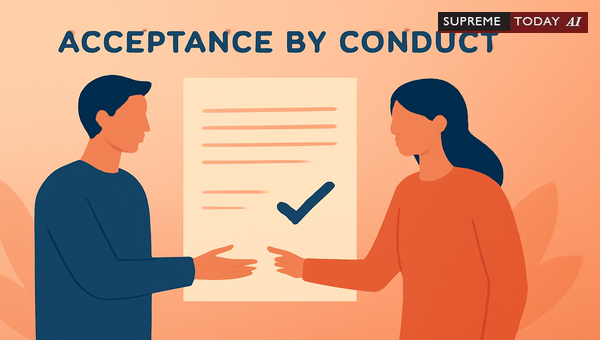
Acceptance by Conduct in Indian Contracts: Key Rules
In the fast-paced world of business and daily transactions, contracts often form without a single word exchanged. Imagine receiving a cheque with an letter—cashing it without protest might just bind you to the deal. This is the essence of , a vital concept under the . But when does behavior count as acceptance? This blog dives deep into the rules, principles, and real-world applications to help you navigate contract formation effectively.
Whether you're a business owner sealing deals through actions or an individual wary of unintended commitments, understanding this can prevent disputes. We'll cover the legal foundations, key principles, exceptions, and insights from case law. Note: This is general information, not specific legal advice. Consult a lawyer for your situation.
Overview of Acceptance in Contract Law
Under the , a contract requires , acceptance, and . Acceptance transforms a proposal into a binding promise, governed primarily by . mandates that acceptance be , while recognizes acceptance by conduct or performance.
Acceptance must mirror the exactly—no tweaks allowed. Variations in material terms prevent contract formation 2016 0 Supreme(Ker) 294 2021 0 Supreme(Telangana) 334. Mere mental agreement won't suffice; it demands clear communication to the offeror 1952 0 Supreme(Cal) 30
Hardesh Goyal VS Spectrum Business Support Ltd. -
.The mode matters too. If the specifies a method (e.g., email), follow it. Absent that, various modes work, including conduct, if it unequivocally shows intent 2006 0 Supreme(Bom) 822 2006 5 Supreme 85.
Key Principles of Acceptance
Here are the cornerstone rules:
: Acceptance must match the precisely. Any deviation is a , not acceptance 2016 0 Supreme(Ker) 294 2021 0 Supreme(Telangana) 334.
Communication Required: It must reach the offeror via words or actions. doesn't count 1952 0 Supreme(Cal) 30
Hardesh Goyal VS Spectrum Business Support Ltd. -
.Prescribed Mode: Stick to the offeror's stipulated method. Otherwise, reasonable modes apply 2006 0 Supreme(Bom) 822.
Acceptance by Conduct: Actions speaking louder than words—this is allowed if clear and intentional. For instance, encashing a cheque sent with an constitutes acceptance unless protested beforehand 2006 5 Supreme 85 2006 0 Supreme(Raj) 1664.
The has clarified contract formation: Ordinarily it is the acceptance of and intimation of that acceptance which result in a contract. By intimating an , when the parties are not in the presence of each other, the offeror is deemed to be making the continuously till the reaches the offeree 2022 0 Supreme(Telangana) 551 2009 0 Supreme(Mad) 1998 2006 0 Supreme(Del) 626 2005 0 Supreme(Bom) 1375. This underscores that acceptance, even by conduct, completes the contract where communicated.
Acceptance by Conduct: Real-World Examples and Case Insights
Conduct becomes acceptance when it unambiguously signals agreement. Classic example: Starting performance under an , like supplying goods after receiving a , implies acceptance if no objections raised.
In supply agreements, courts look at actions. One case involved a medical equipment supplier where the defendant hospital admitted receiving and paying for goods under an agreement, then disputed it on grounds. The court deemed defenses weak, noting prior conduct affirmed the contract 2022 0 Supreme(Telangana) 551.
Another illustration: Telephonic acceptance. Though conveyed from one place, if received elsewhere, the contract forms at the reception point, tying into disputes 2006 0 Supreme(Del) 626. The observed that the Contract Act does not expressly deal with the place where a contract is made. Ordinarily, it is the acceptance of and intimation of that acceptance which results in a contract 2006 0 Supreme(Del) 626.
Under Roman-Dutch influences in some contexts, even third-party benefits via conduct can bind if accepted
. Had communicated to Joseph Fernando his acceptance of the benefit of the stipulation made in his favour in P2.
In arbitration matters, courts assess where acceptance occurred for . A construction contract's acceptance at a specific locale established there, absent exclusive clauses 2012 0 Supreme(MP) 929.
These cases show conduct's power: Delivering goods, making partial payments, or performing services without protest solidifies contracts.
Exceptions and Limitations
Not all actions bind. Key caveats:
Protest Before Action: Vocalize objections prior to conduct. Encashing a cheque after protesting negates acceptance 2006 5 Supreme 85.
No Clear Intent: Ambiguous acts don't qualify. Courts probe intention.
Disputed Debts: fail if conduct-based debts are bona fide disputed. One consultancy fee case dismissed petition as no enforceable contract via conduct existed 2009 0 Supreme(Mad) 1998.
Modern tech fits too: (e.g., 'I Agree' buttons) count as conduct if clear
Hardesh Goyal VS Spectrum Business Support Ltd. -
.clauses matter but don't oust others unless exclusive. Acceptance location influences this: The contract was formed at Gwalior, giving rise to a part of the within its (from arbitration petition) relevant ID from sources.
Practical Recommendations for Businesses and Individuals
To avoid pitfalls:
Document Everything: Record protests in writing before acting.
Clarify Modes: Specify acceptance methods in offers.
Monitor Conduct: Train teams—actions like shipping imply acceptance.
Seek Advice: In disputes, trace acceptance via emails, deliveries, payments.
In summary, valid acceptance under the Act is:- .- Communicated to the offeror.- Per prescribed mode, or via unequivocal conduct 2006 0 Supreme(Bom) 822 1952 0 Supreme(Cal) 30
Hardesh Goyal VS Spectrum Business Support Ltd. -
2006 5 Supreme 85 2016 0 Supreme(Ker) 294 2021 0 Supreme(Telangana) 334 2006 0 Supreme(Raj) 1664.Conclusion: Mastering Acceptance by Conduct
Acceptance by conduct streamlines deals but demands caution. Unequivocal actions bind parties, as courts emphasize communication and intent. From cheque encashments to goods deliveries, precedents affirm this flexibility while protecting against unintended pacts.
Key Takeaways:- Conduct accepts if clear and protest-free.- Always communicate reservations early.- Location of acceptance impacts and enforcement.
Stay informed, act deliberately, and let conduct work for—not against—you. For tailored guidance, reach out to legal experts.
References: 2006 0 Supreme(Bom) 822 1952 0 Supreme(Cal) 30
Hardesh Goyal VS Spectrum Business Support Ltd. -
2006 5 Supreme 85 2016 0 Supreme(Ker) 294 2021 0 Supreme(Telangana) 334 2006 0 Supreme(Raj) 16642022 0 Supreme(Telangana) 551 2012 0 Supreme(MP) 929 2009 0 Supreme(Mad) 1998 2006 0 Supreme(Del) 626 2005 0 Supreme(Bom) 1375. #ContractLaw #AcceptanceByConduct #IndianContracts


















