


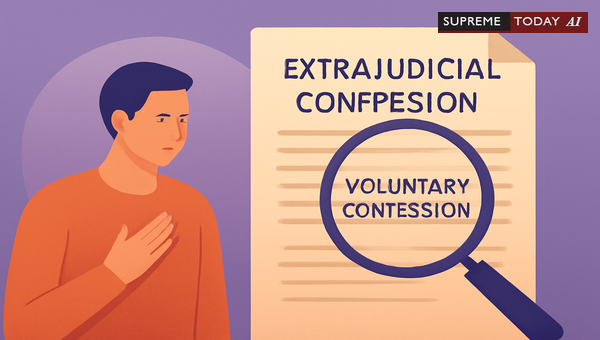
What Is in Indian Law?
In the realm of criminal law, confessions play a pivotal role in establishing guilt. But not all confessions carry the same weight. Have you ever wondered, What is ? This question often arises in legal discussions, especially in Indian jurisprudence where such statements are treated with caution. An refers to a statement made by an accused outside a court or magistrate's presence, typically to private individuals. While it can provide valuable insights, courts view it as inherently weak evidence, requiring rigorous scrutiny.
This blog post delves into the definition, legal principles, admissibility, limitations, and judicial precedents surrounding extrajudicial confessions. Drawing from established case law, we'll explore why these confessions demand and careful evaluation. Note: This is general information and not specific legal advice. Consult a qualified lawyer for your case.
Definition of
An is a confession made by an accused outside of a judicial setting, typically to a private individual rather than before a magistrate or court. This type of confession is considered a weak form of evidence in criminal jurisprudence. 2021 0 Supreme(Guj) 8
Unlike recorded under , extrajudicial ones lack formal safeguards, making them susceptible to fabrication or coercion. For instance, they are often oral statements shared with family, friends, or acquaintances post-crime. The has consistently emphasized their fragile nature, noting they must be approached with care and caution. 2022 0 Supreme(All) 1212
Legal Principles Governing Extrajudicial Confessions
Indian courts have developed stringent principles to evaluate these confessions. Here's a breakdown:
Weak Evidence: Extrajudicial confessions are inherently weak and must be examined with care and caution. They cannot be the sole basis for a unless corroborated by other evidence. 2021 0 Supreme(Guj) 8 2022 0 Supreme(All) 1212
Voluntariness and Truthfulness: For admissibility, the confession must be made voluntarily and be truthful. Courts probe the circumstances to rule out coercion or inducement. As held, The can be accepted and can be the basis of , if it passes the test of credibility. The extra-judicial confession should inspire confidence and the court sh.... 2023 0 Supreme(Chh) 154
Credibility and : It must inspire confidence, supported by cogent circumstances or other prosecution evidence. or improbabilities diminish reliability. 1965 0 Supreme(SC) 43 1961 0 Supreme(SC) 406
Judicial Scrutiny: Courts scrutinize the context, including the confessor's relationship with the recipient. Confessions to close relations are often deemed more credible. 2023 0 Supreme(Cal) 298 2012 0 Supreme(SC) 367
Additional insights highlight that it must be true, voluntary, credible, and inspires confidence. 2023 Supreme(Online)(Chh) 14343 2024 0 Supreme(AP) 525 2023 0 Supreme(Jhk) 63
Admissibility and Use in Court
Extrajudicial confessions are admissible under the but rarely standalone proof:
Corroborative Role: They serve best as corroborative evidence, bolstered by a complete chain of . 1970 0 Supreme(SC) 246 2017 0 Supreme(Bom) 2348
Judicial Precedents: The mandates , stating they should not be relied upon without it. 2022 4 Supreme 385 1970 0 Supreme(SC) 246
In practice, courts assess if the confession is of sterling quality, made voluntarily in proper circumstances. 2024 0 Supreme(AP) 525 2023 0 Supreme(Jhk) 63
For example, timing matters: Further, the alleged incident is said to have taken place on whereas the that has been made by the accused was on at about 7.00 AM. Except the , there is no other evidence to connect the accu.... 2024 0 Supreme(AP) 526 2024 0 Supreme(AP) 628
Delays or lack of other links often lead to rejection.
Limitations and Risks of Extrajudicial Confessions
Despite potential value, several pitfalls exist:
Potential for Misinterpretation: They can be misrepresented, especially under suspicious contexts. mitigates this. 1989 0 Supreme(P&H) 617 1996 0 Supreme(Pat) 579
Judicial Discretion: Acceptance rests on the court's discretion, considering all circumstances and witness credibility. 2004 0 Supreme(Guj) 122 2017 0 Supreme(Bom) 2348
Case law reveals further risks:
Made to strangers or after significant delays: PW1 admitted in the cross examination that he did not know the appellant before he came to him and allegedly made the . The incident is of but the alleged was made on . 2025 0 Supreme(Telangana) 642
Interested witnesses or conceived evidence: The SHO and the police team were unquestionably present at the factory and the evidence of extra-judicial confession seems to have been conceived in an endeavour to strengthen the prosec.... 2019 0 Supreme(Raj) 377
Post-incident delays criticized: , learned counsel for the appellant, has vehemently criticized the extra-judicial confession on the ground that such confession was made after 18 days of the occurrence. 2018 0 Supreme(MP) 120
Under , confessions to interested persons may be inadmissible. 2024 0 Supreme(SC) 539
don't automatically invalidate, but overall credibility is key. 2023 0 Supreme(Jhk) 63
Real-World Case Insights
Judgments illustrate these principles. In one, an led to FIR alterations but failed without : Based on the , PW-22 altered the Section of law to and issued altered FIR. 2024 0 Supreme(AP) 526
Another deemed it genuine when voluntary: The is voluntary and genuine. 2016 0 Supreme(Mad) 1045
Yet, courts reject if unreliable: The second circumstance is with regard to the alleged . 1 made after one month of the incident before P.W. 8. 2016 0 Supreme(Kar) 623
These examples underscore the need for cogent circumstances and no suspicious timing. 2024 0 Supreme(AP) 642
Conclusion and Key Takeaways
Extrajudicial confessions remain a complex evidentiary tool in Indian law, marked by weaknesses and the imperative for . While they can aid in proving guilt, reliance demands voluntary nature, credibility, and supporting evidence.
Key Takeaways:- Treat as weak evidence; always seek .- Ensure voluntariness and scrutinize context.- Assess witness credibility and timing.- Stay abreast of precedents for effective advocacy.
Legal practitioners should conduct thorough investigations, emphasizing . For the accused, challenging credibility via delays or inconsistencies can be crucial.
References: 2021 0 Supreme(Guj) 8 2022 0 Supreme(All) 1212 2022 4 Supreme 385 2023 0 Supreme(Gau) 675 1965 0 Supreme(SC) 43 1961 0 Supreme(SC) 406 2023 0 Supreme(Cal) 298 2012 0 Supreme(SC) 367 1970 0 Supreme(SC) 246 2017 0 Supreme(Bom) 2348 1989 0 Supreme(P&H) 617 1996 0 Supreme(Pat) 579 2004 0 Supreme(Guj) 122 2024 0 Supreme(AP) 526 2024 0 Supreme(AP) 628 2025 0 Supreme(Telangana) 642 2023 0 Supreme(Chh) 154 2019 0 Supreme(Raj) 377 2018 0 Supreme(MP) 120 2016 0 Supreme(Kar) 623 2016 0 Supreme(Mad) 1045 2023 Supreme(Online)(Chh) 14343 2023 0 Supreme(Bom) 1394 2024 0 Supreme(AP) 525 2023 0 Supreme(Jhk) 63 2024 0 Supreme(SC) 539
#ExtrajudicialConfession #IndianLaw #CriminalEvidence















