


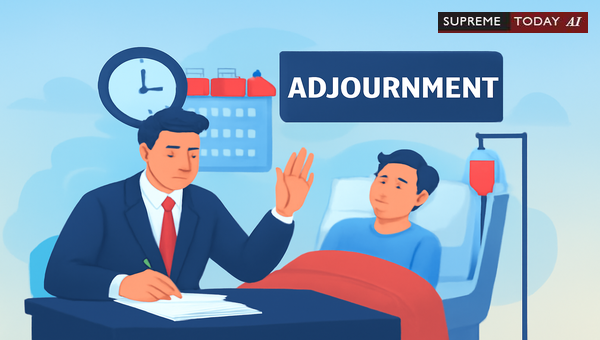
Advocate's Medical Emergency: Not a Valid Excuse for Adjourning Evidence?
In the fast-paced world of litigation, unexpected events like a lawyer's medical emergency can disrupt proceedings. But does such a crisis provide grounds to postpone the critical stage of ? The question often arises: medical emergency of an advocate is not an excuse for adjourning the evidence. This issue strikes at the heart of , balancing human needs with the imperative for swift justice.
Indian courts, particularly the , have repeatedly addressed this tension. While empathy for genuine emergencies exists, judicial precedents firmly prioritize the integrity of proceedings. This blog delves into key rulings, legal principles under the , and insights from related cases to clarify when—and when not— are warranted.
Main Legal Finding: Emergencies Do Not Automatically Justify Delays
Legal authorities establish that a medical emergency faced by an advocate or medical professional does not constitute a valid excuse for adjourning . Courts acknowledge the need for immediate attention in crises but stress maintaining . As noted, courts must be vigilant against unnecessary and that have grown like cancer which corrodes the entire body of justice delivery system 2000 5 Supreme 111.
Key points include:- A medical professional's emergency does not automatically warrant adjournment 2000 5 Supreme 111 2012 8 Supreme 321.- Timely is paramount to prevent delays 2011 6 Supreme 157.- rulings discourage excessive , urging party cooperation 2009 0 Supreme(SC) 1431 1927 0 Supreme(SC) 57.
Legal Principles on Adjournaments and Emergencies
Under , trials must proceed expeditiously, with granted only for special reasons. The has clarified that while emergencies may allow temporary pauses, they do not permit indefinite postponements. Parties cannot proceed with the trial at its leisure and pleasure and must cooperate for effective progress 2011 6 Supreme 157.
In 2012 8 Supreme 321, courts highlighted that are limited, explicitly stating: the absence of the lawyer or his non-availability because of professional work in other court or elsewhere or on the ground of strike call or the change of a lawyer or the continuous illness of the lawyer... will not justify more than three 2011 6 Supreme 157. This underscores that even illness claims require strict scrutiny.
A related principle emerges from 2023 0 Supreme(HP) 475, where the court held: At any rate inconvenience of an advocate is not a 'special reason' for bypassing the mandate of Section 309 of the Code. Here, despite claims of inadequate opportunity for defense evidence, the petition was dismissed, emphasizing continuous witness examination unless special reasons apply.
Judicial Stance on Medical Emergencies in Practice
Courts reject unsubstantiated emergency pleas to curb . In 1927 0 Supreme(SC) 57, the observed that a criminal case is built on the edifice of evidence and that evidence that is admissible in law must be produced in a timely manner. Vigilance prevents miscarriages of justice from delays.
Similarly, in 2004 0 Supreme(All) 1681, the court addressed counsel's unforeseen emergency absence: The question is if counsel absents himself on account of some unforeseen emergency and is not able to represent his client, would it be deemed to be a default on the part of litigant himself. While allowing relief in that pre-amendment case, it stressed advancing justice, not permitting defaults lightly.
Contrast this with parole contexts like 1989 0 Supreme(P&H) 651, where a prisoner's wife's illness claim was rejected due to misrepresentation, terminating . Courts demand credible proof, reinforcing that emergencies without substantiation fail judicial tests.
Exceptions: When Limited Delays May Be Granted
Genuine, well-documented emergencies can warrant minimal delays. For instance:- Sudden illnesses or natural calamities may justify short if supported by medical certificates 2012 8 Supreme 321.- In
, a lawyer's sickness led to an application for adjournment post-recovery, but courts expect prompt arrangements.
However, prolonged or unproven claims are rejected. In cases like 2022 0 Supreme(Mad) 813, courts recognized true emergencies (e.g., acute hemorrhage) but criticized delays in unrelated judicial contexts, awarding compensation for elsewhere.
Implications for Advocates, Litigants, and Courts
Advocates must anticipate issues by arranging substitutes or backups. Litigants bear responsibility for timely evidence, as courts discourage emergencies as pretexts. Judicial officers enforce timelines rigorously.
From 2022 0 Supreme(Cal) 618, medical evidence reliability is pivotal; delays in producing it undermine cases. Courts uphold injured witness testimony despite investigative faults, prioritizing evidence over excuses.
Recommendations for Best Practices
To navigate this landscape:- Promptly notify courts of genuine emergencies with medical evidence.- Prepare alternatives, like co-counsel, to avoid defaults.- Courts should scrutinize claims critically, limiting to proven necessities.- Adhere to CrPC 309 for day-to-day trials post-witness commencement 2023 0 Supreme(HP) 475.
Conclusion and Key Takeaways
In summary, a medical emergency of an advocate is generally not an acceptable excuse for adjourning evidence. Precedents like those in 2000 5 Supreme 111, 2012 8 Supreme 321, and 2011 6 Supreme 157 emphasize over individual hardships unless exceptionally substantiated.
Key takeaways:- Prioritize timely evidence production.- Use credible proof for any delay requests.- Courts favor justice delivery over .
This post provides general insights based on judicial precedents and is not specific legal advice. Consult a qualified lawyer for your case.
References
- 2000 5 Supreme 111: Vigilance against unnecessary .
- 2012 8 Supreme 321: Limits on lawyer absence excuses.
- 2009 0 Supreme(SC) 1431: No justification for evidence adjournment.
- 1927 0 Supreme(SC) 57: Timely evidence essential.
- 2011 6 Supreme 157: Party cooperation mandatory.
- 2023 0 Supreme(HP) 475: Advocate inconvenience not special reason.
- 2004 0 Supreme(All) 1681: Unforeseen emergencies not litigant default.
- 1989 0 Supreme(P&H) 651: Misrepresentation rejects emergency claims.















