


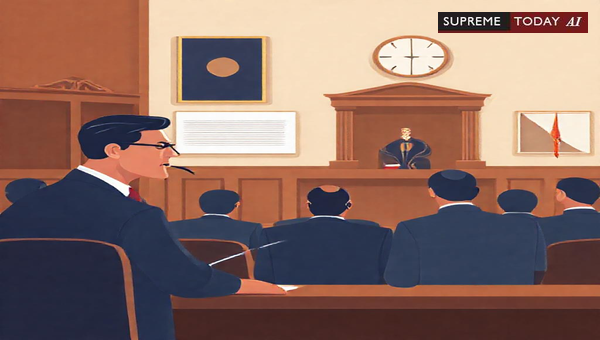
When a Lawyer Loses Temper in Court: Whether Screaming at a Fellow Advocate Constitutes
Courtrooms are places of controlled argument, not shouted exchanges. Yet tempers do flare, and one recurring question in professional ethics is whether an advocate who screams at a fellow advocate during proceedings commits . The short answer, drawn from the (BCI) Rules and the , is that such behaviour generally does amount to misconduct — and it can attract disciplinary consequences ranging from reprimand to .
The Ethical Framework Every Advocate Signs Up To
The empowers the , under , to frame rules prescribing standards of professional conduct and etiquette. These standards, codified in of the , begin with a foundational premise: an advocate must, at all times, comport himself in a manner befitting his status as an 2023 4 Supreme 421. Crucially, the Rules recognise that what may be lawful or moral for an ordinary citizen may still be improper for a member of the Bar 2023 4 Supreme 421.
Advocates are officers of the court, not mere agents of their clients, and this status carries a heightened duty of dignity and restraint 2026 0 Supreme(Kar) 192.
Which Specific BCI Rules Are Violated by Shouting at Another Advocate?
Duty to Conduct Oneself with Dignity
Section I of Chapter II enumerates duties to the Court. Item 1 requires an advocate to conduct himself with , while Item 2 mandates that an advocate maintain towards the courts a respectful attitude, bearing in mind that the dignity of the judicial office is essential for the survival of a free community 2022 0 Supreme(Guj) 1714. Screaming in open court, whatever the provocation, plainly undermines that dignity.
The Prohibition on — Item 4
The most directly applicable provision is . It obliges an advocate to use his best efforts to restrain his client from improper conduct towards the court, opposing counsel, or parties, and expressly requires the advocate to exercise his own judgment in the use of restrained language in correspondence, avoiding scurrilous attacks in pleadings, and using during arguments in court 2019 0 Supreme(SC) 345 and 2010 0 Supreme(Kar) 131.
Shouting at a fellow advocate during arguments is a textbook example of and conduct in court. The Rule makes clear that the advocate cannot hide behind the client's aggression — the duty to exercise independent judgment in maintaining restraint is the advocate's own 2019 0 Supreme(SC) 345.
Duties Owed to Fellow Members of the Profession
Indian courts have long recognised that an advocate's duties fall into three broad classes: duty to the client, duty to the Court, and duty to fellow members of the profession
SOLICITOR GENERAL vs JAYAWICKREME
. The ethical framework requires advocates to maintain dignity in dealings with fellow lawyers and to refrain from conduct that demeans opposing counsel or erodes the integrity of the judicial process 2011 3 Supreme 684.How Courts Have Interpreted
The has adopted a broad interpretation: misconduct includes any conduct that tends to lower the image of the profession or is regarded as disgraceful or dishonourable by professional brethren of good repute and competence, drawing on authorities such as Re: A Solicitor ex-parte Law Society (1912) 1 KB 302 and R.D. Saxena (2000) 7 SCC 264 2019 0 Supreme(UK) 370.
Two important nuances emerge from the case law:
- Not every breach of etiquette is misconduct. Courts have distinguished between mere breaches of professional etiquette and conduct amounting to involving moral turpitude 1934 0 Supreme(All) 153. However, shouting at another advocate in open court goes beyond etiquette — it disrupts proceedings, undermines the dignity of the court, and lowers the profession's image.
- Misconduct and contempt can overlap. An advocate found guilty of for misbehaviour during proceedings may also be guilty of in a given case, but it is for the or the to impose professional sanctions such as debarring the advocate from practice 2026 0 Supreme(Kar) 192. A court exercising appellate or contempt jurisdiction cannot itself punish an advocate for by converting itself into the statutory disciplinary body 2025 Supreme(Online)(Del) 48640.
In one recent matter involving an advocate who misbehaved during a sessions trial, the directed criminal contempt proceedings, a reference to the , and criminal complaints — though an unconditional apology later led the court to recall those directions subject to symbolic penalties, including a nominal fine and a direction to plant fruit-bearing saplings 2026 0 Supreme(Kar) 192.
The Disciplinary Process Under Section 35 of the Advocates Act
Where, on receipt of a complaint or otherwise, a has reason to believe that an advocate on its roll has been guilty of professional or other misconduct, it must refer the case to its 2023 0 Supreme(Raj) 2086 and 2019 0 Supreme(UK) 370. After giving the advocate an opportunity of being heard, the Committee may order:
- Suspension from practice for such period as it deems fit; or
- Removal of the advocate's name from the State roll of advocates 2019 0 Supreme(UK) 370.
Certain procedural safeguards apply. Ordinarily, a between the complainant and the advocate is a precondition for invoking disciplinary jurisdiction on the ground of 2025 7 Supreme 147. Where a emerges from the complaint itself, no preliminary enquiry is needed and the matter goes straight to the under 1998 0 Supreme(Bom) 444. Recording of reasons to believe that misconduct has occurred is a sine qua non before referral 2025 7 Supreme 147. Complaints from persons lacking — for instance, where no client-advocate relationship exists — may be quashed at the threshold 2025 0 Supreme(Kar) 2723.
Consequences Beyond Bar Council Action
Serious misconduct invites severe sanctions. In one case involving fabricated vakalatnamas and fictitious compromises, the restored a seven-year debarment, holding that punishment must meet the 2012 8 Supreme 685. While shouting at opposing counsel is typically less grave than fraud, repeated or egregious intemperate conduct — especially combined with contemptuous behaviour toward the court — can cumulatively justify suspension. Courts have also stressed that reciprocal courtesy between Bench and Bar is essential for the efficient functioning of courts, and that dignity and decorum of the must be safeguarded 2026 0 Supreme(Kar) 192.
Key Takeaways
- Screaming at a fellow advocate during court proceedings generally violates of the BCI Rules, which prohibits during arguments 2019 0 Supreme(SC) 345.
- It also breaches the duties of dignity and respectful attitude owed to the Court under 2022 0 Supreme(Guj) 1714.
- Such conduct falls within the broad judicial definition of — behaviour disgraceful or dishonourable in the eyes of professional brethren of good repute 2019 0 Supreme(UK) 370.
- Disciplinary proceedings are initiated under , with sanctions ranging from suspension to removal from the roll 2019 0 Supreme(UK) 370.
- Contempt proceedings may run in parallel, but only the Bar Councils can impose sanctions 2026 0 Supreme(Kar) 192.
- Complaints must satisfy and prima facie requirements before a will entertain them 2025 7 Supreme 147 and 1998 0 Supreme(Bom) 444.
Advocates facing provocation in court should remember that restraint is not weakness — it is a codified professional obligation. This article is general information based on reported precedents and the BCI Rules; the outcome in any specific case will depend on its facts and the discretion of the disciplinary or judicial forum concerned.
#ProfessionalMisconduct #AdvocatesAct #BarCouncilOfIndia #LegalEthics #CourtroomConduct












