


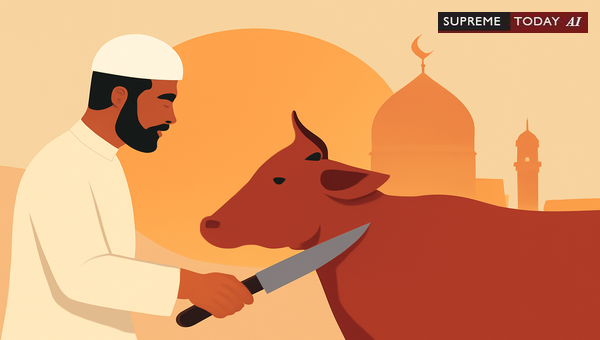
Animal Sacrifice Not Essential in Islam: Court Rulings
In India, the intersection of religious practices and animal welfare laws often sparks heated debates, particularly during festivals like Bakri Eid (Eid al-Adha). One central question arises: Is animal sacrifice an of Islam? This issue has been repeatedly examined by the judiciary, with the establishing a clear stance. Understanding this legal position is crucial for anyone navigating religious freedoms under the , especially , which guarantees the right to freely profess, practice, and propagate religion, subject to , , and .
This blog post delves into key judicial pronouncements, explaining why animal sacrifice—particularly the slaughter of cows—is viewed as optional rather than obligatory. We'll explore landmark cases, essential practice tests, and additional context from recent rulings, all while emphasizing that this is general information and not specific legal advice. Consult a qualified lawyer for personalized guidance.
The Legal Test for Essential Religious Practices
For a religious practice to receive constitutional protection under , it must be to the religion. The has outlined a definitive test: the nature of the religion would change without that practice. If the taking away of a practice results in a fundamental change in the character of the religion, it can be considered essential 2023 0 Supreme(Ker) 321 2004 2 Supreme 427.
Applying this to Islam, courts have consistently held that animal sacrifice does not meet this threshold. It is permissible ( or recommended) but not mandatory ( or obligatory) for religious merit.
Key Findings on Bakri Eid Sacrifice
The sacrifice during Bakri Eid, known as Qurbani, involves offering animals like goats, sheep, cows, or camels. However, judicial scrutiny reveals:
Optional Nature: The sacrifice of a goat for one person or a cow/camel for seven persons is considered optional for Muslims. It is not an obligatory duty that a person must sacrifice a cow to earn religious merit on Bakri Eid 2014 0 Supreme(HP) 1209 2016 0 Supreme(Bom) 522 1994 0 Supreme(SC) 1138 2016 0 Supreme(Bom) 506.
Cow Slaughter Specifically Not Essential: The sacrifice of a cow on Bakri Eid is not considered an for Muslims. While it may be a religious purpose, it is optional and not a mandatory requirement for the practice of Islam 2014 0 Supreme(HP) 1209 2016 0 Supreme(Bom) 522 1994 0 Supreme(SC) 1138 2016 0 Supreme(Bom) 506 2021 0 Supreme(Mad) 3215.
Alternative Options Available: Once the religious purpose of Muslims consists of making sacrifice of any animal which should be a healthy animal, on BakrI'd, then slaughtering of cow is not the only way of carrying out that sacrifice 2016 0 Supreme(P&H) 1989 2020 0 Supreme(Ker) 342. A goat can suffice for one person, making cow sacrifice economically convenient but not religiously compelled 2014 0 Supreme(HP) 1209 2016 0 Supreme(Bom) 506.
Historical Precedents: Some Mughal Emperors prohibited cow slaughter, underscoring it has not always been indispensable 2014 0 Supreme(HP) 1209.
These rulings affirm that a total ban on cow slaughter does not violate , as it doesn't alter Islam's fundamental character.
Broader Judicial Consensus and Regulations
and other precedents reinforce this view. For instance:
In State of W.B. and others v. Ashutosh Lahiri, it was held it is optional for a Muslim to sacrifice a goat... slaughtering of healthy cow on BakrI'd was held to be not essential or required for religious purpose of Muslims 2016 0 Supreme(P&H) 2023.
Exemptions for religious purposes in cattle laws are strictly construed for essential practices only, not optional ones 2014 0 Supreme(HP) 1209 1994 0 Supreme(SC) 1138.
Recent cases highlight regulations on animal sacrifice:
Practices must comply with state cattle preservation laws, prohibiting sale or sacrifice for slaughter/religious purposes in certain contexts 2017 0 Supreme(Ker) 590 2017 0 Supreme(Mad) 4214.
Animal sacrifice is generally not practiced in mosques or dargahs; unauthorized acts at sites like Sikkandar Dargah may violate law unless protected 2025 Supreme(Online)(Mad) 60376 2025 0 Supreme(Mad) 4513.
No statutory ban in places like Tamil Nadu, but unregulated sacrifices are illegal 2023 0 Supreme(Mad) 1962 2025 0 Supreme(Mad) 4513.
Courts distinguish essential tenets from customs: The has clarified that animal sacrifice is not an for Muslims; it is an optional act and not mandatory for religious fulfillment 2022 0 Supreme(Gau) 1419 2023 0 Supreme(Ker) 321.
Protests claiming constitutional rights under have occurred, but peaceful historical practices don't elevate optional rites to essential status 2025 Supreme(Online)(Mad) 32928 2025 0 Supreme(Mad) 3202.
Implications for Religious Freedom and Animal Welfare
Balancing religious freedom with animal welfare and public is key. While Muslims may choose sacrifice, states can regulate it:
Economic Arguments Rejected: Affording seven goats vs. one cow doesn't make cow sacrifice essential 2014 0 Supreme(HP) 1209 2016 0 Supreme(Bom) 506.
Site-Specific Practices: Offerings aren't essential everywhere unless a site has special significance 2023 Supreme(Online)(Ker) 57530 2023 0 Supreme(Ker) 321.
This framework allows laws like cow slaughter bans without infringing core religious rights.
Key Takeaways and Recommendations
- Animal sacrifice, especially cows on Bakri Eid, is optional, not essential to Islam.
- Only integral practices get protection; optional ones can be regulated.
- Argue based on doctrine, not custom or economics, in court.
- Historical and alternative options (e.g., other animals) support this position.
In summary, judicial consensus holds: It is, therefore, obviously not an but an optional one 2020 0 Supreme(Ker) 342. Restrictions are constitutionally valid. This analysis draws from established precedents—always seek professional legal counsel for specific cases, as laws evolve.
Word count: 1028. This post provides general insights based on public legal documents.
#AnimalSacrifice #ReligiousPractice #IndianLaw












