


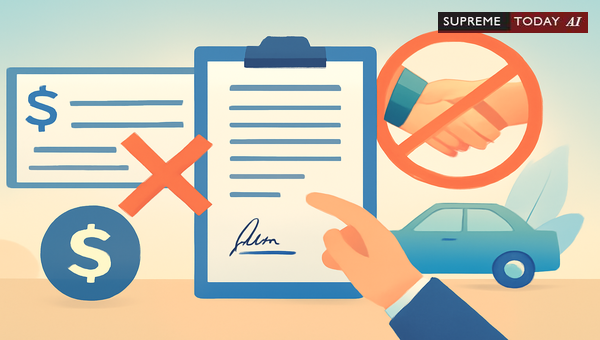
Vehicle Loan : When NI Act Doesn't Apply
In the world of vehicle financing, disputes over loan repayments can quickly escalate, especially when cheques bounce and criminal complaints under of the (NI Act) come into play. But what happens if the loan agreement includes an , yet no steps are taken to initiate arbitration when the dispute arises? And if the debtor's liability for the debt isn't conclusively proved? These questions are at the heart of many legal battles between lenders and borrowers.
in the Case of Vehicle Loan: No Steps Taken to Conduct Arbitration Proceedings When Dispute Arose, Liability of Debt Due Not Proved, Not Attracted – Whether Correct? This precise issue has been examined in recent judgments, providing clarity for finance companies, vehicle dealers, and individuals navigating such conflicts. This post breaks down the legal findings, precedents, and practical insights to help you understand when proceedings may not hold up.
Main Legal Finding
Generally, in vehicle loan disputes featuring an , if no steps have been taken to initiate arbitration proceedings despite the clause's presence, and the liability of the debt has not been conclusively proved, of the NI Act is not attracted2023 0 Supreme(Mad) 2755. Courts have consistently held that the under is , placing the onus on the accused to disprove debt existence—but only after a case of subsisting liability is made 2001 7 Supreme 810.
Key Points from Judicial Scrutiny
- No arbitration initiated: Despite the clause mandating arbitration for disputes, the lender failed to commence proceedings, leaving the dispute unadjudicated 2023 0 Supreme(Mad) 2755.
- Debt liability disputed or unproved: Courts require clear evidence of a ; mere issuance of a cheque isn't enough if the underlying obligation is contested 2023 0 Supreme(Mad) 2755 2022 0 Supreme(Bom) 816.
- inapplicable: This provision kicks in only for proved, subsisting liabilities tied to 2001 7 Supreme 810.
Detailed Analysis
Absence of Steps to Invoke Arbitration
Loan agreements for vehicles often include arbitration clauses stipulating that disputes shall be finally resolved through arbitration 2023 0 Supreme(Mad) 2755. However, when repayment disputes emerge, lenders must take concrete steps—like appointing an arbitrator or filing under the —to enforce this. In one case, documents showed no such initiation, rendering parallel criminal proceedings under premature 2023 0 Supreme(Mad) 2755.
This aligns with broader precedents where courts emphasize adherence. For instance, when a dispute over remaining loan consideration arose, the respondent promptly invoked the 2023 0 Supreme(Del) 619. Contrastingly, failure to do so weakens the complainant's position, as seen in where arbitration applications were rejected if not all parties signed on 2018 0 Supreme(Gau) 712.
Debt Liability Not Established
The cornerstone of is a legally recoverable debt or liability at the cheque's issuance. If disputed—say, over loan amount, interest, or repayment credits—courts probe deeper. The liability of the debtor has not been established; the debt is disputed or not proved 2023 0 Supreme(Mad) 2755. Where liability is admitted, arbitration might be bypassed, but denial shifts the burden back to the claimant 2022 0 Supreme(Bom) 816.
Related rulings reinforce this. In a loan recovery arbitration, proceedings advanced only after proving default on equated monthly installments 2017 0 Supreme(Del) 3261. Similarly, attract only if on the date of the cheque liability or debt exists or the amount has become legally recoverable 2023 Supreme(Online)(DEL) 4910.
Why Doesn't Apply
targets linked to a . The presumption is : the onus is on the accused to prove that the cheque was not issued for a debt or liability 2001 7 Supreme 810. But without foundational proof from the complainant, no case arises. Courts quash such complaints if arbitration paths remain unexplored and debt unverified 2004 0 Supreme(Jhk) 577.
Even can trigger liability if dishonoured, provided debt exists—A cheque issued as security can attract liability under 2025 Supreme(Online)(HP) 4601. Yet, injunctions or moratoriums (e.g., under IBC ) halt proceedings, as the under of the IB Code applies to all debts 2024 0 Supreme(Bom) 492.
Legal Precedents Supporting the View
- in : Where liability is admitted, arbitration cannot be invoked, and similarly, criminal proceedings under are not sustainable when liability is not established 2004 0 Supreme(Jhk) 577.
- Quashing of complaints: Proceedings dismissed where no subsisting liability existed at dishonour 2004 0 Supreme(Jhk) 577.
- Arbitration in loan disputes: In a transport finance case with an , courts noted the onus to prove cheque discharge of debt
Shri Manik Lal Das vs Shri Dipankar Majumder
.
Other cases highlight contrasts: Complaints survived quashing if factual disputes warranted trial, not pre-trial adjudication 2023 0 Supreme(P&H) 2638.
Exceptions and Limitations
While the rule holds, exceptions apply:- Proved liability with minor disputes: If debt is established (e.g., via loan docs), arbitration must precede ; criminal action bars until resolution.- Security or : Liable if debt proven, even sans principal debtor 2025 Supreme(Online)(HP) 4601 2023 Supreme(Online)(DEL) 4910.- impacts: IBC halts arbitration against guarantors 2024 0 Supreme(Bom) 492.- Jurisdictional nuances: Quashing sparingly used; trial resolves facts 2025 Supreme(Online)(HP) 4601 2023 0 Supreme(P&H) 2638.
Merely contesting debt doesn't auto-bar if complainant evidences it.
Practical Recommendations
- Lenders: Initiate arbitration promptly upon dispute—don't leap to 2023 0 Supreme(Mad) 2755. Secure debt proof via statements, EMIs.
- Borrowers: Contest liability early; highlight arbitration non-compliance.
- Courts' role: Scrutinize debt proof pre-proceedings 2001 7 Supreme 810.
In arbitration challenges, file timely objections with merit 2017 0 Supreme(Del) 3261. Arbitrators' awards stand unless manifestly erroneous 2015 0 Supreme(Bom) 798.
Conclusion and Key Takeaways
Yes, the position is correct: No arbitration steps plus unproved debt liability typically shields against 2023 0 Supreme(Mad) 2755 2001 7 Supreme 810. This protects against misuse of criminal law for civil recoveries, prioritizing contractual dispute mechanisms.
Key Takeaways:- Adhere to arbitration clauses to strengthen claims.- Prove debt existence beyond cheque issuance.- presumes liability, but disputes unravel it.
This is general information based on precedents and not specific legal advice. Consult a qualified lawyer for your situation. Cases evolve, so verify latest rulings.
References:1. 2023 0 Supreme(Mad) 2755: Arbitration and loan disputes.2. 2001 7 Supreme 810: burden of proof.3. 2004 0 Supreme(Jhk) 577: Quashing where liability unproved.4. Additional insights from 2025 Supreme(Online)(HP) 4601, 2024 0 Supreme(Bom) 492,
Shri Manik Lal Das vs Shri Dipankar Majumder
, etc. #Section138, #ArbitrationLaw, #VehicleLoanDispute












