


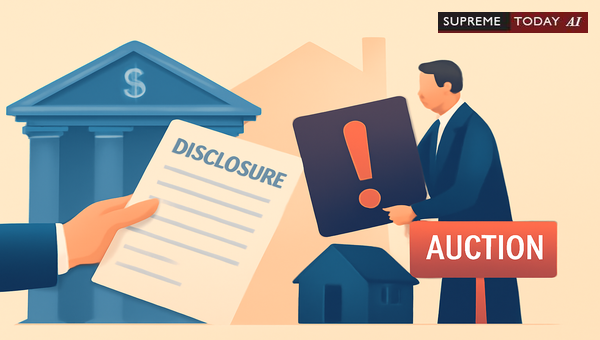
Bank's Duty to Disclose Property Facts in Auctions
In the complex world of property transactions, especially auctions conducted by banks under laws like the , transparency is paramount. Buyers often rely on the information provided by financial institutions, assuming full disclosure of the property's true nature. But what happens when critical details—such as , unauthorized constructions, or discrepancies in area—are omitted? The question arises: Did the Bank have a Duty to Disclose all Relevant Facts about the True Nature of the Property?
This blog post delves into this critical legal obligation, drawing from established principles, case law, and practical implications. While this is general information and not specific legal advice, understanding these duties can empower buyers, sellers, and practitioners to navigate transactions more effectively.
Overview of the Bank's Disclosure Duty
Financial institutions, particularly banks acting as , generally owe a to disclose all that could influence a buyer's decision. This includes the property's legal status, , valuation basis, and any defects not apparent to a reasonable buyer. Failure to do so may lead to claims of , fraud, or invalidation of the sale.
As highlighted in legal precedents, banks must uphold transparency in property dealings. For instance, courts have emphasized that the seller's duty to disclose material defects and in property sales is paramount, and failure to do so can invalidate the sale. 2024 0 Supreme(Telangana) 264
This duty stems from principles of (seller beware), shifting some responsibility from the buyer to the seller—especially when the seller, like a bank, has superior knowledge.
Key Legal Principles and Case Law
Principle of Full Disclosure in Property Auctions
Under frameworks like the (), banks must ensure auction notices accurately represent the property. empowers banks to sell secured assets, but this comes with an implicit obligation for fairness.
In one pivotal case, the court ruled: The Bank was under a duty to disclose all relevant facts including, the fact that the property put on auction sale was a lease-hold property and it belongs to the Housing Board. This is a basic requirement of fair play in action and more so, in case of a Public Sector Bank. 2016 0 Supreme(Jhk) 941 The auction was deemed illegal due to , leading to a refund of the bid amount and findings of by the bank.
in Auction Sales
The doctrine of was central in a challenge to an auction of flats on unauthorized stilt floors. The petitioners argued by the bank, which failed to disclose the property's sealed status by the . The court held: - Auction Sale - - The court emphasized the duty of the bank to disclose and ensure fair representation of property in auction sales, ruling that failure to do so invalidates the sale. 2024 0 Supreme(Telangana) 264 The was allowed, declaring the sale invalid.
Disclosure of Material Defects Like Area Discrepancies
Another key ruling addressed a bank's failure to disclose actual land area. The plaintiff claimed the bank accepted payment for 54 cents but delivered less (34.60 cents), suppressing this fact. The restored the trial court's decree for damages, stating: As per seller was bound to disclose any buyer any material defect in property of which buyer is not aware and which buyer could not ordinarily discover. 2022 0 Supreme(SC) 1176 The clause did not absolve the bank, and it was directed to pay compensation with interest.
Broader Context from Related Precedents
While some cases underscore disclosure in non-property contexts, they reinforce the general principle of transparency. For example, courts have noted the importance of complete disclosures to ensure justice, as seen in criminal proceedings. 2024 3 Supreme 199
In auction scenarios, —even in e-auctions—renders sales voidable. The court in one matter set aside an order and ordered a refund of Rs.31,25,000 due to suppressed material information about lease-hold status. 2016 0 Supreme(Jhk) 941
Implications of Non-Disclosure
Non-disclosure can have severe repercussions:- Invalidation of Sale: Auctions may be quashed, as in unauthorized construction cases. 2024 0 Supreme(Telangana) 264- Damages and Compensation: Buyers can claim refunds or losses, including interest. 2022 0 Supreme(SC) 1176- Fraud Claims: Suppression of facts may constitute fraud, leading to suits.- : Banks retaining bid amounts without delivering clear title face refunds. 2016 0 Supreme(Jhk) 941
Buyers participating in auctions are not entirely unprotected; courts scrutinize whether the bank withheld discoverable facts.
Practical Recommendations
For Buyers and Clients
- Demand Disclosures: Request details on legal status, , measurements, and due diligence reports before bidding.
- Conduct Independent Verification: Hire surveyors or lawyers to check property records, despite bank assurances.
- Review Auction Notices: Scrutinize for omissions; challenge vague terms like if are hidden.
For Legal Practitioners
- Advise clients on SARFAESI remedies, including writ petitions under .
- Pursue damages under or contract law for defects.
- Emphasize fiduciary duties of public sector banks for heightened scrutiny.
For Banks
- Perform thorough due diligence and disclose all known issues in notices.
- Avoid over-reliance on disclaimers; ensure fairness to prevent litigation.
Conclusion and Key Takeaways
Generally, banks have a clear duty to disclose all relevant facts about a property's true nature, rooted in fiduciary responsibility, , and statutory fairness under SARFAESI and TPA. Cases like those involving unauthorized flats 2024 0 Supreme(Telangana) 264, area shortfalls 2022 0 Supreme(SC) 1176, and lease-hold misrepresentations 2016 0 Supreme(Jhk) 941 illustrate that omissions can invalidate sales and trigger liabilities.
Key Takeaways:- Transparency builds trust and avoids costly disputes.- Buyers: Verify independently; don't assume completeness.- Always consult a qualified lawyer for case-specific advice, as outcomes depend on facts.
By staying informed, you can mitigate risks in property auctions. References include 2024 3 Supreme 199 2024 0 Supreme(Telangana) 264 2022 0 Supreme(SC) 1176 2016 0 Supreme(Jhk) 941.
#BankDisclosureDuty, #PropertyAuctionLaw, #CaveatVenditor


















