


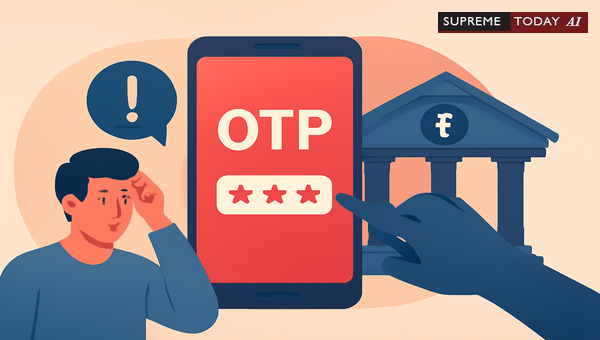
Is Bank Liable If Customer Shares OTP in Fraud?
In today's digital age, banking frauds are rampant, often involving one-time passwords (OTPs). Imagine receiving a call from someone pretending to be your bank, asking for your OTP to verify a transaction. You share it, and suddenly, your account is drained. The burning question arises: Is the bank liable if the customer shares OTP in fraud?
This post dives deep into guidelines, judicial precedents, and real-world cases to clarify liability. While banks must safeguard accounts, like sharing OTPs typically shifts responsibility. Note: This is general information, not legal advice—consult a lawyer for your situation.
Understanding OTP and Its Role in Banking Security
OTPs are six-digit codes sent to your registered mobile for authenticating high-value transactions. They're a cornerstone of secure online banking. However, fraudsters exploit trust by phishing for OTPs via calls, SMS, or apps.
guidelines emphasize customer responsibility. As per Circular No. /2017-18/15 DBR.No.Leg.BC.78/09.07.005/2017-18, if a customer shares , they bear the loss until they report and the bank takes action 2024 0 Supreme(Gau) 1214
. Sharing OTP constitutes negligence, making the customer liable 2024 0 Supreme(Gau) 1214
.
Main Legal Finding: Customer Bears the Loss in Most Cases
Generally, banks are not liable for fraudulent transactions if the customer shared the OTP. Courts and hold that such actions indicate , absolving the bank unless proven otherwise.
Key Principles
circulars on customer protection state:- Customers must report promptly ()
.- Sharing credentials like OTP, MPIN, or passwords makes the customer liable until reporting ()
.- Banks provide secure systems, but negligence shifts liability ()
.
Explicitly: In cases where the loss is due to negligence by a customer, such as where he has shared the , the customer will bear the entire loss until he reports the unauthorised transaction to the bank
2022 0 Supreme(Gau) 275.
Judicial Precedents Reinforcing Customer Liability
Indian courts consistently side with banks when OTP sharing is involved.
- in vs. P.V. George (2019 0 Supreme(AP) 168): Absent proof that the customer did not share OTP, the bank isn't responsible for negligent sharing 2019 0 Supreme(AP) 168.
- in Oriental Insurance Company Ltd. (
): Customers sharing OTP or passwords are liable; banks aren't responsible for subsequent fraud
.
- Bright Transport case: No proof of non-sharing means customer liability, especially with OTP-authenticated transactions 2024 0 Supreme(Gau) 1214.
In one case, transactions over six days via net banking required OTPs. The court rejected claims of SIM duplication without evidence, holding the account holder responsible as passwords were known only to them
. It is not in dispute that without OTP being sent on the mobile phone of the customer, transaction through net banking facility cannot be made
.
When Might the Bank Be Liable? Exceptions and Counterarguments
Liability isn't absolute. Banks must prove and exercise reasonable care.
- If the bank fails to establish OTP sharing or shows systemic failure, it may bear responsibility 2024 0 Supreme(Gau) 1214.
- : implies zero customer liability if reported within and no negligence by customer or bank. Yet, it appears from the plain language employed in that in case of un authorized transaction occurring due to third party breaches i.e where the deficiency neither lies with the customer or the bank, the customer liability will be 'zero' if the fraudulent transaction is reported within 2022 0 Supreme(Gau) 753.
In a credit card fraud case under , no OTP was received, and the complainant blocked the card promptly. The bank bore liability as no negligence was proven: Even if there is no specific security lapse or contributory negligence on part of petitioner, there is no negligence/contributory negligence on part of complainant-respondent too
.
Another instance: If banks don't prevent fraud post-notification, or if duplicate SIM claims lack evidence of non-sharing, banks may lose
. However, banks must cogently establish negligence with reliable evidence—perceived negligence isn't enough 2022 0 Supreme(Gau) 753.
Application to Real Scenarios
- Customer shares OTP: Liable until reporting 2024 0 Supreme(Gau) 1214
.
- Prompt reporting post-fraud: Bank handles losses after
.
- No OTP sharing proof: Bank may need to refund, especially in third-party hacks 2022 0 Supreme(Gau) 753.
In a school account fraud, tagging personal accounts wrongly led to bank scrutiny, but sharing credentials doomed the claim
.
Recommendations for Customers and Banks
For Customers:
- Never share OTPs, even with 'bank officials'—real banks don't ask.
- Report fraud immediately via app/hotline; keep records.
- Monitor SMS alerts; change credentials if suspicious.
For Banks:
- Implement robust security; educate on phishing.
- Act swiftly on reports.
- Document proof of negligence clearly.
Customers should report immediately and keep records of communication 2024 0 Supreme(Gau) 1214.
Conclusion: Protect Yourself First
The consensus from and courts is clear: Sharing OTP typically makes you liable for fraud, as it proves negligence 2024 0 Supreme(Gau) 1214
. Banks aren't insurers against poor judgment, but they must prove lapses and handle fairly.
Key takeaways:- Don't share OTP—it's your firewall.- Report fast to limit losses.- In disputes, evidence rules.
Stay vigilant in digital banking. For personalized advice, reach out to legal experts.
References:1. 2024 0 Supreme(Gau) 1214: Liability hinges on .2.
: on sharing credentials.3. 2019 0 Supreme(AP) 168: Kerala HC on OTP sharing.4.
, 2022 0 Supreme(Gau) 753,
: Contrasting cases on proof and exceptions. #BankFraud #OTPSharing #RBIGuidelines















