




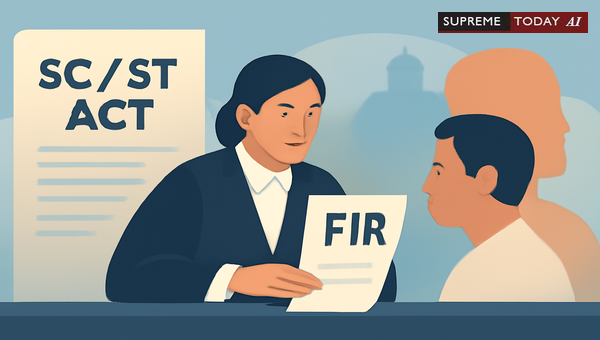
Releases Accused in Case Over Caste Omission
In a significant ruling, the , presided over by Justice Revati Mohite Dere, released an accused in a case under the (). The key ground? The caste of the accused appellant was conspicuously absent from the (). This decision highlights critical procedural aspects in SC/ST cases, where details and accused identification play pivotal roles.
If you've ever wondered: Judgement or order by justice Mohite dere at released accused in scst act ground cast of accused appellant was not mentioned in —this post breaks it down. We'll explore the legal standards, judicial precedents, and related cases, drawing from authoritative sources. Note: This is general information for educational purposes and not specific legal advice. Consult a qualified lawyer for your situation.
Understanding Omissions in Cases
The serves as the foundation of any criminal investigation, but it's not meant to be exhaustive. Courts, including the and , have clarified that omissions in the do not automatically undermine the prosecution's case, unless they strike at its core.
- Purpose of : It's an initial report to launch the investigation, not a comprehensive encyclopedia. 2023 0 Supreme(Bom) 2
- Effect of Omissions: Minor contradictions or missing details aren't fatal if corroborated by trial evidence. The notes that the absence of specific details in the cannot be equated with falsehood or fabrication, especially when the substantive evidence supports the prosecution. 2023 0 Supreme(Bom) 2
- Impact in SC/ST Contexts: In cases involving marginalized communities, courts scrutinize omissions to prevent injustice, but credibility hinges on the totality of evidence. 2023 0 Supreme(Bom) 2
In the case at hand, the omission of the accused's caste was crucial. For provisions to apply, the accused typically must not belong to an SC/ST community, and the offence must be motivated by caste. Without this detail in the , the prosecution's case weakens, justifying release or bail.
Accused Identification: and Court ID
Identification of the accused is another cornerstone, especially in SC/ST cases where fairness is paramount to avoid bias.
(TI Parade)
- Primary Role: Helps witnesses unfamiliar with the accused confirm identity; it's a prudence rule, not mandatory. 1999 9 Supreme 149
- Timing and Conduct: Delays without explanation reduce its value, entitling the accused to . 1999 9 Supreme 149
- Absence Not Fatal: If witnesses had close observation opportunities, court identification suffices. 2023 0 Supreme(Bom) 2
Court Identification
- Substantive evidence if credible and circumstance-supported. The in George and Others v. State of Kerala (AIR 1998 SC 1376) held that court ID, corroborated earlier, is reliable. 1999 9 Supreme 149
In SC/ST matters, courts ensure no caste bias taints identification. Justice Mohite Dere's rulings often emphasize this, as seen in appeals under . For instance, in one case, inconsistent witness roles and non-identification in TI parade led to bail after over three years in custody: As far as is concerned, Anant has not identified appellant in , as being one of assailants. 2023 0 Supreme(Bom) 1212
Justice Revati Mohite Dere's Key Rulings in SC/ST Bail Appeals
Justice Mohite Dere has handled numerous appeals, frequently granting relief where procedural lapses exist.
- Bail Granted on Inconsistencies: In a murder case under , bail was allowed due to role inconsistencies and TI parade failure. 2023 0 Supreme(Bom) 1212
- Injury Mismatch: Injuries not matching witness statements led to release: Learned counsel for appellant submits, that injuries sustained by complainant are not consistent with statement of injured and of eye witnesses. 2023 0 Supreme(Bom) 1144
- Similar Roles to Released Co-Accused: Bail extended when appellant's role mirrored that of bailed co-accused: Today, learned A.P.P states that the role of the appellant is similar to that of co-accused–Akshay @ Sonya Yewale.
These align with broader standards: Courts are cautious in SC/ST cases to prevent prejudice and ensure procedural fairness. 2023 0 Supreme(Bom) 2
Other precedents reinforce:- Kanta Prasad v. Delhi Administration (AIR 1958 SC 350): TI parade failure affects weight, not admissibility. 1999 9 Supreme 149- Budhsen & Anr. v. State of U.P. (2011 SCC 288): Credibility depends on observation opportunity. 1999 9 Supreme 149
Application to the Caste Omission Case
The omission of caste directly impacts applicability. Without it, the fails to establish the foundational element—caste-based atrocity. Justice Mohite Dere noted in related orders: REVATI MOHITE DERE, J. across multiple SC/ST appeals, often directing All concerned to act on the authenticated copy of this order.
2023 Supreme(Online)(Bom) 26420
This mirrors guidance: Omissions go to the root if they create reasonable doubt. Here, lacking caste details disentitles prosecution benefits under , like restrictions. 2023 0 Supreme(Bom) 2
Broader Implications and Procedural Safeguards
- SC/ST Case Vigilance: Courts assess totality—proximity, consistency, corroboration.
- : Unexplained delays or lapses favor the accused. 1999 9 Supreme 149
- Fairness Imperative: Ensures no miscarriage, balancing victim protection with accused rights.
Related cases by Justice Mohite Dere, like those under alongside SC/ST, stress observations don't bind trial courts: It is made clear, that observations made herein are , and trial Court shall decide case on its own merits. 2023 0 Supreme(Bom) 1144
Key Takeaways
- omissions, like missing caste, can lead to accused release in SC/ST cases if they undermine the core case.
- Identification reliability trumps procedure if witnesses are credible.
- Justice Mohite Dere's judgments exemplify procedural rigor in Bombay HC SC/ST appeals.
This ruling underscores 's role in setting investigation motion while cautioning against over-reliance. For those facing similar issues, early legal intervention is key—though outcomes vary by facts.
Sources: 1999 9 Supreme 149 2023 0 Supreme(Bom) 2 2023 0 Supreme(Bom) 1144 2023 0 Supreme(Bom) 1212 and others cited.
Stay informed on evolving legal standards!
#SCSTAct, #BombayHighCourt, #FIRomission












