


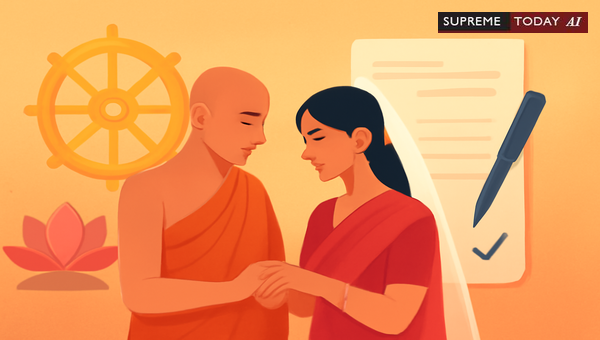
Buddhist Marriage Law in India: HMA or SMA?
In a diverse nation like India, where religious customs intertwine with statutory laws, questions about marriage laws for specific communities often arise. A common query is: Buddhist Marriage Comes under in which Law? This is particularly relevant for Buddhists seeking clarity on the legal validity of their unions, rights to , , and more. While Buddhist marriages may follow traditional rites, Indian law provides a structured framework primarily under the and the . This post breaks down the applicable laws, recognitions, and practical recommendations, drawing from and statutory provisions.
Disclaimer: This article provides general information based on legal precedents and is not a substitute for professional legal advice. Consult a qualified lawyer for your specific situation.
Applicable Laws Governing Buddhist Marriages
Buddhist marriages in India are not governed by a standalone personal law but fall under and Hindu personal laws due to the inclusive definition of 'Hindu' in Indian statutes.
1. Hindu Marriage Act, 1955
The HMA explicitly applies to Buddhists. states it extends to persons professing the Hindu, Buddhist, Sikh, or Jain religion. Courts have consistently held that Buddhist shall also be treated as Hindus under this Act
. This means Buddhist marriages can be validated if they align with the Act's conditions, such as consent, age, and prohibitions on 1996 0 Supreme(SC) 866.
For instance, even where one party is a non-Buddhist, rites like those followed by Hindu Mahars (who sometimes adopt Buddhist ceremonies) are recognized, explaining the resort to the Buddhist rites being followed in these marriages even where one of the parties to the marriage is a non-Buddhist 2006 0 Supreme(AP) 1139 1974 0 Supreme(SC) 418.
2. Special Marriage Act, 1954
The SMA offers a option, ideal for or civil marriages. It recognizes unions between individuals of different religions, including Buddhists, and links to under the 1950 0 Supreme(All) 141. notes that such a marriage severs ties from the undivided family for those professing Buddhism 2023 0 Supreme(SC) 1046.
Notably, ensures that if both parties are Hindu, Buddhist, Sikh, or Jain, laws remain aligned with personal laws, implying continuity despite SMA solemnization 2025 Supreme(Online)(Bom) 3729. Sections 19 and 21 do not apply in such cases under the SMA, preserving family structures 2012 0 Supreme(Guj) 170.
3. under
Beyond marriage validity, allows claims for spouses from Buddhist marriages. Courts uphold these if the marriage is proven through rites like tying a marriage necklace or applying vermilion, deeming them sufficient for marital status 2006 0 Supreme(Bom) 182 2006 0 Supreme(Bom) 188.
Recognition of Buddhist Marriages
Indian law respects practices if they are certain, reasonable, and not opposed to 1981 0 Supreme(Bom) 27. For Buddhists, this includes community-specific rites.
- Chakma Community Example: In certain tribal groups like the Chakma, law prevails. One case noted that HMA does not apply if a prior spouse exists under custom, as Hindu Marriage Act is not applicable to the petitioner
.
- General Buddhist Customs: Marriages per Buddhist rites are valid for legal proceedings, including and . Evidence from cases shows even Hindu-Buddhist mixed rites are accepted 2006 0 Supreme(AP) 1139.
However, for broader enforceability, registration is key. Courts emphasize that while customs provide proof, under HMA or SMA offers ironclad protection 2024 0 Supreme(Telangana) 237.
Key Findings from
- Validity Across Laws: Buddhist marriages gain legal protection under both HMA and SMA, ensuring rights in and 1996 0 Supreme(SC) 866 1950 0 Supreme(All) 141.
- Precedence: In communities like Chakma, customs may override statutes, but generally, HMA applies as Buddhists are treated as Hindus
.
- Nuances: SMA marriages between Buddhists follow Hindu via , maintaining consistency 2025 Supreme(Online)(Bom) 3729.
- Enforcement: proofs suffice under CrPC, reinforcing legal standing 2006 0 Supreme(Bom) 182.
Additional insights from sources highlight that even Hindu Mahars adopting Buddhist rites do not alter HMA applicability, as conversion is often temporary for ceremonies 1974 0 Supreme(SC) 418.
Practical Recommendations
To navigate these laws effectively:1. Register Your Marriage: Opt for SMA for civil certainty or HMA if aligning with customs. Registration proves validity in disputes.2. Document Customs: Gather photos, witness statements, or videos of rites (e.g., necklace tying) for court evidence.3. Seek or : Rely on or HMA provisions, citing precedents like those validating Buddhist customs 2006 0 Supreme(Bom) 188.4. Considerations: SMA is preferable to avoid conflicts.
In specific communities, verify if laws (e.g., Chakma) take precedence 2025 Supreme(Online)(Kar) 26748.
Conclusion and Key Takeaways
Buddhist marriages in India generally come under the Hindu Marriage Act, 1955, with Buddhists treated as Hindus under Section 2, supplemented by the Special Marriage Act for options and CrPC for . practices are recognized, providing flexibility, but registration ensures robust legal protection.
Key Takeaways:- Primary Law: HMA for most Buddhists; SMA for civil/.- Customs Valid: If reasonable and proven.- Rights Protected: , upheld.- Action Step: Register to safeguard rights.
Stay informed on evolving jurisprudence, as courts continue interpreting these inclusively. For personalized guidance, consult a family law expert.
#BuddhistMarriage #IndianFamilyLaw #HMAIndia












