


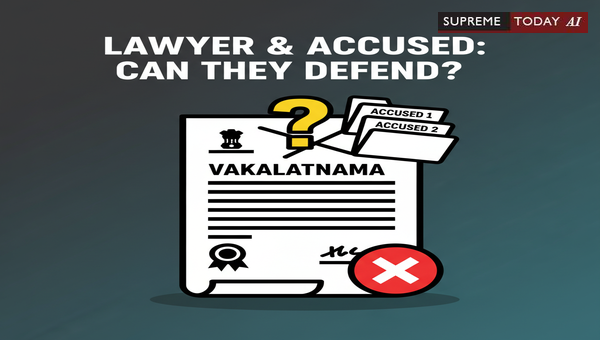
Can an Advocate Accept Vakalatnama for an Accused If They Are Also Accused?
In the complex world of legal representation in India, the vakalatnama serves as a critical power of attorney, authorizing an advocate to act on behalf of a client in court proceedings. But what happens when the lines blur? Specifically, whether an Advocate can accept the Vakalatnama for Accused if he is also Accused in this case raises profound questions about conflicts of interest, ethical duties, and procedural validity. This scenario could arise in multi-accused cases involving family, colleagues, or related parties, potentially compromising impartiality.
While direct precedents on an advocate accepting vakalatnama while being co-accused are limited, related principles from case law emphasize ethical boundaries and grounds for disengagement. Courts generally prioritize the advocate's role as an officer of the court over client loyalty, as noted in common law contexts where advocates are, first, officers of the court; their fealty compels them to assist the court, rather than remain mere mouthpieces to their clients 2019 0 Supreme(Bom) 1277. This post explores the issue, drawing on key grounds for vakalatnama withdrawal and insights from judicial decisions.
Understanding Vakalatnama and Potential Conflicts
A vakalatnama is not merely a formality; it binds the advocate to represent the client diligently under the Advocates Act, 1961, and rules of professional conduct. Accepting one while being an accused in the same case typically triggers a conflict of interest. An advocate's personal stake could influence strategy, testimony, or advocacy, undermining justice.
For instance, in cases with familial ties among accused—like two real brothers and a nephew alongside an employee in a nursing home operated by an accused doctor—it is deemed quite unnatural for overlapping roles, highlighting ethical red flags 2023 0 Supreme(All) 2461. Courts may view such acceptance as defective from inception, akin to a flawed instrument lacking essential elements.
Grounds for an Advocate to Withdraw Vakalatnama
Even if initially accepted, advocates may seek withdrawal under specific circumstances. These grounds provide insight into when representation becomes untenable, including potential conflicts:
1. Lack of Instructions or Brief
An advocate may withdraw if they haven't received a brief or documents from the client. In Sri Arvind Kumar Sharma's case, the court allowed withdrawal noting he never received any brief from the opposite party and did not appear or argue on their behalf. Without engagement, the vakalatnama isn't binding 2023 0 Supreme(All) 760.
2. Client's Request
Clients can demand withdrawal. In Hiyat Khan, the client's wish to argue personally led to permitted disengagement 2000 0 Supreme(All) 818. Clear communication prevents disputes.
3. Defective Vakalatnama
A vakalatnama missing requirements, like an Advocate Welfare Ticket, is invalid. The court in Sri Arvind Kumar Sharma deemed it defective, facilitating withdrawal 2023 0 Supreme(All) 760.
4. No Appearance or Representation
Non-appearance justifies exit, as substantive engagement is absent 2023 0 Supreme(All) 760.
These grounds underscore that vakalatnama isn't irrevocable; courts balance client rights with judicial integrity.
Insights from Related Case Law
Judicial precedents reinforce caution in advocate-client dynamics, especially with conflicts:
Withdrawal from Prosecution: Under CrPC Section 321, public prosecutors' withdrawal applications require independent satisfaction and public interest justification. In one case, the trial court erred by dismissing on technical grounds without proper review, remitting for reconsideration 2023 0 Supreme(All) 2461. This supervisory role extends analogously to private advocates.
Advocates' Welfare and Practice Rights: Voluntary sanad surrender doesn't bar resuming practice, a fundamental right. However, benefits availed must be refunded 2024 0 Supreme(Kar) 434. This affirms advocates' protections but doesn't override conflict rules.
Plaint Rejection and Advocate Liability: Allegations of fraud against advocates don't warrant plaint rejection pre-trial; issues like misjoinder go to merits 2023 0 Supreme(Cal) 1549. Relevant for co-accused scenarios involving advocate-defendants.
Advocate Clerks and Natural Justice: Refusal to register clerks must follow natural justice; mechanical denials are quashed 2020 0 Supreme(Mad) 329. Parallels advocate registration/withdrawal fairness.
Procedural Duties: Advocates must file vakalatnamas promptly, as delays in revisions aren't condoned without diligence
Sant Sagar Builders & Developers Pvt. Ltd. VS Sagar Heights Co-Operative Housing Society Ltd.
.Evidence Production: Late evidence requires valid reasons; routine allowances are discretionary abuses 2019 0 Supreme(Bom) 1277. Ties to ensuring clean representation.
Review Petitions: Imposed advocates or procedural irregularities don't vitiate trials absent errors apparent on record 2018 0 Supreme(SC) 704.
These cases illustrate courts' vigilance against irregularities in representation.
Ethical Considerations and Best Practices
Bar Council rules prohibit advocates from appearing in cases against close relations or with personal interests without disclosure. If an advocate is co-accused:- Disclosure is Mandatory: Courts may reject or recall vakalatnama.- Withdrawal Recommended: To avoid ethics violations.
Recommendations:- Advocates: Verify no conflicts; secure clear instructions and valid documents before acceptance.- Clients: Disclose all facts; communicate intentions early.- Verify compliance (e.g., welfare stamps) to avert defects.
Key Takeaways
- Accepting vakalatnama as a co-accused is fraught with conflicts, likely leading to withdrawal or invalidation.
- Primary withdrawal grounds: no brief, client request, defects, non-appearance 2023 0 Supreme(All) 760 2000 0 Supreme(All) 818.
- Courts prioritize public interest and natural justice in representation disputes.
This analysis is for informational purposes and reflects general principles; outcomes vary by facts. Consult a qualified advocate for case-specific advice. Stay informed on evolving legal ethics to navigate India's courts effectively.
References: 2023 0 Supreme(All) 760 2000 0 Supreme(All) 818 2023 0 Supreme(All) 2461 2024 0 Supreme(Kar) 434 2023 0 Supreme(Cal) 1549 2020 0 Supreme(Mad) 329
Sant Sagar Builders & Developers Pvt. Ltd. VS Sagar Heights Co-Operative Housing Society Ltd.
2019 0 Supreme(Bom) 1277 2018 0 Supreme(SC) 704 #Vakalatnama #LegalEthics #AdvocateRights















