


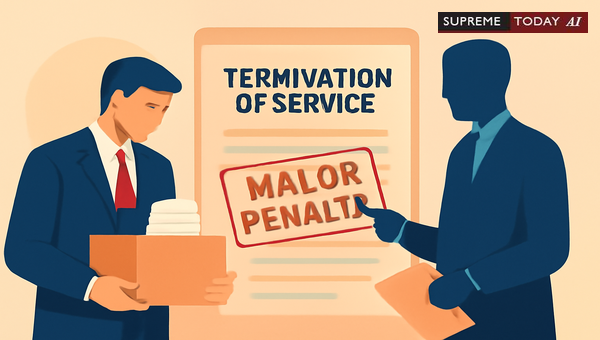
Can Service Be Terminated Without a ?
In the realm of employment law, one common concern for workers is: In Service Without any Not Terminate from his Service. This question touches on whether an employer can end an employee's service without imposing a like or removal, especially when no severe misconduct has been established. While demand strict procedural safeguards, termination under certain conditions—such as probationary periods or administrative reasons—may be permissible without them.
This blog post provides a comprehensive analysis based on established legal principles, court rulings, and service regulations. Note: This is general information and not specific legal advice. Consult a qualified attorney for your situation.
Understanding vs. Termination
, such as or , are reserved for grave misconduct and require to the offense. Courts emphasize that , including , must be proportionate to the gravity of the misconduct. The imposition of such penalties requires a thorough examination of the circumstances surrounding the case 2022 0 Supreme(Mad) 1835.
In contrast, is often less severe and does not always carry the stigma of a disciplinary action. Under many service rules, termination—especially for temporary or probationary employees—can occur with notice and without a formal inquiry, as it stems from contractual rights rather than punishment 2022 0 Supreme(Gau) 923 2023 0 Supreme(All) 547.
Key distinctions include:- /Removal: , disqualifies from future employment, requires inquiry 2025 0 Supreme(Raj) 1342 2025 0 Supreme(Raj) 1876.- Termination: Administrative, for or procedural grounds, typically without stigma 2024 0 Supreme(Gau) 976.
An order of termination from service amounts to imposition of a only if linked to alleged misconduct without 2017 0 Supreme(Gau) 132. Otherwise, it may stand if procedures are followed.
and
Any attempt to impose a must adhere to . This includes:1. Framing specific charges and issuing a .2. Conducting a detailed inquiry.3. Providing the employee an opportunity to defend 2022 0 Supreme(Pat) 910 2017 0 Supreme(Jhk) 1223 2021 0 Supreme(Del) 2011.
Failure to do so renders the action arbitrary. without following , such as failing to conduct a proper inquiry or not providing a show cause notice, is considered arbitrary and violates the 2017 0 Supreme(Jhk) 1223 2021 0 Supreme(Del) 2011.
Additionally, the imposing authority must be competent. If a penalty is imposed by an authority not designated as the , it may be deemed invalid 2023 0 Supreme(All) 1026.
From service rules like the , which shall not be a disqualification for future employment under the Government is a penalty which is envisaged under ... classifies penalties into minor and major. Reduction in rank and are classified... 2023 0 Supreme(Bom) 1436. like demand full procedure under 2014 0 Supreme(P&H) 1276.
: A Key Exception
For employees during probation, termination based on does not qualify as . Termination during probation is not considered if it follows the rules governing probationary periods, which allow for termination based on without the need for a formal inquiry 1966 0 Supreme(SC) 89.
This is a of the employer, not a . Authorities can terminate services without a formal inquiry if the employee is a temporary or probationary staff, but such actions should not be mistaken for measures unless misconduct is involved 2023 0 Supreme(All) 547.
Court Rulings on Disproportionate and Procedural Lapses
Courts frequently intervene when penalties are excessive or procedures flawed:- Disproportionate Penalty: In cases where the penalty of removal was deemed excessive compared to the misconduct, courts have intervened to set aside such penalties 2022 0 Supreme(Mad) 1835. For instance, Once the initiation of the inquiry is for in that event imposition of of from service was not warranted 2023 0 Supreme(Pat) 598.- Procedural Failures: If explanations are ignored or no proper inquiry held, penalties are overturned 2013 8 Supreme 156 2014 0 Supreme(MP) 781. of from service has been imposed upon the petitioner, on the ground of absence without sanctioned leave. and from service comes within the purview of 2013 0 Supreme(UK) 753.- Inquiry Specifics: For charges like gratification, the penalty of from service, under , is a and must follow Rule 26 procedures 2019 0 Supreme(UK) 111.
In long-service cases, courts prefer alternatives: considering the fact that the petitioner had worked for more than 29 years there being no previous adverse remarks... the disciplinary authority ought to have borne in mind... why he had preferred the penalty of and not the 2011 0 Supreme(Mad) 4351.
like those under , including from service, require inquiry unless not practicable 2014 0 Supreme(P&H) 1276.
Implications and Severity of Penalties
Imposing has severe consequences:- Loss of pension benefits.- Disqualification from future employment.- 2025 0 Supreme(Raj) 1342.
Lesser actions like suspension or simple termination have fewer requirements. Imposing such as , removal, or reduction in rank requires strict procedural compliance, including holding a formal inquiry, framing charges, and obtaining approval from competent authorities 2024 0 Supreme(Gau) 1173 2024 0 Supreme(All) 2052 2025 0 Supreme(Raj) 1342.
Removal and from service stand on the same footing and both terminate the relationship of employer-employee 2023 0 Supreme(J&K) 233, but only after for misconduct.
Recommendations for Employees and Employers
For Employees
- Document all communications and disciplinary steps.
- Challenge terminations lacking in court, citing natural justice violations.
- If no major misconduct, argue for limits 2024 0 Supreme(Gau) 1173.
For Employers
- Distinguish from .
- For , ensure inquiry, competent authority, and .
- For probationers, use clear notice under service rules.
Employees facing termination should ensure that is followed. If not, they may challenge the termination in court, citing violations of natural justice and procedural irregularities.
Key Takeaways and Conclusion
Generally, service can be terminated without a if based on probationary , contractual terms, or procedural grounds—without needing a full inquiry. However, labeling misconduct without elevates it to a , risking court invalidation.
The cornerstone is procedural fairness: demand inquiry and opportunity to defend, while simple termination does not if non-. Courts protect against arbitrariness, as seen in rulings quashing disproportionate dismissals 2022 0 Supreme(Mad) 1835 2023 0 Supreme(Pat) 598.
In summary: Adhere to rules distinguishing termination from . Employees, seek counsel promptly; employers, prioritize compliance to avoid litigation.
This analysis highlights the balance between employer rights and employee protections in service matters. Stay informed on evolving case law for your employment security.
#EmploymentLaw, #TerminationRights, #LaborLaw












