


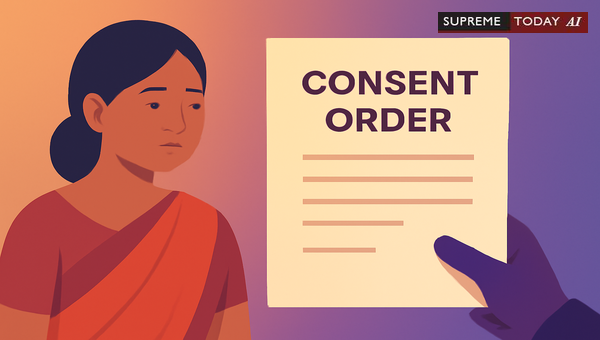
Can You Challenge a Consent Maintenance Order in India?
In the realm of Indian family law, maintenance orders play a crucial role in ensuring financial support for spouses and children. But what happens when a —agreed upon by both parties and sanctioned by the court—is later contested? The question arises: A of Maintenance Cannot be Otherwise Challenged. This blog delves into the binding nature of such orders, key legal principles, precedents, and practical insights, drawing from established case law under the , particularly .
While this post provides general information based on judicial precedents, it is not a substitute for professional legal advice. Consult a qualified lawyer for your specific situation.
Understanding Consent Orders of Maintenance
A for maintenance is essentially a contractual agreement between parties (typically husband and wife) that receives court approval. Once passed, it carries the weight of a , making it binding on both sides. These orders are common in proceedings under CrPC, which mandates maintenance for wives, children, and parents unable to maintain themselves.
The core principle is finality: parties who voluntarily agree to terms at the level generally cannot renege later out of dissatisfaction. As courts have emphasized, such orders promote stability and prevent endless litigation in family matters. 2012 0 Supreme(Jhk) 1513
Key Legal Principles Governing Consent Orders
Binding Nature and Limited Challenges
Consent orders are not easily modifiable. Mere allegations, such as concealment of facts by the other party, do not suffice to recall or alter the order. Courts require valid grounds, like fraud, coercion, or material change in circumstances, backed by substantial evidence. Mere claims are insufficient. 2023 0 Supreme(Del) 4084
Importantly, a cannot be challenged via by the opposing party if they failed to contest it at the lower court. This ensures parties actively participate during initial hearings. 2012 0 Supreme(Jhk) 1513
Violations Do Not Nullify Rights
Even if one party violates the , it does not automatically disentitle the claimant from maintenance under CrPC. Courts prioritize the protective intent of the provision over procedural lapses. 2022 0 Supreme(Del) 2126
Grounds and Limitations for Challenging Consent Orders
Challenging a is an uphill battle. Here's a breakdown:
No : Parties cannot indirectly challenge a through parallel proceedings. For instance, in one case, pursuing a separate suit for refund was deemed a 'collateral attack' to circumvent the , constituting . Parties cannot 'blow hot and cold' by accepting benefits while later disputing terms.
Misinterpretation of Consent: Courts scrutinize claims of 'consent to separate.' A document purportedly showing consent must be unambiguous and witnessed. In a notable ruling, a divorce-related document was not treated as consent for separate residence, especially under compelling circumstances. Delay in filing maintenance claims also does not negate entitlement if consent was misinterpreted. 2024 0 Supreme(Chh) 598
Enhancement Under CrPC: While consent orders are hard to challenge outright, alterations for changed circumstances (e.g., inflation) may be sought under . However, courts distinguish this from initial orders. In one revision, enhanced maintenance was made operative from the filing date due to delays not attributable to the applicant, considering rising costs. 2016 0 Supreme(Chh) 363
Income Concealment and Proof Burden: Husbands cannot evade liability by claiming reduced income without proof. If a wife has approximate knowledge of income, the onus is on the husband to disprove claims convincingly. Failure to do so upholds orders for .
Interplay with Other Maintenance Provisions
Consent orders under CrPC often intersect with civil remedies like . If maintenance is awarded by consent in matrimonial proceedings, execution under CrPC may be stayed until civil payments cease. Courts adjust amounts, recognizing the husband's awareness of prior obligations when consenting. It is true that the order of under section 24 of Hindu Marriage Act is passed earlier to the order under of Criminal Procedure Code... However, both the parties has ignored the fact that the order of maintenance in this case was passed by the consent of both the parties. 2005 0 Supreme(Bom) 681
Additionally, a wife's refusal to live with her husband for sufficient reasons does not bar maintenance, even if he offers support conditionally. This upholds social justice in maintenance cases. 2004 0 Supreme(Pat) 1043
Legal Precedents: What Courts Have Ruled
Respect for Consent: Courts stress that challenges must rest on substantial grounds, not regret. 2012 0 Supreme(Jhk) 1513
No Quashing Lightly: invoke sparingly, only in exceptional abuse-of-process cases. Orders directing maintenance stand if the wife has valid refusal grounds. 2004 0 Supreme(Pat) 1043
Reasoned Fixation: Maintenance must be based on record evidence; arbitrary fixation is set aside, but consent overrides if voluntary.
These precedents underscore that consent orders are sacrosanct unless vitiated by illegality.
Practical Recommendations
To navigate these complexities:
Draft Carefully: Ensure consent orders are precise, with full disclosure, to avoid future disputes.
Gather Evidence: For any challenge, compile robust proof of fraud or change in circumstances before approaching courts.
Seek Enhancement Properly: Use for inflation-adjusted increases, not revisions.
Consult Experts: Engage family law specialists early, as trial-level resolution is key.
Key Takeaways
Consent orders for maintenance are generally binding and not challengeable on flimsy grounds like concealment allegations. 2023 0 Supreme(Del) 4084
Fail to contest at trial? You're barred from higher court revisions. 2012 0 Supreme(Jhk) 1513
Violations or parallel claims don't erase rights; courts favor equity. 2022 0 Supreme(Del) 2126
In summary, while Indian law protects maintenance seekers, it equally safeguards consensual resolutions. Respecting these orders fosters amicable family resolutions. For personalized guidance, reach out to a legal professional.
References:- 2023 0 Supreme(Del) 4084- 2022 0 Supreme(Del) 2126- 2012 0 Supreme(Jhk) 1513-
- 2024 0 Supreme(Chh) 598- 2016 0 Supreme(Chh) 363-
- 2005 0 Supreme(Bom) 681- 2004 0 Supreme(Pat) 1043 #FamilyLawIndia, #MaintenanceOrder, #CrPC125















