


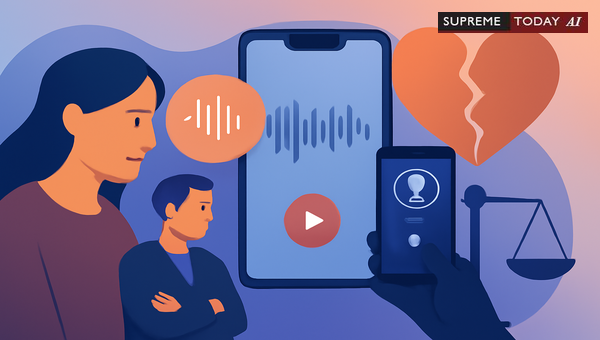
How to Challenge Audio Recordings in Divorce Cases
In heated divorce proceedings, especially those involving allegations of , audio recordings often surface as explosive evidence. Imagine your spouse producing a secret phone recording claiming it captures you admitting to an affair. How do you counter it effectively in court? This is a common query: how to counter an audio recording in court in a divorce case involving ? While audio can seem damning, apply stringent standards for , offering multiple avenues to challenge it. This guide outlines proven strategies based on judicial precedents, emphasizing that this is general information—not specific legal advice. Consult a lawyer for your case.
Understanding of Audio Recordings
Audio recordings, whether on tapes, CDs, or digital files, are classified as 'documents' under . However, their susceptibility to tampering—through editing, transposition, or excision—demands rigorous proof. Mere production isn't enough; the party relying on it must prove its source, accuracy, and unaltered state. Courts have repeatedly held that mere production is insufficient without proof of source, accuracy, and unaltered state. 2010 1 Supreme 502
For electronic records, mandate a certificate certifying accuracy and integrity. Failure to comply often leads to exclusion. In matrimonial disputes, where emotions run high, challenging these recordings can be pivotal, particularly when is alleged under .
Key Grounds for Initial Objection
- Lack of Pleading: Facts about the recording must be specifically pleaded; unpleaded CDs post-evidence closure are barred. 2014 0 Supreme(P&H) 164
- Procedural Non-Compliance: Demand the upfront.
Challenging Authenticity and
Demand of the original device (e.g., phone, microchip) and any copies. Courts have directed such scrutiny in various cases. In a contempt matter involving sting CDs, the court examined materials and found them genuine and un-tampered, but noted that of handlers wouldn't alter the content unless tampering is shown. 2009 0 Supreme(SC) 1329
In divorce contexts, similar rigor applies. For instance, audio-video statements were disallowed because genuineness and authenticity... are in doubt without forensic verification under .
Highlight gaps in : Who handled the device? Was it preserved securely?
From related precedents, proving itself requires , not mere suspicion. Courts have set aside divorce decrees where no finding on sexual intercourse was recorded, stressing the need for the alleged adulterer as a necessary party. 2023 0 Supreme(MP) 105 This underscores that weak foundational evidence, like unverified audio, crumbles under scrutiny.
Voice Identification: A Critical Hurdle
Voice matching is essential. Without expert verification or voice sample comparison, recordings are inadmissible. In a divorce cruelty case, the court mandated the husband produce the cell phone and directed the wife to provide a voice sample for comparison, stating Proper identification of voices and accuracy of recordings are crucial for . 2012 0 Supreme(Mad) 2453 2004 6 Supreme 57
Similarly, in a rent dispute, courts permitted voice samples to a Forensic Lab for pendrive clips, affirming its relevance. 2023 0 Supreme(P&H) 732 Request the court order your voice sample and the opponent's device for —mere witness testimony () won't suffice. 2004 6 Supreme 57
Privacy Violations in Secret Recordings
Secretly recorded conversations often infringe 's right to privacy, especially in matrimonial cases. Courts have rejected such evidence as it promotes a dangerous trend to allow people to be fixed or exposed on Audio CDs obtained by malfeasance. 2014 0 Supreme(P&H) 164 In a Hindu Marriage Act divorce, a covert recording was deemed inadmissible for violating . 2022 0 Supreme(MP) 1030
However, privacy isn't absolute. under Section 14 of the Act, 1984, may admit evidence if it aids dispute resolution, subject to forensic checks. In one case, a secretly recorded CD of the wife speaking derogatorily was allowed provisionally, with FSL examination ordered, as Section 14 empowers courts to receive relevant evidence despite Evidence Act bars. 2020 0 Supreme(Del) 629 Argue it's an instrument of torture and oppression against a spouse, tilting discretion. 2014 0 Supreme(P&H) 164
allegations must also implead the co-respondent unless cruelty (not direct ) is the ground. False claims can backfire as cruelty against the accused spouse. 2024 0 Supreme(MP) 405
Forensic Safeguards and
File objections via (IA) under or Evidence Act provisions before admission. Key demands:- Production of original device and recording.- Voice sample/expert comparison at Forensic Lab.- .- of the recorder/handler.- Forensic report on tampering.
In criminal analogs, like dowry deaths, audio was upheld only post-forensic positivity. 2018 0 Supreme(P&H) 400 Courts emphasize , as in dying declarations requiring official equipment over personal mobiles. 2022 0 Supreme(Kar) 450
Exceptions and Strategic Considerations
Challenges may fail if waived earlier or in public interest stings with verified originals. 2009 0 Supreme(SC) 1329 In proofs, even one act suffices, but needs substantiation—not . Failed proofs lead to dismissed petitions. 2024 0 Supreme(All) 2252
Video conferencing for witness exams preserves testimony integrity amid constraints like pandemics, per Supreme Court guidelines. 2021 0 Supreme(P&H) 166
Key Takeaways and Recommendations
- Act Early: Object pre-admission to exclude evidence.
- Build a Multi-Pronged Attack: Combine authenticity, voice ID, privacy, and procedural challenges.
- Preserve Record: Note grounds for appeal.
- Seek Expert Help: Forensic labs and counsel are indispensable.
Successful counters have excluded evidence in divorce, criminal, and election cases. While audio can sway opinions, courts prioritize 'duly proved' records. In disputes, unverified claims often falter, protecting against misuse. Remember, outcomes depend on facts—engage a family law specialist promptly.
This post draws from judicial precedents and is for informational purposes. Laws evolve; verify with current statutes.
#DivorceLaw, #AudioEvidence, #AdulteryCase















