


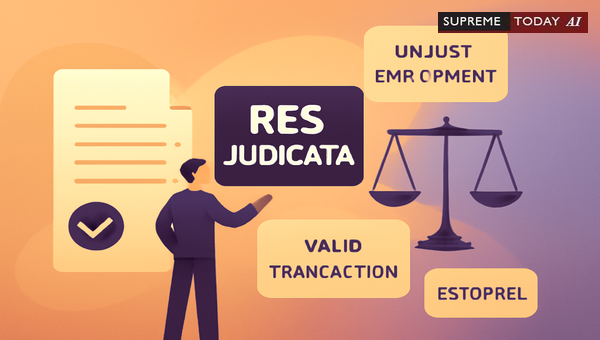
Can't Challenge a Valid Transaction After Receiving Benefits?
In the world of contracts, property deals, and business transactions, there's a fundamental question many face: Can a transaction be questioned after obtaining benefits of a valid transaction? The short answer, generally speaking, is no. Once parties have executed a lawful deal and one side has reaped its rewards, courts typically uphold the finality of that agreement. This principle promotes certainty in legal dealings, prevents endless litigation, and avoids .
This blog dives deep into the doctrine, drawing from Indian case law and statutory insights. We'll cover the core legal principles, landmark judgments, exceptions, and real-world applications. Note: This is general information, not legal advice. Consult a qualified attorney for your specific situation.
Understanding the Core Principle: Finality of Valid Transactions
The idea that a transaction cannot be questioned after obtaining benefits of a valid transaction stems from longstanding legal doctrines. It ensures stability in commercial and personal dealings. Key pillars include:
- : Once a matter is finally decided between parties, it can't be relitigated. This extends to transactions validated through execution and benefit receipt.
- : Parties can't retain benefits at another's expense without justification. As held in Renusagar Power Co. Ltd. vs. General Electric Co. (1994), retention of benefits without lawful basis is prohibited, barring recovery once obtained unless fraud exists 1997 0 Supreme(Guj) 104.
- and : You can't accept and reject the same instrument. A party cannot claim validity to gain advantages, then challenge it later. This is nothing but which he cannot be allowed to say 2015 0 Supreme(Pat) 1115.
These principles create a presumption of validity for completed, lawful transactions where benefits are enjoyed.
Landmark Case Law Supporting Non-Questionability
Indian courts have consistently reinforced this rule through precedents:
The emphasized , stating that questioning a transaction is barred post-benefit receipt unless fraud or illegality is proven 1997 0 Supreme(Guj) 104.
Lawful transactions in the ordinary course of business can't be invalidated later just because they proved unprofitable. Assets transferred belong to rightful parties, and claims to undo them are barred once complete 2023 0 Supreme(Guj) 27.
Additional Insights from Related Cases
- In company law contexts, post-winding-up dispositions can be validated under , protecting legitimate interests if they serve justice 2024 0 Supreme(Bom) 483. The court noted such transactions are bonafide and in the interest of the business.
- principles shine in partition disputes, where suppressing facts to challenge a decree after benefiting is frowned upon 2015 0 Supreme(Pat) 1115.
These cases illustrate that courts prioritize finality for good-faith dealings.
Statutory Backing and Limitations
Statutes echo this stance:
- (relevant contract/land laws): Transactions remain valid until declared invalid by a court 2021 0 Supreme(Guj) 2.
- General Civil Law: and prevent reopening settled matters.
Limitations protect parties:- Lawful transactions with valid consideration can't be questioned post-benefits 2023 0 Supreme(Guj) 27.- No relitigation of settled transactions absent fraud.
Exceptions: When Challenges Are Possible
While the rule is strong, it's not absolute. Transactions may be scrutinized if:
- Fraud, Coercion, or Misrepresentation: Voidable at inception, challengeable via proceedings.
- Minor's Repudiation: Under (,(3)), a minor can repudiate a guardian's unauthorized transfer by suit or conduct upon majority 2026 1 Supreme 225. Evidence must prove title claims.
- Illegal or Null Transactions: E.g., lacking consideration or consensus, treated as nullities
. Or prohibited transfers deemed null and 2020 6 Supreme 555.
- Public Interest/Statutory Voids: Winding-up dispositions void unless court-validated 2024 0 Supreme(Bom) 483, or securities transactions under special acts 2008 0 Supreme(SC) 948.
Even here, challenges often require pre-execution proof or timely action—post-benefit enjoyment strengthens the finality bar.
Practical Application to Everyday Scenarios
Consider these examples:
- Property Sales: A buyer enjoys possession and improvements; seller can't later claim invalidity without fraud proof 2023 0 Supreme(Guj) 27.
- Business Deals: Companies executing sales post-petition but get court nod 2024 0 Supreme(Bom) 483.
- Agreements to Sell: suits within limitation aren't denied solely for delay, but time-essence breaches or price hikes may influence equity 2020 6 Supreme 555.
In Official Liquidator cases, courts stress ordinary business transactions' sanctity 2023 0 Supreme(Guj) 27. Similarly, tenants accepting leases can't later deny validity after benefits 2011 0 Supreme(Pat) 484.
The doctrine applies broadly: contracts, leases, sales—anywhere benefits flow from a presumptively valid act.
Key Takeaways for Businesses and Individuals
- Prioritize Due Diligence: Ensure transactions are lawful upfront to avoid disputes.
- Document Benefits: Receipt solidifies finality.
- Act Promptly on Issues: Fraud claims need early evidence.
- Seek Equity: Courts demand —dishonest pleas fail 2015 0 Supreme(Pat) 1115.
Conclusion
The principle that a transaction cannot be questioned after obtaining benefits of a valid transaction is robustly supported by Indian law. Doctrines like , , and , backed by cases such as Renusagar1997 0 Supreme(Guj) 104 and Official Liquidator2023 0 Supreme(Guj) 27, promote transactional certainty. Exceptions for fraud or illegality exist but demand strong proof.
In a litigious world, this rule saves time and resources. Always verify legality at execution—once benefits are enjoyed, the door to challenges often closes.
References:- 1997 0 Supreme(Guj) 104 – Renusagar Power Co. Ltd. vs. General Electric Co.- 2023 0 Supreme(Guj) 27 – - 2021 0 Supreme(Guj) 2 – interpretations- 2015 0 Supreme(Pat) 1115, 2024 0 Supreme(Bom) 483, 2026 1 Supreme 225, 2020 6 Supreme 555,
, 2011 0 Supreme(Pat) 484
This post is for informational purposes only. Laws evolve; professional advice is essential.
#ResJudicata, #UnjustEnrichment, #ContractLaw















