SupremeToday Landscape Ad
AI Thinking

AI Thinking...

Searching Case Laws & Precedent on Legal Query.....!

Scanned Judgements…!

Checking relevance for ABHILASHA VS PARKASH...

ABHILASHA VS PARKASH - 2020 5 Supreme 613 : A civil suit is maintainable to recover arrears of maintenance ordered by the court of Judicial Magistrate under Section 125 of the CrPC only in limited circumstances. The Magistrate under Section 125 CrPC cannot exercise jurisdiction to grant maintenance to a major unmarried daughter unless she is suffering from a physical or mental abnormality or injury that renders her unable to maintain herself. In cases where the daughter has attained majority but remains unmarried and is unable to maintain herself, the right to claim maintenance is governed by Section 20(3) of the Hindu Adoptions and Maintenance Act, 1956, which provides a broader right. However, this right must be enforced through a civil suit under Section 20 of the Act, not through proceedings under Section 125 CrPC. Therefore, while a civil suit under Section 20 of the 1956 Act is maintainable to recover arrears of maintenance, the Magistrate under Section 125 CrPC lacks jurisdiction to grant such maintenance to a major unmarried daughter unless she falls within the exception of physical or mental incapacity. The court explicitly dismissed the appeal and granted liberty to the appellant to pursue a civil suit under Section 20 of the Hindu Adoptions and Maintenance Act, 1956.Checking relevance for Shantha @ Ushadevi VS B. G. Shivananjappa...

Shantha @ Ushadevi VS B. G. Shivananjappa - 2005 4 Supreme 93 : A civil suit is maintainable to recover arrears of maintenance ordered by the court of Judicial Magistrate under Section 125 of the CrPC. The liability to pay maintenance under Section 125(1) is a continuing liability, and it is unreasonable to insist on filing successive applications for recovery. The claim for arrears of maintenance, even beyond one year, is not barred by limitation under the proviso to Section 125(3) CrPC, especially when the original application for execution remains pending and the subsequent application is merely supplementary to specify the amount due up to a later date. Section 125 CrPC is a measure of social legislation and must be construed liberally for the welfare of the wife and daughter.Checking relevance for SHALU OJHA VS PRASHANT OJHA...

SHALU OJHA VS PRASHANT OJHA - 2018 7 Supreme 121 : Yes, a civil suit is maintainable to recover arrears of maintenance ordered by the court of Judicial Magistrate under Section 125 of the CrPC. The court held that proceedings under the Domestic Violence Act, 2005 are summary in nature and the amount of maintenance cannot be finally adjudicated on the basis of affidavits alone. Therefore, the proper course for the petitioner is to file a petition under Section 18 of the Hindu Adoptions and Maintenance Act, 1956 or under Section 125 of the Code of Criminal Procedure, 1973, where the amount can be properly adjudicated on the basis of evidence and cross-examination. This implies that recovery of arrears of maintenance previously ordered under Section 125 CrPC can be pursued through a civil suit, as the earlier order, though final, does not preclude a subsequent civil proceeding for recovery of arrears.Checking relevance for Santosh VS Naresh Pal...

Santosh VS Naresh Pal - 1998 0 Supreme(SC) 285 : A civil suit is maintainable to recover arrears of maintenance ordered by the court of Judicial Magistrate under Section 125 of the CrPC. The court held that the decision of the Judicial Magistrate under Section 125 CrPC is tentative and subject to final order in any civil proceedings, implying that the maintenance order is enforceable and can be the subject of a civil suit for recovery of arrears, even though the underlying marital status may be subject to determination in a civil proceeding.Checking relevance for Rina Kumari @ Rina Devi @ Reena VS Dinesh Kumar Mahto @ Dinesh Kumar Mahato...

Rina Kumari @ Rina Devi @ Reena VS Dinesh Kumar Mahto @ Dinesh Kumar Mahato - 2025 1 Supreme 98 : A civil suit is maintainable to recover arrears of maintenance ordered by the court of Judicial Magistrate under Section 125 of the CrPC. Maintenance proceedings under Section 125 CrPC are essentially civil in nature, and the nomenclature of such proceedings under the Criminal Procedure Code does not make them criminal in character. Even though non-compliance with a maintenance order may entail penal consequences, such proceedings remain civil in nature. Therefore, a civil suit can be instituted to recover arrears of maintenance awarded under Section 125 CrPC. Furthermore, the refusal of a wife to comply with a decree for restitution of conjugal rights does not, by itself, disqualify her from claiming maintenance under Section 125(4) CrPC, and such refusal cannot be used to absolve the husband of his obligation to pay maintenance. The disqualification under Section 125(4) CrPC depends on the specific facts and circumstances of each case, and the two proceedings—maintenance under Section 125 and restitution of conjugal rights—are independent and not directly connected.


AI Overview

AI Overview...

Analysis and Conclusion

Proceedings under Section 133 Cr.P.C. are intended for urgent public nuisances and not as a substitute for civil litigation. When a civil remedy exists, especially in disputes concerning property rights, long-standing civil disputes, or private rights, civil suits are maintainable and preferred. The courts consistently emphasize that civil rights should be enforced through civil courts, and invoking Section 133 Cr.P.C. in such contexts is generally considered inappropriate and not maintainable. Therefore, if a remedy is available under Section 133 Cr.P.C., the civil suit remains maintainable and the proceedings under Section 133 are not a bar to civil litigation.

Maintainability of Civil Suits in Private Nuisance Cases vs Section 133 CrPC Proceedings

Civil Suit Maintainable Despite Section 133 CrPC Remedy?

In the realm of Indian law, navigating between criminal and civil remedies can be perplexing, especially when dealing with nuisances or property disputes. A common query arises: Is a civil suit maintainable where the plaintiff has a remedy under Section 133 CrPC? This question often surfaces in cases involving alleged obstructions, encroachments, or interferences that blur the lines between public safety concerns and private rights.

This blog post delves into the legal nuances, drawing from established principles, judicial precedents, and practical strategies. Whether you're a property owner facing a neighbor's construction or a litigant weighing your options, understanding these distinctions is crucial. Note that this is general information and not specific legal advice—consult a qualified lawyer for your situation.

Overview of Section 133 CrPC

Section 133 of the Criminal Procedure Code (CrPC) empowers executive magistrates to issue conditional orders to prevent public nuisances that pose imminent danger to public health, safety, or convenience. For instance, it addresses issues like obstructions in public ways or unsafe structures threatening the community. However, its scope is limited: Section 133 CrPC is designed to address public nuisances and is not applicable to private disputes. It provides a summary remedy for situations where there is an imminent danger to public health or safety CHANDRA KANTA JAWAHAR VS ADDL SESSIONS JUDGE KANPUR - AllahabadBASAR ALI MOLLA VS STATE OF WEST BENGAL - Calcutta.

The proceedings are summary in nature, meant for emergencies, not protracted civil battles. The proceedings under Section 133 are intended for emergency situations and should not be used to resolve long-standing disputes or private grievances Sukh Lal VS Brij Basi - AllahabadDeo Narain Jaiswal, Govardhan Das Jaiswal, Smt. Manjulata Jaiswal VS State of Uttar Pradesh - Allahabad. Courts emphasize that this provision safeguards public rights, not individual property claims.

Nature of Civil Suits and Maintainability

Civil suits, governed by the Code of Civil Procedure (CPC), are the go-to remedy for private disputes, such as easement rights, injunctions against trespass, or declarations of title. Under Section 9 CPC, civil courts have jurisdiction over all civil suits unless expressly or impliedly barred. Importantly, the availability of a Section 133 CrPC remedy does not bar a civil suit, particularly when the issue is private.

When a dispute is primarily private in nature, the appropriate remedy is to file a civil suit. Courts have consistently held that private parties cannot invoke Section 133 CrPC for disputes that do not constitute a public nuisance CHANDRA KANTA JAWAHAR VS ADDL SESSIONS JUDGE KANPUR - AllahabadShankar Singh VS S. D. M. , Shikohabad - Allahabad. Even if Section 133 proceedings are initiated, a parallel civil suit remains maintainable. The existence of a civil suit does not automatically stay proceedings under Section 133 CrPC; however, if the civil suit addresses the same issues, it may influence the Magistrate's decision BUDHWA VS STATE OF U. P. - AllahabadKARAM HUSSAIN VS STATE OF U P

  • Allahabad

  • .

    From additional judicial insights, consider a case where It was decided in the Civil Suit that plaintiff respondent no.1 Shivsahay Yadav had no perfected easementary right to way on the land in question and his suit for mandatory injunction was dismissed Yagbalk Vishwakarma vs Shivsahay Yadav - 2022 Supreme(Online)(MP) 1050 - 2022 Supreme(Online)(MP) 1050. Here, the civil court adjudicated the private right, underscoring that such matters belong in civil forums, not under CrPC's summary process.

    Key Legal Principles: Public vs. Private Nuisances

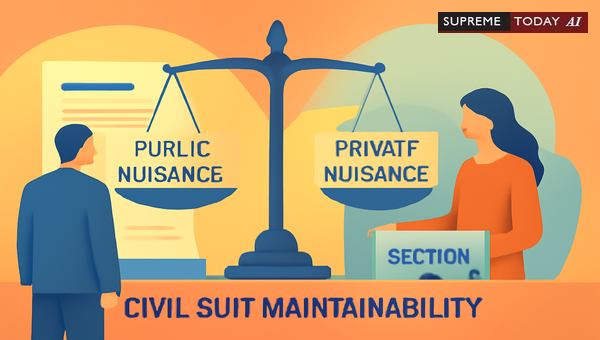
    The cornerstone distinction lies between public and private nuisances:

    Courts have ruled that long-standing issues without imminent public harm should go to civil courts: If a nuisance has existed for a long time without any immediate danger, the proper course of action is to seek relief through civil courts rather than through Section 133 CrPC TATA TELE SERVICES LTD. VS STATE OF UTTAR PRADESH - 2006 0 Supreme(All) 59KARAM HUSSAIN VS STATE OF U P

  • Allahabad
  • .

    Moreover, Maintainability of civil suits when remedy under Section 133 Cr.P.C. exists - Courts have consistently held that if a civil dispute or private right is involved, the civil remedy is preferred, and proceedings under Section 133 Cr.P.C. are not maintainable or appropriate Pathamuthu vs The District Collector - MadrasVenkatappa vs Maramma Devaru - KarnatakaMunshi Prasad, Son of Late Satya Narayan Mahto VS State of Bihar through District Magistrate, Saran at Chapra. Bihar - Patna.

    Judicial Precedents and Case Law

    Indian courts have clarified this through numerous rulings:

    1. Pendency of Civil Suit: The pendency of a civil suit should be considered as evidence supporting the denial of public rights in proceedings under Section 133, and the Magistrate may be directed to stay proceedings until the civil suit is resolved BRAHMANAND RAI VS STATE OF UTTAR PRADESH - Allahabad.

    2. Property Rights Excluded: In disputes over sub-tenancy or injunctions, civil courts affirm maintainability: Under section 9 of CPC, it is the duty of the civil court to try all civil suits unless barred... Since no other remedy is available to the plaintiff to get the relief sought in the suit, so, the suit is maintainable Arun Khurmi VS Sanjana Sood - 2024 Supreme(P&H) 856 - 2024 0 Supreme(P&H) 856.

    3. No Bar from Special Remedies: Even where special statutes exist, civil suits proceed unless expressly barred, as seen in challenges under Companies Act or land codes: The suit is not maintainable in Civil Court, as special remedy is available under the provisions of the Companies Act—but this was contested, highlighting case-specific analysis N. Ramji VS Ashwath Narayan Ramji - 2017 Supreme(Mad) 1208 - 2017 0 Supreme(Mad) 1208. Similarly, for Bhumiswami rights: Whether the civil suit for declaration of Bhumiswami right and injunction which has been directly filed in the Civil Court is maintainable without availing the remedy under Section 57 (2) of the Code or not? State of M. P. VS Radhika Prasad - 2012 Supreme(MP) 356 - 2012 0 Supreme(MP) 356State of M. P. VS Radhika Prasad - 2012 Supreme(Chh) 141 - 2012 0 Supreme(Chh) 141.

    4. Exceptions for Public Interest: Section 133 may apply in genuine public threats, but even then, if the dispute is primarily civil or private, civil courts are the appropriate forum SMT NETRAMMA vs PAKEERAPPA S/O PAKEERAPPA - KarnatakaAnwar Uddin Barbhuiya, S/o- Late Tazamul Ali Barbhuiya vs State of Assam Represented By The Public Prosecutor - Gauhati.

    These precedents reinforce that civil suits are typically maintainable and preferred for private matters.

    Strategic Considerations for Litigants

    • Assess the Nature: Is it public (imminent harm to many) or private (your property rights)? Opt for civil suit in the latter.
    • Parallel Proceedings: File civil suit first; it can influence or stay CrPC actions.
    • Evidence Gathering: Document long-standing nature to argue against Section 133.
    • Monitor Outcomes: It is advisable to monitor the proceedings under Section 133 if a civil suit is pending, as the outcomes may influence the civil litigation strategy.

    If public elements exist, consider both remedies judiciously, but prepare for courts directing you to civil forums.

    Conclusion and Key Takeaways

    In summary, a civil suit is maintainable even where a remedy under Section 133 CrPC exists, especially for private disputes, property rights, or non-emergent issues. Section 133 is no substitute for civil adjudication: Proceedings under Section 133 Cr.P.C. are intended for urgent public nuisances and not as a substitute for civil litigation. When a civil remedy exists... civil suits are maintainable and preferred Bhagwan Laxmi Narain Mandir Trust Situate At Mohalla VS State Of U. P. - AllahabadChandrawati Devi VS State of Madhya Pradesh - Madhya PradeshVenkatappa vs Maramma Devaru - Karnataka.

    Key Takeaways:- Prioritize civil courts for private nuisances.- Use Section 133 only for genuine public emergencies.- Leverage pendency of civil suits to manage CrPC proceedings.- Always seek professional legal counsel tailored to your facts.

    This framework empowers informed decisions in your legal journey. Stay updated on evolving jurisprudence! CHANDRA KANTA JAWAHAR VS ADDL SESSIONS JUDGE KANPUR - AllahabadBUDHWA VS STATE OF U. P. - AllahabadTATA TELE SERVICES LTD. VS STATE OF UTTAR PRADESH - 2006 0 Supreme(All) 59BRAHMANAND RAI VS STATE OF UTTAR PRADESH - Allahabad.

    (Word count: 1028. This post is for informational purposes only and does not constitute legal advice.)

    #Section133CrPC, #CivilSuit, #LegalRemedies
    Chat Download
    Chat Print
    Chat R ALL
    Landmark
    Strategy
    Argument
    Risk
    Chat Voice Bottom Icon
    Chat Sent Bottom Icon
    SupremeToday Portrait Ad
    logo-black

    An indispensable Tool for Legal Professionals, Endorsed by Various High Court and Judicial Officers

    Please visit our Training & Support
    Center or Contact Us for assistance

    qr

    Scan Me!

    India’s Legal research and Law Firm App, Download now!

    For Daily Legal Updates, Join us on :

    whatsapp-icon telegram-icon
    whatsapp-icon Back to top