




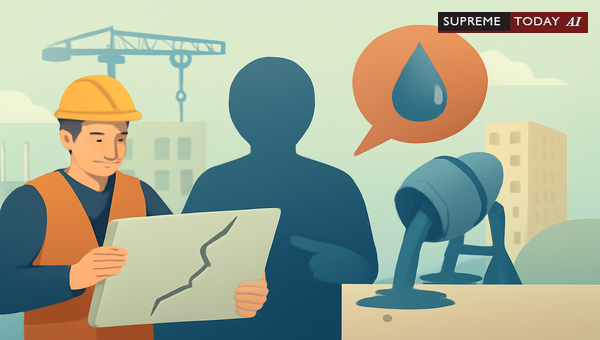
Contractor Liable for Substandard Building Work Without Water Scarcity?
In the construction industry, quality is non-negotiable. Imagine hiring a contractor to build your dream structure, only to discover substandard work—like inadequate curing of concrete (CC work) due to claims of water shortage, even when water is plentiful. This scenario raises a critical question: the contractor is constructing a building in a substandard manner and even without scarcity of water as not enough for curing the cc work. Does this constitute a ? Generally, yes, and it can lead to serious legal repercussions.
This blog delves into the legal principles governing construction quality, the role of resource management like water for curing, and contractor accountability. Drawing from judicial precedents, we'll explore when substandard work triggers liability, especially absent genuine excuses like scarcity. Whether you're a property owner, contractor, or project manager, understanding these nuances can prevent disputes and ensure compliance.
What Constitutes ?
occurs when work deviates from agreed specifications, using inferior materials, unskilled labor, or improper techniques. For concrete curing, water is essential to prevent cracks and ensure strength—typically requiring consistent moisture for 7-28 days depending on conditions. Claiming not enough water without actual scarcity often signals .
Legal documents emphasize that construction must adhere to contractual specifications and standards2004 0 Supreme(Gau) 432. In one case, the court highlighted that using substandard materials or poor workmanship, especially if not due to scarcity but due to or , can be grounds for contractual breach 2004 0 Supreme(Gau) 432. This principle holds even if resources like water are available but mismanaged.
Contractor's Contractual Obligations and Quality Standards
Contracts typically mandate high-quality execution. Construction in accordance with contractual specifications and standards is mandatory2004 0 Supreme(Gau) 432. Failure to meet these—such as skimping on water for curing despite availability—breaches the agreement.
Courts have consistently ruled that deviations without justification invite liability. For instance, in scenarios involving inferior materials despite instructions for quality, contractors faced penalties 2004 0 Supreme(Gau) 432. Similarly, proper supervision and maintaining quality standards are essential, and failure to do so may amount to or 2012 0 Supreme(Gau) 1295.
Integrating broader case law, design flaws can sometimes absolve contractors. In a check dam project, the court found design deficiencies rather than construction errors absolve the contractor from liability, entitling him to payment for completed works
. Here, leakage stemmed from flawed specifications, not execution. However, this doesn't apply to like ignoring available water resources.
Water Scarcity Claims: Valid Excuse or Evasion?
Water scarcity isn't directly addressed in many documents, but related cases illuminate the issue. Unauthorized resource use, like drawing well water without permission leading to depleted levels, exemplifies breach through mismanagement 1962 0 Supreme(SC) 315. If scarcity is feigned—even without scarcity of water—it strengthens claims of .
One project halted due to resident concerns over a deep well causing water scarcity in the neighborhood2022 Supreme(Online)(KER) 40990, underscoring that resource impacts must be managed legally. Conversely, in soil-related disputes, contracts accounted for site conditions like shiny and slushy nature of the soil, but extra payments required compliance 2026 Supreme(Online)(Ker) 7182. Fabricating scarcity to justify poor curing won't hold; courts scrutinize intent.
Supervision, Accountability, and Resource Management
Effective oversight is key. Failure to supervise properly and maintain quality standards constituting 2012 0 Supreme(Gau) 1295 often results from absent engineers-in-charge. In a building case, a project engineer objected to substandard work by the contractor, leading to disputes 2014 0 Supreme(All) 1032. Proper supervision prevents such issues.
Other precedents reinforce this. Public servants and contractors faced charges for substandard materials not per specs, with certain works... not to the specification of the contract, but... of substandard materials
. In cases involving unwarranted extra work, prosecutions hinged on proving bills for unexecuted or subpar tasks 2017 0 Supreme(Mad) 4169.
Notably, owners or architects aren't always liable if contractors handle execution. Excavation accidents were attributed to contractors, not principals, absent direct nexus to 2020 0 Supreme(Kar) 1548. There must be a direct nexus between the and the consequences2020 0 Supreme(Kar) 1548.
Legal Consequences of Substandard Work
Breaches can lead to penalties, termination, or lawsuits. Constructing in a substandard manner without valid reason (e.g., genuine scarcity) can lead to contractual penalties, termination, or legal action2004 0 Supreme(Gau) 432. Courts may order payments withheld or damages awarded.
In corruption cases, misusing positions for substandard payments triggered charges, with elements of conspiracy established through actions... in executing supplemental agreements not supported by legitimate claim2026 Supreme(Online)(Ker) 7182. Heavy fines and imprisonment followed. Similarly, tender non-compliance in government buildings caused financial loss probes
.
Disciplinary actions arise too, as in transfer disputes over irregularities 2014 0 Supreme(All) 1032. may apply, but courts uphold contract terms like deposits for claims 2009 0 Supreme(SC) 346.
Case Studies: Lessons from the Bench
- Design vs. Execution: Contractor cleared in dam leakage due to specs, paid fully
.
- Substandard Billing: Falsely claimed work led to acquittals on doubtful evidence, but vigilance urged 2017 0 Supreme(Mad) 4169.
- Resource Projects: Water schemes stalled for environmental clearance amid scarcity fears 2019 Supreme(Online)(NGT) 300.
These illustrate courts' focus: genuine compliance shields; exposes.
Recommendations for Stakeholders
- Contractors: Adhere strictly to specs, document resource use, ensure curing protocols.
- Clients/Supervisors: Implement robust oversight, verify claims like water scarcity.
- All Parties: Include clear clauses on quality, resources, and dispute resolution.
Authorities should challenge deviations via penalties 2004 0 Supreme(Gau) 432.
Key Takeaways
- Substandard work without genuine scarcity breaches contracts 2004 0 Supreme(Gau) 432.
- Supervision failures equal 2012 0 Supreme(Gau) 1295.
- Resource mismanagement invites scrutiny 1962 0 Supreme(SC) 315.
In conclusion, while challenges like site conditions exist, feigned excuses undermine projects. Consult professionals for specifics—this is general information, not legal advice. Stay compliant to build safely and sustainably.
References:1. 2004 0 Supreme(Gau) 432 - Contractual standards and substandard materials.2. 2012 0 Supreme(Gau) 1295 - Supervision duties.3. 1962 0 Supreme(SC) 315 - Resource use breaches.4. Additional cases as cited.
#ConstructionLaw, #ContractorLiability, #BuildingStandards















