


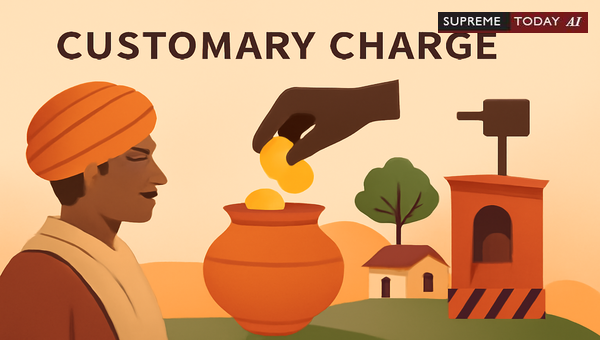
Customary Charges in Indian Law: Key Insights
In the diverse legal landscape of India, where traditions and statutes often intersect, the concept of a frequently arises. But what exactly is a ? It refers to a fee or payment traditionally accepted within a specific community or legal framework, often recognized by courts if rooted in long-standing practices. Whether you're a landowner dealing with historical rights, a community member involved in local tolls, or simply curious about how customs shape modern law, understanding customary charges is crucial.
This blog dives deep into the definition, key court rulings, and broader applications, drawing from landmark judgments and related cases. We'll explore how courts balance tradition with statutory limits, ensuring you grasp the nuances without needing a law degree.
Defining Customary Charges
A is a fee or payment rooted in local practices and traditions that courts have acknowledged. In Indian law, these charges gain legal weight when consistently observed and not contrary to public policy or statutes. They appear in contexts like charity collections, tolls, property rights, and even marriages or temple rituals.
For instance, courts have upheld such charges when they align with community norms, but they impose checks to prevent overreach. This balance is evident in various judgments, highlighting that while customs endure, they must conform to constitutional and statutory frameworks.
Landmark Cases on Customary Charges
Indian courts have addressed customary charges in multiple scenarios. Here are pivotal examples:
1. Charge for Charity
The term denotes a for charity, quantified at 2 annas per 100 rupees. In one case, it amounted to Rs. 22-8.0, and respondents agreed to bear it, reducing the decree amount accordingly. 1917 0 Supreme(Mad) 376
This illustrates how courts recognize and enforce traditional fees when parties consent and practices are established.
2. Collection Practices
collections have acquired a force of law under . However, a lacked authority to set up a parallel check post for vehicle fees on minerals, showing limits on such practices. 2019 0 Supreme(Megh) 167
3. Rights and Customary Supplies
Restoration of included all customary rights and easements, entitling the Zemindar to supplies like water for tanks. This underscores customary charges' role in property and resource management. 1904 0 Supreme(Mad) 1
4. Santhal Customary Laws in Inheritance
The High Court recognized customary laws among the Santhal community for inheritance, emphasizing their legal significance in rights and privileges. 2008 0 Supreme(Jhk) 1446
Broader Applications from Related Cases
Customary charges extend beyond fees to rights in land, marriage, temples, and more. Integrating insights from additional sources reveals a consistent judicial approach: proof and statutory alignment are key.
Customary Rights vs. Easements
is different from . Origin of such is in . Farmers couldn't use cultivated land as pathways, even if habituated over years, as it stemmed from necessity, not pure custom. 2014 0 Supreme(Bom) 563 2014 0 Supreme(Bom) 558
Customary Practices in Marriages and Divorce
Hindu customary marriages, involving rites like tying a thali, are legally binding and indissoluble without court decree. A Hindu customary marriage cannot be dissolved in any other way than by decree of a Court.
requires community proof via judgments; unproven claims fail. 2025 0 Supreme(Ker) 2671 2025 Supreme(Online)(Del) 9819 2025 Supreme(Online)(MP) 9469
Temple Rites and Community Customs
Disputes over temple practices, like deity processions, hinge on proven customs. The petitioner has claimed relief based on the custom prevalent in the Karimuttom Devi Temple, and he asserts that the said customary rites are violated. 2025 Supreme(Online)(Ker) 55758 2023 0 Supreme(Megh) 24
Land Rights and Registration
don't override registered titles without gazettement under statutes like the .
Other Contexts: Banking and Transport
Banks may apply if agreed, but not overriding contracts.
In transport, rules may require carriages to accept . 2011 0 Supreme(MP) 1095
Key Takeaways on Customary Charges
- Recognition Criteria: Customary charges are enforceable if community-established and not statutorily barred. Courts demand evidence like past judgments or consistent practice.
- Limitations: Practices can't bypass authority; e.g., no parallel tolls without power. 2019 0 Supreme(Megh) 167
- Property Impact: and easement cases show customs integral to resource rights. 1904 0 Supreme(Mad) 1 2014 0 Supreme(Bom) 563
- Personal Laws: Marriages and divorces under custom need ritual proof and court validation.
- Proof Burden: Establishing a requires proof of community recognition through judgments or past instances. 2025 0 Supreme(Ker) 2671
Conclusion: Navigating Customary Charges Today
Customary charges remain vital in Indian law, bridging tradition and modernity. From fees 1917 0 Supreme(Mad) 376 to temple rites 2025 Supreme(Online)(Ker) 55758, courts uphold them with evidence while enforcing limits under statutes like Article 372. 2019 0 Supreme(Megh) 167
Important Disclaimer: This post provides general information based on judicial precedents and is not legal advice. Consult a qualified lawyer for case-specific guidance, as outcomes depend on facts and jurisdiction.
For legal strategies, assess customary practices against statutes early. Stay informed—customs evolve with case law.
References:- 1917 0 Supreme(Mad) 376 2019 0 Supreme(Megh) 167 1904 0 Supreme(Mad) 1 2008 0 Supreme(Jhk) 1446-
2025 Supreme(Online)(Ker) 55758 2014 0 Supreme(Bom) 563 2014 0 Supreme(Bom) 558 2011 0 Supreme(MP) 1095
2025 0 Supreme(Ker) 2671 2025 Supreme(Online)(Del) 9819 2025 Supreme(Online)(MP) 9469
2023 0 Supreme(Megh) 24
#CustomaryLaw, #IndianCourts, #LegalRights















