


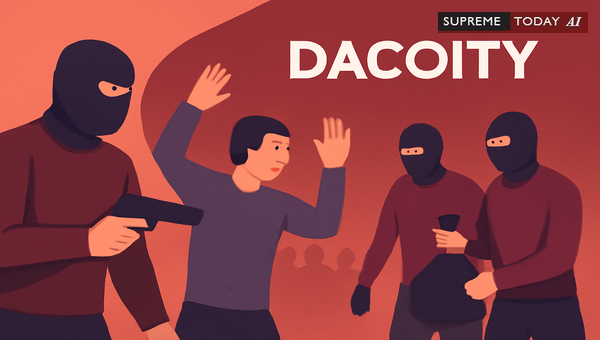
Understanding the Essential Ingredients of Under the
is one of the most serious offences under the (), often evoking images of organized gang robberies that terrorize communities. But what exactly constitutes legally? If you've ever wondered about the essential ingredients of , this post breaks it down based on judicial interpretations and statutory provisions. Whether you're a law student, legal professional, or simply curious about criminal law, understanding these elements is crucial for grasping how courts establish liability in such cases.
Defined under , elevates to a graver offence when committed by a group. We'll explore the core requirements, supported by key court rulings, and touch on related concepts like preparation and .
What Are the Essential Ingredients of ?
The offence of requires specific elements to be proven . Courts have consistently outlined these as follows:
- Five or more persons acting : The act must involve at least five individuals acting in association. 1956 0 Supreme(SC) 74 2023 0 Supreme(Del) 922 1974 0 Supreme(Ker) 254
- Commission or : The group must either commit or make an attempt to do so. 1956 0 Supreme(SC) 74 2023 0 Supreme(Del) 922
- Participation as or : All involved persons must either directly commit/attempt the or aid it while present. 1956 0 Supreme(SC) 74 1974 0 Supreme(Ker) 254
- In pursuance of the of the : The actions must align with a shared unlawful purpose. 1956 0 Supreme(SC) 74 2024 0 Supreme(Chh) 479
As judicially defined: When five or more persons commit or attempt to commit a , or where the whole number of persons committing or attempting to commit a , and persons present and aiding such commission or attempt, amount to five or more, every person so committing, attempting or aiding, is said to commit . 1956 0 Supreme(SC) 74 2023 0 Supreme(Del) 922 1974 0 Supreme(Ker) 254
The Role of '' and Group Size
The emphasis on '' or 'jointly' is pivotal. Mere presence isn't enough; there must be united or concerted action towards the . In one case, the court acquitted appellants under , noting: if that act is dissociated from the , it cannot be brought home to the other members. It follows that the ingredients essential to constitute the offence of are absent in this case, even accepting the prosecution case in toto. 2007 0 Supreme(Bom) 780
This highlights that the prosecution must prove active participation by at least five persons, either as major actors or : The section contemplates actual participation by every one of the five or more persons in the commission of the either as or as major actors. 1974 0 Supreme(Ker) 254
Detailed Breakdown: Participation and
1. Number of Persons and Aiding
The group must total five or more, including those aiding: Persons present and aiding such commission or attempt, amount to five or more. 1956 0 Supreme(SC) 74 Even if some flee without loot, an attempt suffices if done . 1956 0 Supreme(SC) 74 2004 0 Supreme(Gau) 490
2. Commission or Attempt of
under involves theft with violence or threat. covers both successful and attempts: There was, in the circumstances of the present case an by the appellant and his companions though in fact no was committed. 1956 0 Supreme(SC) 74
3. of
Tied to , the must be proven. In related cases, courts stress: In the facts of a case, the essential ingredients of Section 149, however, have to be amply established. 2020 0 Supreme(All) 374 2020 0 Supreme(All) 402 Without shared intent, liability fails, as seen where firing was deemed self-defense rather than pursuit. 2020 0 Supreme(All) 402
The offence is complete when the group acts in accordance with the , whether directly or by aiding others. 1956 0 Supreme(SC) 74
Exceptions, Limitations, and Related Offences
No blanket exceptions exist, but proof gaps—like insufficient evidence of five persons or —lead to acquittals. For instance, preparation for () requires showing habitual offenders or gang association: shows that they are habitual offender and intent to commit ... whoever, at any time after the passing of this Act, shall belong to a gang of persons associated... 2025 Supreme(Online)(Kar) 32306
In a case under Sections 399/400, acquittal followed due to uncorroborated testimonies and contradictions. 2025 Supreme(Online)(Kar) 32306
with murder () or preparation demands stricter proof, but core ingredients remain anchored in Section 391.
Prosecution's Burden and Judicial Insights
To convict:- Evidence must show at least five persons in concert. 1956 0 Supreme(SC) 74- Examine ' roles and links. 1974 0 Supreme(Ker) 254- Attempts without loot can still qualify if conjoint. 1956 0 Supreme(SC) 74
Courts reinforce: Judicial decisions reinforce these principles, clarifying that the offence of is established when five or more persons act in concert, with participation either as or , in the commission or attempt of a , in pursuance of a shared . 1956 0 Supreme(SC) 74 2023 0 Supreme(Del) 922 1974 0 Supreme(Ker) 254
Practical Recommendations for Legal Practice
- For Prosecutors: Corroborate witness accounts; resolve inconsistencies early.
- For Defense: Challenge group size, intent, or via contradictions.
- Evidence Tip: Even flight post-attempt can indicate if tied to .
Key Takeaways
- Core Formula: 5+ persons + conjoint /attempt + principal/aider roles + .
- demands more than isolated —group dynamics are key.
- Related sections (149, 395, 399) amplify but hinge on these basics.
In conclusion, the essential ingredients of are a group of five or more persons acting jointly, either committing or attempting to commit a , with participation as or , all sharing a , and such acts connected to that object. 1956 0 Supreme(SC) 74 2023 0 Supreme(Del) 922 1974 0 Supreme(Ker) 254
This post provides general insights based on judicial precedents and is not legal advice. Consult a qualified lawyer for case-specific guidance. References include key documents like 1956 0 Supreme(SC) 74, 2023 0 Supreme(Del) 922, 1974 0 Supreme(Ker) 254, 2007 0 Supreme(Bom) 780, 2025 Supreme(Online)(Kar) 32306, 2020 0 Supreme(All) 374, and 2020 0 Supreme(All) 402.
#DacoityLaw, #IPC391, #CriminalLawIndia












