


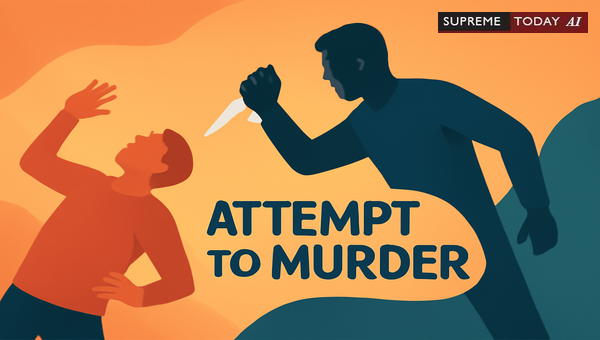
Does 'Dashing a Person by the Bye' Constitute Attempt to Murder Under IPC Section 307?
In the realm of criminal law, everyday language can sometimes blur into legal interpretations, leading to complex questions about liability. Imagine a scenario where someone is described as having dashed a person by the bye – a phrase suggesting a sudden, forceful collision or strike, perhaps in passing. Does this simple act automatically trigger the grave charge of attempt to murder under ?
This blog post delves into this intriguing legal query, examining the nuances of intent, overt acts, and judicial precedents. Whether you're a law student, legal professional, or simply curious about criminal liability, understanding these elements is crucial. Note that this is general information and not specific legal advice – consult a qualified lawyer for personalized guidance.
Understanding the Phrase Dashed a Person by the Bye
The term dashed typically implies a sudden, forceful impact, like a blow, shove, or collision. By the bye adds a sense of casualness or incidentally, evoking an abrupt act without premeditation. But in criminal law, words matter less than context.
The key question is: Whether the word 'dashed a person by the bye' can attract the offence of attempt to murder? On its own, no. The phrase does not inherently carry the weight of murderous intent. Courts scrutinize the surrounding circumstances, including the nature of the act, weapons involved (if any), and the accused's mindset. Mere physical contact, even forceful, rarely suffices without more.
Legal Framework: – What Constitutes Attempt to Murder?
punishes whoever does an act with intention or knowledge that, if it caused death, would amount to murder. Punishment can extend to life imprisonment or up to 10 years, even if death doesn't occur.
The core ingredients are:- (): Intention to cause death or knowledge that the act is likely to cause death 2025 0 Supreme(SC) 1677.- (guilty act): An in execution of that intent 2008 0 Supreme(SC) 1049 2025 0 Supreme(SC) 1677.
As clarified, the most important ingredient for attempt to murder is intention or knowledge and that the act must be done in furtherance of that intent 2025 0 Supreme(SC) 1677. Importantly, an attempt in order to be criminal need not be penultimate – meaning it doesn't have to be the last step before death; any coupled with the right mindset qualifies 2025 0 Supreme(SC) 1677 2008 0 Supreme(SC) 1049.
When Does Dashing Cross into Attempt to Murder Territory?
A forceful dash – say, with a vehicle, fist, or object – may be capable of causing death depending on force, location, and vulnerability. However, liability hinges on context:
- With requisite intent/knowledge: If done deliberately to kill, yes. For instance, ramming a vehicle at high speed into someone during a quarrel could qualify 2025 0 Supreme(Ori) 72.
- Without : An accidental bump or reflexive strike in self-defense typically falls under lesser offences like (voluntarily causing hurt) or 324 (with dangerous weapons) 2025 0 Supreme(SC) 1677.
Courts emphasize: The act must be done with the intention or knowledge that it could cause death or such bodily injury as is likely to cause death 2025 0 Supreme(SC) 1677. Mere striking doesn't automatically elevate to Section 307 unless evidence shows murderous intent 2008 0 Supreme(SC) 1049.
Insights from Judicial Precedents
Indian courts have consistently stressed intent over the act alone. In one ruling, to justify a conviction under , it is not essential that bodily injury capable of causing death should have been inflicted – intent plus suffices 2008 0 Supreme(SC) 1049.
Related cases reinforce this:- In assaults involving knives during house trespass (), conviction upheld where the nature and manner of the attack demonstrated the accused's intention to cause serious harm 2025 0 Supreme(Ker) 2460 2025 Supreme(Online)(Ker) 26446. Victim testimony sufficed, even without independent witnesses, as intent was inferred from grievous injuries.- Conversely, where injuries weren't fatal and no clear intent to kill existed, charges reduced to IPC. There was no intention of the accused appellants to kill the injured – considering trivial disputes and non-lethal weapons like scissors 2021 0 Supreme(All) 644.- in Sarju Prasad v. (AIR 1965 SC 843) held: to attract the provisions of Sec.307 IPC, the prosecution is to establish the intention of the accused that the injury which was caused was one of the kinds referred in Sec.300 IPC 2010 0 Supreme(P&H) 2548 2010 0 Supreme(P&H) 356.
These precedents show courts analyze totality: weapon, injury severity, prior enmity, and escape attempts by the victim.
Exceptions and Limitations: When It Doesn't Apply
Not every dash is an attempt to murder. Key exceptions include:- Accidental or negligent acts: No , so perhaps (causing death by negligence) 2025 0 Supreme(SC) 1677.- Minor injuries: If not likely to cause death, lesser charges apply. The act must be capable of causing death or such injury as is likely to cause death. If the impact is minor or accidental, it does not meet the threshold 2025 0 Supreme(SC) 1677.- Lack of overt intent: Threats alone or non-lethal scuffles don't qualify. In , courts note: Merely because accused is stated to be carrying a pistol and had threatened to fire an inference cannot be drawn that he had intention to commit offence of murder 2010 0 Supreme(P&H) 356.
Compromises in personal disputes can lead to quashing, prioritizing peace where intent isn't proven 2010 0 Supreme(P&H) 2548.
Practical Recommendations for Legal Practitioners
- Focus on evidence: Gather witness statements, medical reports, and forensics to prove/disprove .
- Contextual analysis: Argue based on circumstances – was it a heated quarrel or cold-blooded attack?
- Charge framing: Prosecutors must show the act, if fatal, would be murder under 2017 0 Supreme(J&K) 442.
Key Takeaways
- Dashed a person by the bye may attract only if accompanied by intention/knowledge to cause death and an in furtherance2025 0 Supreme(SC) 1677 2008 0 Supreme(SC) 1049.
- Isolated acts without murderous mindset lead to lesser offences.
- Judicial wisdom: Intent is king; acts are contextual.
In conclusion, language like dashed a person by the bye doesn't standalone condemn someone to attempt to murder charges. Courts demand proof of deadly intent. This analysis draws from established precedents, but laws evolve – always seek expert advice for specific cases. Stay informed, stay safe.
This post is for informational purposes only and does not constitute legal advice.
#IPC307, #AttemptToMurder, #CriminalLawIndia















