


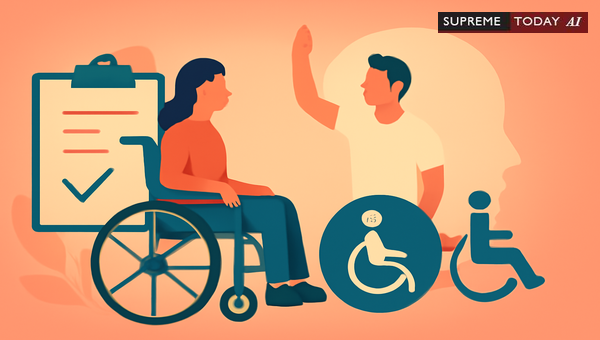
Understanding Definition in Indian Law
In today's diverse society, understanding legal protections for persons with disabilities is crucial. What exactly constitutes under Indian law? This question often arises for individuals seeking benefits, accommodations, or advocacy. This blog post delves into the definition of , drawing from key legislation like the , and related judgments. We'll explore definitions, legal frameworks, assessments, and practical implications.
Note: This article provides general information based on legal provisions and judgments. It is not a substitute for professional legal advice. Consult a qualified lawyer for specific cases.
What is the Definition of ?
The term Multiple Disability Definition Judgment refers to judicial and statutory interpretations clarifying when a person qualifies as having . Under Indian law, are explicitly recognized as a distinct category.
According to , mean the presence of more than one of the 2021 4 Supreme 330. This builds on the broader , defined in as disabilities specified in the Schedule with at least 40% impairment 2021 0 Supreme(SC) 338.
in the Schedule
The Schedule to the RPWD Act lists various categories:- Physical Disabilities: Locomotor disability, visual impairment, hearing impairment, speech and language disability.- Intellectual Disabilities: Specific learning disabilities, autism spectrum disorder.- Mental Illness: Recognized as a standalone specified disability.- Chronic Neurological Conditions: Multiple sclerosis, Parkinson’s disease, and others 2021 4 Supreme 330.
These expand on earlier laws like the (PWD Act), where Section 2(i) defined disabilities including blindness, low vision, leprosy-cured, hearing impairment, locomotor disability, mental retardation, and mental illness 2013 8 Supreme 721.
arise from a combination of two or more such impairments, as noted in older provisions: '' means a combination of two or more disabilities as defined in clause (i) of section 2 of the Person with Disabilities (Equal Opportunities, Protection of Rights and Full Participation) Act, 2020 0 Supreme(Del) 75.
Legal Framework Governing
The RPWD Act, , marks a progressive shift, broadening disability to include long-term physical, mental, intellectual or sensory impairments which, in interaction with barriers, hinder full and effective participation in society on an equal basis with others 2021 0 Supreme(SC) 338. This Act repeals the PWD Act, , but references persist in transitional cases.
Supporting laws include:- : Defines and addresses specific like autism combined with others 2016 0 Supreme(Guj) 136.- : Intersects with mental illness as a component of .
Government obligations under the RPWD Act emphasize equality, non-discrimination, and accommodations for those with . Courts have reinforced this in various contexts.
Judicial Interpretations and Key Judgments
Indian courts have clarified through practical applications, emphasizing cumulative impact over isolated assessments.
Assessment of Disability Impact
Disability evaluation must consider interaction of impairments and their effect on societal participation 2021 0 Supreme(SC) 338. In motor accident compensation cases, courts assess based on occupation: A disability cannot correctly be assessed only in terms of a percentage point in relation to the rest of the body, but must be assessed by seeing whether, as a result of that disability, the injured is able at all to perform the job or vocation for which he is trained or in which he is skilled 2017 0 Supreme(Bom) 2133 2017 0 Supreme(Bom) 2112.
For instance, a driver losing a leg may have 100% functional disability, even if physical percentage is lower, leading to higher compensation 2017 0 Supreme(Bom) 2133. This principle applies analogously to , where combined effects amplify limitations.
Guardianship and Financial Rights
In a PPF account case, courts rejected rigid guardianship requirements under repealed acts, appointing family as guardians for a comatose person, highlighting protections for those with severe disabilities potentially including multiples 2020 0 Supreme(Del) 75. The decision analyzed statutes like the National Trust Act, , and RPWD Act, , deeming old certificate demands untenable.
Pension and Welfare Benefits
Pension rights for mentally retarded individuals (often part of ) require expert certification, not subjective judgments. One court quashed a pension discontinuation, directing review under 2016 0 Supreme(Guj) 136.
Reservation and Employment
Reservation under PWD Act (3% quota) includes . A case clubbed visual (30%) and locomotor (15%) disabilities to qualify, despite debates on aggregation 2014 0 Supreme(Kar) 606.
Rights and Benefits for Persons with
Individuals with access:- Benchmark status for reservations in education, employment (4% under RPWD Act).- Government schemes: Accommodations, aids, priority in housing/transport.- Legal safeguards: Against discrimination, with mandatory accessibility.
Recommendations for assessment:- Evaluate cumulative impact of disabilities.- Use certified medical boards for certification.- Advocate for holistic support systems.
Challenges and Practical Considerations
Challenges include transitional issues from PWD Act to RPWD Act, where definitions like tied to repealed sections cause confusion 2020 0 Supreme(Del) 75. Insurance contexts, like , mirror by focusing on inability to work in any occupation
.
Courts stress : In a situation like this, the disability must be assessed on multiple factors. One of these factors must necessarily be the nature of occupation or employment of the injured 2017 0 Supreme(Bom) 2112.
Conclusion and Key Takeaways
India's legal framework, led by the RPWD Act, , robustly defines and protects persons with —more than one specified impairment hindering participation. Key takeaways:- Seek benchmark certification for 40%+ cumulative disability.- Leverage judgments emphasizing functional impact over percentages.- Advocate proactively for accommodations and benefits.
Understanding these nuances empowers individuals and practitioners. For tailored guidance, reach out to legal experts specializing in disability rights.
This post is for informational purposes only and reflects general interpretations as of the latest available data.
#MultipleDisabilities, #RPWDAct, #DisabilityRightsIndia















