


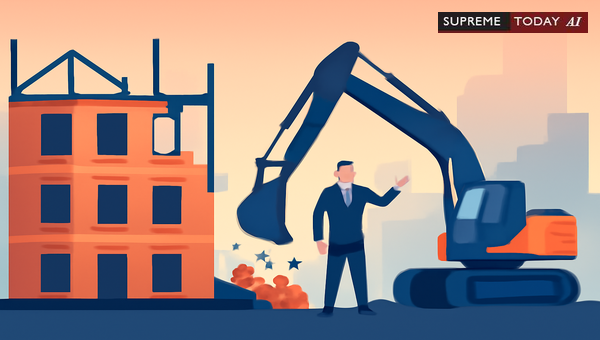
Removal of Agents: Legal Guide
In the fast-paced world of real estate and urban development, ensuring compliance with building laws is crucial. But what happens when construction agents exceed their authority or engage in illegal activities? The question arises: Constrection Agents by Laws will be Removed—a shorthand for whether bylaws and statutes mandate the removal of agents.
This blog post delves into the legal framework governing such scenarios, drawing from judicial precedents and statutory provisions. While this provides general insights, it is not legal advice—consult a qualified attorney for specific cases.
Main Legal Finding
Legal provisions and judicial directions typically emphasize that agents acting beyond their lawful authority, particularly in construction and development, must be removed or held accountable for illegal acts. The law generally mandates that unauthorized agents or persons executing construction in violation of , , or are subject to removal, demolition, or legal action. Authorities are empowered—and often required—to act decisively to uphold planned development and the . 2024 0 Supreme(SC) 1199 2018 0 Supreme(Jhk) 481
Key Points on Agent Removal and Demolition
- Mandatory Action by Authorities: Governments and municipal bodies must remove or demolish unauthorized constructions and hold illegal agents accountable. This is reinforced by directives. 2024 0 Supreme(SC) 1199 2018 0 Supreme(Jhk) 481
- Prohibition of Illegal Activities: is strictly prohibited, with removal mandated to protect urban planning. 2024 0 Supreme(SC) 1199 2025 0 Supreme(Mad) 3750
- Judicial Reinforcement: Courts consistently order demolition of illegal structures built by agents without proper authority, ensuring those responsible face consequences. 2024 0 Supreme(SC) 1199 2018 0 Supreme(Jhk) 481
These principles aim to prevent haphazard development and enforce accountability.
Detailed Analysis: Authority to Remove Unauthorized Agents
Obligation Under Law
Courts have clearly established that agents involved in are liable for removal. The has directed that illegal constructions violating sanctioned plans or building laws must be demolished, binding authorities to act. Unauthorized works, whether by direct action or rogue agents, undermine urban planning and must be dismantled. 2024 0 Supreme(SC) 1199 2018 0 Supreme(Jhk) 481
For instance, in cases involving on government land, statutes like Section 248 of relevant codes allow of unauthorized occupants, with buildings removed at the encroacher's expense if not self-removed. AS far the contention of the plaintiff that the provisions of are not applicable to building, property etc. , a bare reading of goes to show that any person who is in unauthorized occupation of any land which is the property of the Government, may be summarily ejected and any building or other works which he may have constructed thereon, if not removed by him. may be removed by the State at the expense of the encroacher. 2005 0 Supreme(Chh) 343
Judicial Precedents
Judicial rulings provide strong backing. Under the Act, courts have ordered demolition of illegal constructions, declaring unauthorized acts must be rectified by removal. 2025 0 Supreme(Kar) 296
The in stressed ruthless demolition of illegal constructions by builders or agents violating plans, urging decisive authority action. 2018 0 Supreme(Jhk) 481
Relatedly, in land acquisition disputes, releasing acquired land to private builders after declaring a has been quashed as , emphasizing strict adherence to and demolition where unauthorized. Power of acquisition not exercised for is vitiated by concept of colourable exercise of power--Exercise of such power not only ultravires the Act but also hit by , 21 and 300-A. 2009 0 Supreme(P&H) 2117
In another context, agents committing torts in construction face , as per common law principles: The Common Law liability of agents who commit torts are clearly stated in ...
While removal is mandated, procedural fairness is key. Demolition requires prior notices, hearings, and documentation to prevent abuse. Authorities must follow these steps, ensuring no collusion. 2024 0 Supreme(SC) 1199 2018 0 Supreme(Jhk) 481
Exceptions are limited; there's no general provision to retain unauthorized agents or structures. In cases over disputed lands, courts deny relief to encroachers, prioritizing public interest. For example, plaintiffs failing to prove cases against state removal orders lose injunction bids, especially with alternative accommodations offered. 2005 0 Supreme(Chh) 343
Integrating Broader Legal Contexts
Agent accountability extends beyond construction. In scenarios, revoking unauthorized agents is common, as seen in suits where new agents replace former ones amid . 2021 0 Supreme(Mad) 3049
Environmental and contract laws also intersect: by agents outside authority don't bind principals, and violations trigger removal. Further, under , acts of and frauds by agents in matters which do not fall within their authority do not affect the principal. 2025 Supreme(Online)(NGT) 289
In corporate or board settings, bylaws allow removal of errant members or agents, akin to construction oversight. 2023 Supreme(Online)(MAD) 13319
Public authority powers under acts like , limit withdrawals to exceptional cases, not favoring private agents over . are confined, preventing indirect unauthorized development. 2009 0 Supreme(P&H) 2117
Recommendations for Compliance
To avoid pitfalls:- For Authorities: Identify illegal agents promptly, issue notices, conduct hearings, and enforce demolition while monitoring for collusion.- For Developers/Builders: Verify agent authority, adhere to sanctioned plans, and maintain documentation.- Procedural Adherence: Always follow due process to withstand judicial scrutiny.
Regular enforcement prevents escalation, as courts favor proactive urban planning.
Conclusion and Key Takeaways
agents acting beyond bylaws face inevitable removal under robust legal mandates. precedents like those in 2024 0 Supreme(SC) 1199 and 2018 0 Supreme(Jhk) 481 underscore demolition and accountability, balanced by procedural fairness.
Key Takeaways:- Illegal constructions must typically be demolished. 2024 0 Supreme(SC) 1199- Agents bear liability for acts. 2018 0 Supreme(Jhk) 481- Prior notices and hearings are essential.- trumps private gains. 2009 0 Supreme(P&H) 2117
Stay informed, comply diligently, and seek professional advice to navigate these complexities. Urban development thrives on .
References:1. 2024 0 Supreme(SC) 1199: directions on demolition and agent accountability.2. 2018 0 Supreme(Jhk) 481: Principles for removing unauthorized constructions.3. 2005 0 Supreme(Chh) 343: Encroachment removal under codes.
#ConstructionLaw, #IllegalBuildings, #AgentRemoval















