




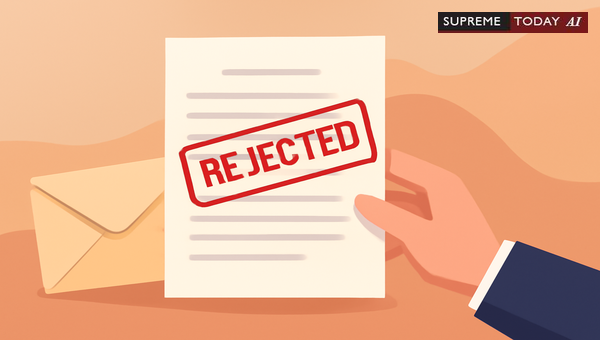
Reply Notice Filed Then Denied: Legal Consequences Explained
In legal proceedings, notices play a crucial role in communication between parties. But what if a party submits a reply notice and later denies having done so? Does this denial automatically invalidate the original reply or prove the opposing party's case? This common scenario raises important questions about , , and court interpretations.
The question at hand is: reply notice given by party later denied the same. Generally, courts in India have clarified that such a denial does not automatically negate the original assertion or constitute for the other side. Let's dive into the legal principles, key judgments, and practical implications.
Main Legal Finding
A reply notice subsequently denied by the party who initially submitted it does not automatically negate the original assertion of having filed the reply, nor does it nullify its . Courts emphasize that the absence of a reply—or a denial of its submission—does not, in itself, prove the truth of the opposing party’s case or amount to an . 2008 0 Supreme(AP) 419
Key points include:- Filing a reply and later denying it does not automatically prove or disprove the case.- Non-filing or denial of a reply notice is not conclusive evidence of the claim's truth or falsehood.- Multiple reasons may explain non-replies, such as oversight or strategy, without implying consent to liability. 2006 0 Supreme(AP) 935
Detailed Legal Principles
Core Judicial Observations
Courts have consistently held that silence or denial regarding a reply does not equate to . For instance, in a key ruling:
Though non-reply to will not automatically prove plaintiffs case, when plaintiff proved his claim, defendant not entering witness box to disprove it by adducing evidence, would lead to inference that defence is false. 2008 0 Supreme(AP) 419
This underscores that while non-reply alone isn't decisive, the overall evidence matters. Similarly:
Merely because no reply had been given, always it cannot be said that the claim of the plaintiff had to be taken as proved. 2008 0 Supreme(AP) 419
In another context:
Such omission would not amount to a tacit consent in respect of demanded liability. 2006 0 Supreme(AP) 935
Regarding and notices:
Exchange of notices would only at utmost constitute demand and refusal in writing, but absence thereof would not either way constitute an admission. 2006 0 Supreme(AP) 935
Implications for Denied Replies
When a party later denies submitting a reply, courts assess the entire evidentiary context rather than treating the denial as fatal. The original reply's content, submission circumstances, and supporting records remain relevant. Courts recognize practical reasons for denials, avoiding mechanical conclusions. 2006 0 Supreme(AP) 974
Explicitly:
It cannot be inferred that when a reply notice is not given automatically it is to be taken that the case of the other party is true. 2006 0 Supreme(AP) 974
In GST registration matters:
The petitioner failed to file a reply to the show cause notice and thus could not claim violation of . However, the petitioner claimed to have filed a reply which was not considered, but the court focused on the procedural aspect rather than the substantive truth of the reply. 2024 0 Supreme(AP) 1301
Insights from Related Cases
This principle extends across various domains, including arbitration, consumer protection, and statutory compliance.
In arbitration under the , a respondent's reply denying amicable settlement did not bar arbitrator appointment, especially with prior filings. The court noted:
The Respondent in its reply to the invocation notice from the Petitioner did not express a desire to amicably settle the disputes. 2019 0 Supreme(Del) 1762
Ratio: Prior filings can render conciliation requirements inconsequential. 2019 0 Supreme(Del) 1762
In tender disputes, non-participation or reply denials don't imply exemptions:
When participation in tender process is made condition precedent for claiming , a party seeking must have participated in the process. There can be no tacit or implied exemption from participating. 2018 0 Supreme(SC) 716
Under the Employees' State Insurance Act, replies denying liability were upheld, with courts remanding for compliance:
As all records had been produced during the course of inspection it was stated that the appellant was not liable to pay any amount of contribution as demanded. 2016 0 Supreme(Bom) 1956
In consumer disputes, replies denying allegations are common, but courts scrutinize overall conduct:
Opposite party No. 2 sent reply to the said notice and denied all the allegations made by the complainant.
Another case highlighted compensation despite replies, focusing on evidence:
The Insurance Company is not liable to pay any claim to the complainant. A reply to the legal notice was duly given by the opposite party.
These examples illustrate that denials are evaluated holistically, not in isolation.
Exceptions and Limitations
While denials aren't conclusive, credibility issues arise if inconsistent with other evidence or suggesting bad faith. Courts may draw if a party avoids disproving claims via evidence. However, this remains an evidentiary assessment, not a strict rule. 2008 0 Supreme(AP) 419
Practical Recommendations
To navigate such situations:- Maintain Records: Keep proofs of all notices, replies, and submissions (e.g., postal receipts, emails).- Respond Promptly: Timely, clear replies strengthen positions.- Holistic Evidence: Rely on comprehensive proof beyond notices.- Seek Legal Counsel: Courts assess context; professionals can strategize effectively.
Parties and courts should prioritize full evidentiary review over isolated non-replies. 2024 0 Supreme(AP) 1301
Conclusion and Key Takeaways
In summary, a party's later denial of a reply notice typically does not invalidate the original or prove the opponent's case. Judicial consensus prioritizes overall evidence, avoiding presumptions from silence or denial. Key takeaways:- Non-reply or denial ≠ admission. 2006 0 Supreme(AP) 935- Courts examine full context. 2008 0 Supreme(AP) 419- Proper documentation is vital.
This article provides general insights based on reported judgments and is not legal advice. Consult a qualified lawyer for specific cases.
References
- 2008 0 Supreme(AP) 419: Non-reply doesn't prove claim; evidence gaps lead to inferences.
- 2006 0 Supreme(AP) 935: Omission not tacit consent; notices not .
- 2006 0 Supreme(AP) 974: No automatic inference from non-reply.
- 2024 0 Supreme(AP) 1301: Procedural focus over reply truth.
- Additional cases: 2019 0 Supreme(Del) 1762, 2018 0 Supreme(SC) 716, 2016 0 Supreme(Bom) 1956,
,
.















