


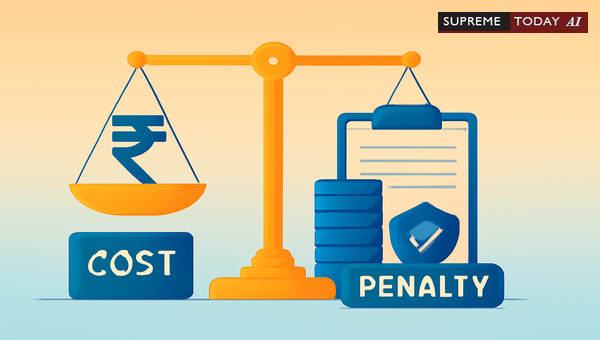
Cost vs Penalty: Are They the Same in Indian Law?
In legal discussions, terms like cost and penalty often spark confusion. Many wonder: Is cost and penalty the same thing? While they may overlap in certain scenarios, Indian jurisprudence draws clear distinctions based on context, purpose, and judicial interpretations. This blog post dives deep into these differences, drawing from landmark cases and statutory insights to help businesses, lawyers, and individuals navigate financial obligations effectively.
Disclaimer: This article provides general information based on legal precedents and is not a substitute for professional legal advice. Consult a qualified attorney for specific cases.
Overview of Cost and Penalty
At first glance, both cost and penalty involve monetary payments, but their essence differs. Costs typically refer to recoverable expenses or necessary outlays in business or legal proceedings, while penalties are punitive measures aimed at deterrence or punishment for non-compliance. The and various tribunals have clarified these nuances across contracts, taxation, and administrative law. 1967 0 Supreme(Bom) 94
For instance, penalties paid to avert losses, such as confiscation of goods, can sometimes be treated as part of business costs. As noted in a key ruling, The penalty paid by it could, therefore, be regarded as part of the cost of the goods to it. 2019 0 Supreme(Bom) 361 This highlights how context blurs lines, yet core distinctions remain.
Definitions and Key Interpretations
Penalty vs.
In contractual law, the line between penalty and is thin. The in Fateh Chand v. Balkishan Dass (AIR 1963 SC 1405) observed that penalty and are nearly synonymous, treating penalties as pre-estimated compensation for breaches rather than pure punishment. 2023 0 Supreme(MP) 493
However, this equivalence doesn't extend universally. , like those for illegal mining (e.g., ten times the royalty), prioritize deterrence over compensation. 2012 0 Supreme(Raj) 767
Cost as Business Expenses
Penalties aren't always punitive; they can qualify as deductible business costs. In taxation contexts, fines paid to salvage goods from seizure are deemed essential expenses: On the facts and circumstances of the present case, the actual cost of the goods to the assessee was not only what it had paid to the importers, but in addition thereto what it had to pay by way of penalty, in order to save the goods from being confiscated and lost to it. 1967 0 Supreme(Bom) 94 2019 0 Supreme(Bom) 361
This treatment underscores that such penalties integrate into the cost of goods for business purposes, distinguishing them from arbitrary fines.
Legal Contexts: Where Distinctions Matter
Deterrent and Punitive Penalties
Penalties often serve as deterrents. In illegal mining cases, hefty impositions recover unlawful gains while discouraging violations. 2012 0 Supreme(Raj) 767 Similarly, late payment penalties, like Rs. 25,000/-, add to the effective cost but remain separate from base prices: Thus, it is evident that there is additional cost involved by way of penalty apart from the actual sale price. 2014 0 Supreme(Mad) 1109
In administrative law, differ from penalties—they're alternatives to prosecution, not punishments. 2009 0 Supreme(Kar) 220
Taxation and Litigation Costs
Tax cases reinforce that penalties can morph into costs when business-critical. Yet, courts award litigation costs separately, sometimes imposing for frivolous claims: The complainant, having wasted much of the time of this Forum and also that of the OP is liable to bear penal cost of Rs. 1000/- payable to OP.
- Consumer
In housing societies, expulsion is weighed against milder options like imposing penalty or of recovering special cost etc. 2008 0 Supreme(Guj) 188 2008 0 Supreme(Guj) 140
International and Comparative Notes
Even in U.S. contexts, like , penalties cap at the violator's account size, unbound by remediation costs, emphasizing their punitive nature over expense recovery. 2025 Supreme(US)(ca11) 71
Judicial Perspectives on Distinctions
Courts stress that penalties must be purposeful, not arbitrary. They deter non-compliance without undue hardship. - Federal Court Putrajaya
In RTI matters, penalties on officers for delays aren't tied to actual costs but to misconduct. 2024 Supreme(Online)(CIC) 4375 2021 Supreme(Online)(CIC) 3202 2021 Supreme(Online)(CIC) 3855
A clear example: late payment penalties aren't based on interest or collection costs but fixed to incentivize timeliness, proving Cost and Penalty Are Not the Same. 2024 Supreme(US)(ca9) 127
Key Takeaway from Precedents:- Penalties: Punitive, deterrent, fixed (e.g., statutory fines). 2021 Supreme(Online)(CIC) 8016 2025 Supreme(Online)(CIC) 2741- Costs: Actual expenses, recoverable (e.g., business outlays, litigation fees).
Practical Implications for Businesses and Individuals
Understanding these differences aids in:- Contract Drafting: Define terms explicitly to avoid penalty misclassification. 2023 0 Supreme(MP) 493- Tax Planning: Claim penalties as costs when they prevent greater losses. 1967 0 Supreme(Bom) 94- Dispute Resolution: Argue for composition over prosecution where applicable. 2009 0 Supreme(Kar) 220
For sales or transactions, note penalties inflate effective costs without altering base prices. 2014 0 Supreme(Mad) 1109
Conclusion and Key Takeaways
Cost and penalty are not the same—penalties punish and deter, while costs cover expenses. Though overlaps exist (e.g., penalties as business costs), context dictates interpretation in Indian law. 2019 0 Supreme(Bom) 361
Key Takeaways:1. Use case law like Fateh Chand for contracts. 2023 0 Supreme(MP) 4932. Treat necessary penalties as deductible costs in taxes. 1967 0 Supreme(Bom) 943. Distinguish from true penalties. 2009 0 Supreme(Kar) 2204. Always consider judicial purpose: deterrence vs. recovery.5. Seek precedents to bolster arguments.
By grasping these nuances, you can better manage liabilities. For tailored advice, consult a legal expert.
#CostVsPenalty, #IndianLaw, #LegalDistinctions















