Searching Case Laws & Precedent on Legal Query.....!
Analysing the retrieved Case Laws
Scanned Judgements…!



Searching Case Laws & Precedent on Legal Query.....!
Analysing the retrieved Case Laws
Scanned Judgements…!
Jurisdiction of Division Bench in Writ Appeals - When a Division Bench hears an appeal against a single Judge’s decision under Article 226, it exercises the same powers as the single Judge, including affirming, reversing, or modifying the order. However, the Division Bench generally cannot remand the case back to the single Judge unless specific rules or judgments permit it. This principle was clarified in a case where the Court held that a Division Bench had no jurisdiction to remand for a decision by the single Judge, emphasizing that the powers exercised are akin to those under Article 226, but with limitations. 2023 0 Supreme(Kar) 552
Power to Consider or Revisit Findings - The Division Bench can consider the correctness of the single Judge's findings in intra-court appeals. It may affirm, modify, or reverse the order but typically does not re-examine the factual findings unless an error of law or jurisdiction is apparent. The scope is primarily to review the legality and correctness of the decision. 2023 0 Supreme(Kar) 552, 2024 0 Supreme(Pat) 922
Remanding Cases and Substituting Proceedings - While some judgments discuss whether a Division Bench can remand a case to the single Judge, the prevailing view suggests limited remand authority. The Division Bench's role is mainly appellate, and remanding is generally not within its jurisdiction unless explicitly provided or under exceptional circumstances. 2023 0 Supreme(Kar) 552
Consideration of Findings in Appellate Jurisdiction - The Division Bench can consider the findings of the single Judge in appeals but cannot re-try or re-evaluate factual issues unless the appeal involves questions of law or jurisdiction. The primary function remains appellate review, not rehearing. 2023 0 Supreme(Bom) 201, 2025 0 Supreme(Bom) 915
Legal Principles on Merger and Finality - When a Single Judge’s order is affirmed by a Division Bench, the order merges into the appellate order, and the Single Judge's decision is considered subsumed. The Single Judge's order does not remain independently operative post-affirmation. 2023 0 Supreme(Cal) 620
References to Larger Benches - In cases where there is a conflict between decisions of Single Benches and Division Benches, or questions of law arise, courts have referred the matter to a larger Bench for authoritative clarification, indicating that a Division Bench can initiate or refer questions to a larger Bench but cannot itself decide on matters outside its jurisdiction. 2023 0 Supreme(Bom) 2240, 2023 0 Supreme(Ker) 642
A Division Bench can consider the findings of a Single Bench during appellate proceedings, including affirming, reversing, or modifying the order, but generally cannot remand the matter back to the single Judge unless explicitly permitted by law or rules. Its primary role is appellate review, not rehearing or re-evaluation of factual findings, unless legal errors are identified.
The power to refer questions to larger Benches exists and is exercised when necessary, but a Division Bench does not have the authority to re-examine factual issues or override the scope of appellate jurisdiction.
The doctrine of merger applies when a Single Judge’s order is affirmed or modified by the Division Bench, leading to the Single Judge's order losing independent operative status.
References:- 2023 0 Supreme(Kar) 552, 2024 0 Supreme(Pat) 922, 2023 0 Supreme(Bom) 201, 2025 0 Supreme(Bom) 915, 2023 0 Supreme(Cal) 620, 2023 0 Supreme(Ker) 642, 2023 0 Supreme(Bom) 2240
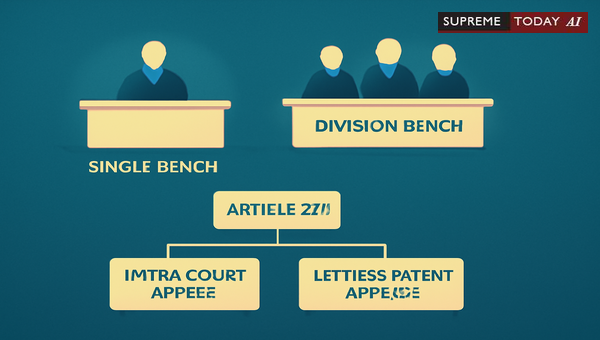
In the intricate structure of the Indian judiciary, particularly within , the interplay between Single Benches and Division Benches is crucial for maintaining judicial discipline and consistency. A common query arises: Article 227 Order Challenge in —can a consider, disregard, or challenge the findings of a ? This question often surfaces in under , , or (LPAs).
Understanding this hierarchy is essential for litigants, lawyers, and legal professionals navigating High Court proceedings. This post delves into key legal principles, binding precedents, exceptions, and practical recommendations, drawing from established case law. Note that this is general information and not specific legal advice—consult a qualified lawyer for your case.
operate with a clear hierarchy: Single Judges handle initial matters, while Division Benches (two or more judges) hear appeals or references. Under Article 227, exercise supervisory powers over and tribunals. When a order is challenged before a , the appellate body reviews it but operates within defined limits.
A can consider the findings of a but is generally not bound by them, unlike the reverse scenario where Single Judges must follow rulings. This ensures higher benches correct errors while upholding precedent.
A Single Judge is bound by decisions. Disagreement requires referral to a larger bench, not a conflicting judgment. As held: A Single Judge is bound by the decisions of a . If a Single Judge disagrees with a ruling, the appropriate course of action is to refer the matter back to the for clarification or to a larger bench if necessary 1996 0 Supreme(Raj) 282 2017 0 Supreme(Kar) 781.
Conversely, a is not bound by another or Single Judge findings and may disregard them if misapplied. A , however, is not bound by the decisions of another . It has the discretion to disregard the findings of a Single Judge 1950 0 Supreme(Raj) 186. This aligns with: Ordinarily, a is bound by the decision of a . Even in case of a , a subsequent cannot take a divergent view 2017 0 Supreme(Gau) 1075.
Single Judges doubting a ruling must refer to the : If a Single Judge doubts the correctness of a ruling, they must refer the matter to the rather than issuing a conflicting judgment 2019 0 Supreme(Chh) 1113 1985 0 Supreme(Kar) 158.
Conflicting decisions? The later one prevails if it addresses the earlier: 2003 0 Supreme(MP) 622. Authority for Full Bench references lies with Division Benches, not Single Judges: The authority to refer matters to a Full Bench lies with a or a larger bench, not with a Single Judge 2012 0 Supreme(Ker) 1053 2006 0 Supreme(Bom) 2104. A may consider: The has to consider whether the matter could be referred to Full Bench 2016 0 Supreme(Ker) 487.
In under or LPAs, Division Benches exercise akin to the Single Judge but with limitations:
Power to Review Findings: Division Benches can affirm, modify, or reverse orders, considering correctness on law or jurisdiction. They cannot re-examine factual findings unless errors are apparent: 2023 0 Supreme(Kar) 552 2024 0 Supreme(Pat) 922.
Limited Remand Authority: Generally, no remand to Single Judge unless rules permit. A had no jurisdiction to remand for a decision by the single Judge 2023 0 Supreme(Kar) 552. However, if contrary to precedent, remand for reconsideration may occur: 2021 0 Supreme(HP) 7.
: Affirmed orders merge into the order, losing independent status: 2023 0 Supreme(Cal) 620.
As noted: No or of this Court has so far considered this question in some contexts, highlighting evolving jurisprudence 2010 0 Supreme(Ker) 178.
Division Benches may disregard Single Judge findings if:
Law misapplied or factors overlooked: 2021 8 Supreme 661 2019 0 Supreme(SC) 886.
Ruling contrary to precedent, leading to remand: 2021 0 Supreme(HP) 7.
In LPAs against dismissals by Single Judges, maintainability is questioned: is dismissed by a learned Single Judge of the High Court, a Letters Patent Appeal is not maintainable before the 2023 0 Supreme(J&K) 365. Single Benches affirm: As a , this Bench is bound by the decision of the
M. Siddiqi VS Kolkata Metropolitan Development Authority - Calcutta
.For practitioners:
Document disagreements with rulings and refer appropriately.
In challenges, argue Single Judge merits while emphasizing precedents.
Prepare for appellate review focusing on legal errors, not facts.
Litigants should note: Division Benches can consider findings in supervisory or appellate roles under Article 227 but prioritize . References to larger benches resolve conflicts: 2023 0 Supreme(Bom) 2240 2023 0 Supreme(Ker) 642 2023 0 Supreme(Bom) 201 2025 0 Supreme(Bom) 915.
A can consider findings under Article 227, with powers to affirm, reverse, or modify, but not re-try facts or freely remand. Single Judges remain bound, ensuring hierarchy. Exceptions allow corrections for legal errors.
Key Takeaways:- Single Benches bound by Division Benches; refer doubts upward.- Division Benches not bound; discretionary review.- Limited remand; merger doctrine applies.- Seek larger bench references for conflicts.
This framework promotes consistency. For tailored advice, consult legal experts. References include 1996 0 Supreme(Raj) 282 2017 0 Supreme(Kar) 781 1950 0 Supreme(Raj) 186 2019 0 Supreme(Chh) 1113 1985 0 Supreme(Kar) 158 2012 0 Supreme(Ker) 1053 2021 8 Supreme 661 2019 0 Supreme(SC) 886 2021 0 Supreme(HP) 7 2003 0 Supreme(MP) 622 2023 0 Supreme(Kar) 552 2024 0 Supreme(Pat) 922 2023 0 Supreme(Bom) 201 2025 0 Supreme(Bom) 915 2023 0 Supreme(Cal) 620 2023 0 Supreme(Bom) 2240 2023 0 Supreme(Ker) 642
#Article227, #DivisionBench, #JudicialHierarchy


When a Division Bench entertains an appeal from a decision of a single Judge in exercise of powers under Article 226, the Division Bench, in deciding such appeal, exercise the same power under that Article, whether it (the Division Bench) affirms, reverses or modifies the decision of the single Judge ... The reference made to the Full....

(ii) Whether the Rules prescribed for creation of jurisdiction in the Division Bench in the matters to be exclusively heard and disposed of by a Single Judge? ... It was also observed that if the matter would have been referred by the learned Single Judge to the Division Bench, there would have been no difficulty for the Division Bench#HL_EN....

that inquiry sitting as a Single Judge but should refer the matter to the Division Bench or in a proper case, place relevant papers before the Hon'ble Chief Justice to enable him to constitute Larger Bench to examine the question. ... He also invited my attention to the Division Bench judgment of this Court in Sandip Mrinmoy Chakrabarty v. ... The Division Ben....

The appeals before the Division Bench were against the exercise of discretion by the Single Judge. ... The appeals before the Division Bench were against the exercise of discretion by the Single Judge. ... The Division Bench of the High Court had reversed the order passed by the learned Single Judge and granted interim injunction. Rev....

I am not going into the question as to whether on the basis of a prima facie view, jurisdiction can be conferred upon the Tribunal and as was done by the Division Bench. ... The next issue is whether the Appellate Tribunal can function as a Single Member Bench? At the outset, it must be noted that although this question arises directly in the RERA appeals, it has not been specifically ra....

This part of the judgment of the Division Bench has been interpreted by the learned Single Judge in the impugned judgment to mean that the Division Bench has waived of the requirement of holding a Selection Committee or in any case reduced it to a mere formality of only examining as to whether the candidate ... He submits that the learned Single Bench ....

In such situation, the order of the Single Bench merged or subsumed into the order of the Division Bench even in case of affirmation by the Division Bench. ... The Single Bench of this Court in Tetulia Coke Plant (supra) was confronted with the question as to whether the contempt application filed before it alleging violation of its o....

case (supra) was not understood in a correct perspective (2) the Division Bench omitted to consider the decision rendered in State v. ... The Division Bench in Laly Joseph's case (supra) has skipped the mandate of referring the issue to a larger Bench. Further, the Division Bench omitted to consider the impact of sub-rule (2) to Rule ....

CrPC is dismissed by a learned Single Judge of the High Court, a Letters Patent Appeal is not maintainable before the Division Bench. ... The finding of the Coordinate Bench has also been questioned by Mr. Salih Pirzada, learned counsel. 11. ... This throws up another question if the Division Bench of the High Court, under the Letters Patent, is in effect reviewing the ....
The issue arose before the Division Bench as to whether the petition was to be placed before the learned Single Judge or could be heard by the Division Bench. ... Division Bench had made a reference to larger bench by the order dtd. 15/11/2011 on the question as to whether a writ petition arising from an order passed....

Ordinarily, a Single Bench is bound by the decision of a Division Bench. Even in case of a co-ordinate bench, a subsequent Division Bench cannot take a divergent view. It may express disagreement with the views of the previous Division Bench and, thereafter, may make a reference to the Chief Justice on the administrative side for constitution of a larger Bench to examine the correctness of the previous co-ordinate bench decision.

The Division Bench has to consider whether the matter could be referred to Full Bench. This was followed and reiterated by a Division Bench of this Court in Anil Kumar Vs. State of Kerala [2012 (4) KLT 793] as well. The issue had also come up for consideration of a Full Bench of this Court and as per the decision rendered in Peter Vs. Sara [2006 (4) KLT 219 (F.B.)] it has been held that a single Judge has no power to refer the matter to a Full Bench and that, if the single ju....

As a Single Bench, this Bench is bound by the decision of the Division Bench. In any case, as pointed out by Mr. Mukherjee, there is an endorsement of stop payment in the award and another endorsement that verification not done which also shows that the making of the award was not complete. (supra) a Division Bench of this Court categorically held that making of the award would be completed only after apportionment of the compensation among the different claimants. This Court....

The apex court held that the Division Bench did not err in rejecting the application of ICICI pertaining to the loan transactions prior to July 10, 1986. The Division Bench opined that what the appellant-ICICI was in fact seeking to do was to convert itself from an unsecured into a secured creditor in respect of transactions which had taken place "15 to 17 years ago". In 1990, the company as well as ICICI made an application under section 536(2) of the Act for allowing the disposition of the c....

We feel obliged to undertake an analysis of the statutory provision from various angles. No Division Bench or Single Bench of this Court has so far considered this question. We find no binding precedents specifically on this point by the Supreme Court or larger Benches of this Court.


An indispensable Tool for Legal Professionals, Endorsed by Various High Court and Judicial Officers
Please visit our Training & Support
Center or Contact Us for assistance

Scan Me!
India’s Legal research and Law Firm App, Download now!


For Daily Legal Updates, Join us on :



 Back to top


