


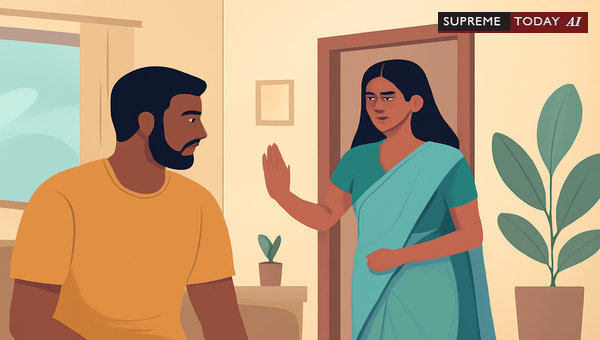
Does Require Same Roof in India?
In family disputes involving allegations of , a common question arises: Does a exist only if parties resided in the same household? Many assume that current co-residence under one roof is mandatory under the (DV Act). However, Indian courts have provided a nuanced interpretation that goes beyond strict physical proximity. This blog post delves into the legal framework, key judicial findings, exceptions, and practical insights to help you understand this critical aspect of family law.
Whether you're facing a DV Act proceeding or seeking clarity on your rights, this guide breaks down the law generally, based on established precedents. Note: This is for informational purposes only and not specific legal advice—consult a qualified lawyer for your situation.
Understanding Under the DV Act
The DV Act, 2005, aims to protect women from violence in domestic settings. defines a as:
a relationship between two persons who live or have, at any point of time, lived together in a 2013 8 Supreme 122 2024 0 Supreme(All) 417.
This definition is comprehensive, encompassing relationships by marriage, (blood relations), adoption, or , as well as joint family arrangements 2013 8 Supreme 122 2024 0 Supreme(Ker) 605
.
Courts have emphasized an expansive interpretation. Actual current co-residence isn't the sole criterion. The phrase live or have, at any point of time, lived together includes:- Past cohabitation.- A in the , even if not presently living there 2022 0 Supreme(Bom) 2042 2010 0 Supreme(Del) 1143 2010 0 Supreme(Del) 1140.
For instance, the has clarified that a woman may claim protection if she previously resided in the household or had a legal right to do so, regardless of current separation 2022 0 Supreme(Bom) 2042 2024 0 Supreme(Ker) 514.
Past Residence and : Key to Establishing the Relationship
The temporal aspect—at any point of time—is pivotal. Courts recognize that:- Past residence suffices, especially in marital or marriage-like relationships. A woman who lived in the but later moved out (e.g., due to strife) retains the for DV Act purposes 2022 0 Supreme(Bom) 2042 2024 0 Supreme(Ker) 514 2024 0 Supreme(All) 417.- Even post-divorce scenarios may qualify if prior residence or rights existed, though this is context-specific 2024 0 Supreme(Bom) 484.
In relationships , such as long-term live-in arrangements with mutual commitment and shared finances, current cohabitation isn't mandatory 2024 0 Supreme(All) 417 2024 0 Supreme(Ker) 514. The has upheld this for women asserting rights without ongoing physical presence 2024 0 Supreme(Ker) 514.
Joint family contexts further broaden this: Women in extended families with a qualify, irrespective of daily co-living 2013 8 Supreme 122 2024 0 Supreme(Ker) 605.
When May Not Exist: Exceptions and Limitations
While expansive, the definition has boundaries. Several judgments highlight scenarios where no exists:
- Permanent separation and separate household: continues so long as the parties live under the same roof and enjoy living together in a . However, where the living together has been given up and a separate household is established and belongings are removed, comes to an end 2022 0 Supreme(MP) 268 2019 0 Supreme(Kar) 1361 2019 0 Supreme(Del) 2014 2015 0 Supreme(P&H) 1622.
For example, if a daughter marries, moves abroad, and establishes her own home, she cannot later claim a with her parental family for property disputes 2019 0 Supreme(Kar) 1361.
Mere relatives without shared living: Sisters-in-law married before the complainant, never staying together, lack a 2022 0 Supreme(MP) 268. Proceedings were quashed as no existed 2022 0 Supreme(MP) 268.
Brief visits or no intent to reside: Temporary stays (e.g., visiting a dying parent and staying in a hotel) don't qualify. Only a compelled or temporarily going out by aggrieved person shall fall in phrase 'at any point of time' 2014 0 Supreme(AP) 482 2022 0 Supreme(MP) 268.
No in separate households: Only violence committed by a person while living in the but not in separate household can constitute 2015 0 Supreme(P&H) 1622. Threats via phone from afar may violate but not DV Act.
In one case, a complainant never resided with petitioners (proven by passport), so no existed 2024 Supreme(Online)(AP) 698. Similarly, claims against non-residing daughters/sons-in-law were dismissed 2015 0 Supreme(P&H) 1622.
Property enforcement via DV Act is improper; civil suits are the remedy when no ongoing domestic ties exist 2015 0 Supreme(P&H) 1622 2019 0 Supreme(Kar) 1361.
Judicial Precedents: Balancing Protection and Limits
Courts strike a balance:- Expansive view: Recognizes women's vulnerabilities, including past bonds and residence rights 2010 0 Supreme(Del) 1143
Shilpa Aggarwal vs Ruchika Gupta - Delhi (2019)
.- Restrictive where terminated: If belongings are removed and a new household formed, only familial ties remain, not domestic ones 2019 0 Supreme(Del) 2014.A set aside proceedings against a sister-in-law with no shared living history, relying on precedents like (2020) 3 SCC 14 2022 0 Supreme(MP) 268. Another quashed a divorced woman's claim post-foreign divorce and separate residence 2014 0 Supreme(AP) 482.
Practical Recommendations for Legal Proceedings
To strengthen a DV Act claim:- Gather evidence of history: Past cohabitation docs, witness statements on shared living or rights.- Highlight relationship nature: Prove marriage-like bonds, financial ties, or joint family status.- Avoid overreach: Don't use DV Act for pure property claims if ties have ended.
Defendants should prove separate households, no past shared residence, or terminated relationships.
Conclusion: Not Strictly Same Roof, But Nuanced
A under the DV Act is not strictly limited to parties currently residing under the same roof. It typically includes past cohabitation, relationships , and rights to reside in a 2022 0 Supreme(Bom) 2042 2024 0 Supreme(All) 417
Shilpa Aggarwal vs Ruchika Gupta - Delhi (2019)
. However, it ends upon permanent separation and establishment of independent households 2022 0 Supreme(MP) 268 2015 0 Supreme(P&H) 1622.Key Takeaways:- Focus on history and rights, not just present living.- Exceptions apply for fully severed ties or non-residents.- Always seek professional advice, as outcomes depend on facts.
This interpretation promotes protection while preventing misuse. Stay informed on evolving case law.
References (select excerpts cited above for brevity):- 2013 8 Supreme 122, 2024 0 Supreme(Ker) 605, 2022 0 Supreme(Bom) 2042, 2024 0 Supreme(All) 417, 2010 0 Supreme(Del) 1143, 2022 0 Supreme(MP) 268, 2019 0 Supreme(Kar) 1361, 2015 0 Supreme(P&H) 1622, and others noted inline.
#DVActIndia, #DomesticRelationship, #SharedHousehold












