


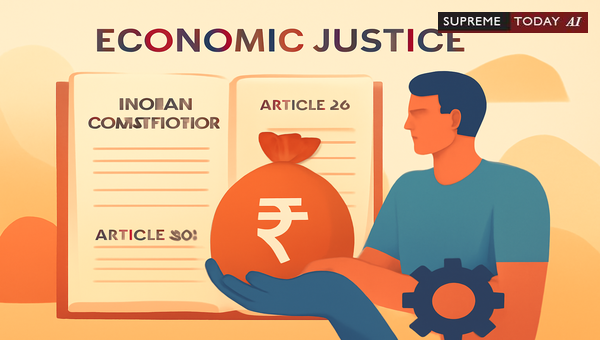
in the Explained
In an era marked by widening economic disparities, the stands as a beacon of hope for achieving fairness and equity. But what exactly does in Constitution entail? This fundamental concept, deeply embedded in India's supreme law, seeks to ensure that every citizen—especially those from marginalized communities—has access to equal opportunities, resources, and protection from exploitation. This blog post delves into the constitutional provisions, judicial interpretations, and key principles that form the bedrock of , providing a comprehensive guide for anyone interested in this vital aspect of Indian law.
Note: This article offers general information and is not intended as specific legal advice. Consult a qualified lawyer for personalized guidance.
Overview of
is a core principle of the , designed to guarantee equality of status, opportunity, and liberty for all citizens. It particularly emphasizes the upliftment of Scheduled Castes (SCs), Scheduled Tribes (STs), and other backward classes, addressing historical and systemic inequalities. The Constitution envisions a where the government actively works to minimize income disparities and foster an . As one source notes, - Rooted in addressing economic disadvantages rather than social criteria; it is enshrined in the Constitution's Preamble, guaranteeing justice—social, economic, and political—alongside equality, dignity, and fraternity 2024 0 Supreme(Ker) 359.
This principle is not merely aspirational but actionable through various provisions, ensuring that economic policies align with constitutional ideals.
Key Constitutional Provisions
The Constitution outlines specific directives for the State to promote , primarily through the .
: Promoting Educational and Economic Interests
explicitly mandates the State to promote the educational and economic interests of the Scheduled Castes, the Scheduled Tribes and other weaker sections and protect them from . This provision underscores the commitment to as a fundamental directive. 2002 0 Supreme(Mad) 1519
:
Inserted by the , directs the State to ensure , so that no citizen is denied justice due to economic or other disabilities. It reinforces , making justice accessible regardless of financial status. 2002 0 Supreme(Raj) 469
: Principles of Economic Policy
Several sources highlight that is enshrined in of the Constitution. 2022 0 Supreme(SC) 1135 2022 7 Supreme 452 2018 0 Supreme(SC) 448 This article, part of the DPSPs, requires the State to formulate policies ensuring equal right to , , and to serve the .
The Preamble: Guiding Light for Justice
The Preamble declares the resolve to secure and . It acts as the interpretive lens for all laws aimed at economic equity. 2017 0 Supreme(HP) 1174
Additionally, empowers the State to promote welfare by securing a social order with justice—social, economic, and political. The constitutional framework thus aims to minimize inequalities and build an . 2024 0 Supreme(Ker) 359 2024 0 Supreme(All) 1014 2025 Supreme(Online)(SC) 10646
Judicial Interpretations and Rulings
The judiciary has played a pivotal role in breathing life into these provisions, often expanding their scope through landmark judgments.
Landmark Cases
In , the observed that aims to make equality of status meaningful and to remove inequalities of opportunity and status. 2017 0 Supreme(Kar) 1592 2017 0 Supreme(Pat) 275
stressed that providing and distributing material resources for common welfare are essential for socio-. 1996 6 Supreme 175
The Court has consistently affirmed that social and is integral to the Constitution, necessitating to address inequalities. This includes promoting equal opportunities through the legal system. 1999 3 Supreme 277 1984 0 Supreme(MP) 215
Broader Judicial Perspectives
Courts recognize as a , crucial for a just social order by removing inequalities and ensuring equitable resource distribution. 2024 0 Supreme(All) 1014 2025 Supreme(Online)(SC) 10646 They adopt a hands-off approach to economic policies unless they violate constitutional norms, upholding the State's discretion in policymaking while emphasizing constitutional philosophy. 2024 0 Supreme(SC) 1002 2025 0 Supreme(Gau) 666 2022 0 Supreme(Cal) 1218
In contract law contexts, the Court has struck down where parties lack , aligning with and the broader goal of social and . 2016 0 Supreme(Gau) 872
Core Principles of
Several interconnected principles guide the implementation of :
Equality of Opportunity: Ensuring all citizens, especially the disadvantaged, have fair access to resources and advancement. 2002 0 Supreme(Raj) 469
Abolition of Inequality: Eliminating economic disparities that perpetuate poverty and exclusion. 1996 6 Supreme 175
Model: The State must actively intervene through policies like and , provided they conform to constitutional standards. 2024 8 Supreme 713 2022 0 Supreme(SC) 1070 2024 0 Supreme(SC) 1002
Interlinkage with Social and Political Justice: As noted, Unless the social justice is provided in order to reach and achieve political justice, it would be a failure in action. 2019 0 Supreme(Kar) 1478 Political justice, involving universal suffrage and democratic participation, complements economic equity. 2022 0 Supreme(SC) 1135
Challenges in Implementation
Despite robust constitutional mandates, realizing faces hurdles like persistent poverty, housing shortages, and unequal resource access. 2022 0 Supreme(HP) 816 2023 0 Supreme(Cal) 667 Practical challenges underscore the need for ongoing policy reforms and vigilant judicial oversight.
Conclusion and Key Takeaways
remains a cornerstone of the , woven into the Preamble, Articles 39, 39A, 46, and beyond. Judicial rulings reinforce the State's duty to foster a welfare-oriented society, promoting equality and curbing exploitation. While progress has been made, sustained efforts are essential to bridge the gap between constitutional ideals and reality.
Key Takeaways:
- Leverage Articles 39, 39A, and 46 to advocate for marginalized groups.
- Draw on precedents for legal arguments on equity.
- Support policies offering free legal aid and economic upliftment schemes.
- Recognize as intertwined with social and political fairness for holistic development.
Recommendations:
- Advocate for aligned policies focusing on weaker sections.
- Use judicial precedents in proceedings related to economic rights.
- Promote schemes enhancing access to justice for the economically disadvantaged.
By aligning governance with these principles, India can move closer to a truly equitable society. Stay informed and engaged— is everyone's right.
#EconomicJustice, #IndianConstitution, #SocialJustice












