


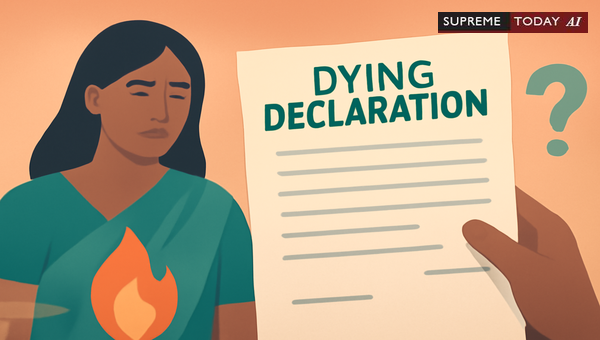
Laxmi Kanta Reddy Case: Under Scrutiny
In high-stakes criminal cases involving suspicious deaths, such as those from burns, often serve as pivotal evidence. The case surrounding Laxmi Kanta Reddy highlights critical legal questions about the reliability and admissibility of such statements. What happens when multiple contradict each other, raise language concerns, or lack proper procedural safeguards? This blog post delves into the Laxmi Kanta Reddy matter, examining key principles from the , particularly Section 32, and their application to real-world scenarios. Note: This is general information based on legal documents and is not specific legal advice. Consult a qualified lawyer for personalized guidance.
Understanding in Indian Law
are statements made by a person who is at the point of death, regarding the cause of their death or circumstances leading to it. Under , these declarations are admissible as exceptions to the because they are considered trustworthy due to the declarant's sense of impending death. However, courts apply strict scrutiny to ensure their voluntariness, the declarant's , and proper recording2009 3 Supreme 360.
Key requirements include:- Certification by the recording officer or doctor that the declarant was in a .- The statement must be voluntary, free from tutoring or inducement.- It should be recorded verbatim, read back to the declarant, and explained if necessary, especially in cases of language barriers 2009 3 Supreme 360.
Failure to meet these can significantly diminish their evidentiary value, as seen in cases like Laxmi Kanta Reddy's.
The Laxmi Kanta Reddy Case: Facts and Timeline
Laxmi Kanta Reddy, a married woman, suffered severe burns leading to her death. Multiple were recorded in the aftermath, alleging cruelty, harassment, and possibly dowry-related issues—common motifs in such tragedies. However, these declarations contained glaring contradictions regarding critical details, such as who poured kerosene or ignited the fire 2013 0 Supreme(SC) 586.
The timeline reveals:- Initial declaration recorded in Telugu, later ones in Kannada, raising translation and comprehension issues.- Absence of certification that statements were read and explained to Laxmi.- Suspicious circumstances around recording, potentially affecting voluntariness 2013 0 Supreme(SC) 586.
These elements cast serious doubt on their credibility, prompting courts to question their reliability for conviction 2011 1 Supreme 751.
Challenges to Credibility: Contradictions and Procedural Lapses
In the documents analyzed, courts emphasized that multiple with significant contradictions undermine their 2013 0 Supreme(SC) 586. For instance, the court noted significant contradictions among three and issues regarding whether the declarations were read and explained to the deceased, leading to doubts about their reliability 2013 0 Supreme(SC) 586.
Language and Translation Issues
Language mismatches are a recurring flaw. If recorded in a language not understood by the declarant (e.g., Telugu speaker with Kannada record), without proof of explanation, authenticity is compromised 2013 0 Supreme(SC) 586. This procedural lapse directly impacts admissibility.
Mental State and Voluntariness
The declarant must be in a , certified by a magistrate or doctor. Without this, as in some burns cases where sedatives or pain affect lucidity, declarations may be discarded 2009 3 Supreme 360.
Legal Principles from Key Cases
Drawing from precedents:- Consistency is Crucial: Courts may reject declarations if they conflict on material facts, like the sequence of events in a burns incident 2013 0 Supreme(SC) 586.- Corroboration Needed: Sole reliance on flawed is risky; , motive, and witness testimonies are essential 1956 0 Supreme(SC) 99.- Procedural Integrity: To be admissible, the dying declaration must be voluntary, made when the declarant was in a , and properly recorded with certification of mental fitness 2009 3 Supreme 360.
In Laxmi Kanta Reddy's context, these principles suggest her declarations' evidentiary weight is weakened by contradictions and lapses, potentially benefiting the defense.
Insights from Related Legal Documents
While the core documents focus on , other sources provide broader context on similar names and issues, underscoring recurring legal themes in Indian jurisprudence.
For example, in a property dispute, Exs.A.35 and 36 are not executed by defendant No.1, Ex.A.35 Sale deed is executed by one Mr Hankare Kishan in favour of R.B.Ganesh Nataraj in respect of Plot No.52, similarly Ex.A.36 sale deed was executed by one Mr Chilika Maila Reddy in favour of Y.Narsi Reddy 2025 Supreme(Online)(Tel) 74153. This highlights execution and authenticity scrutiny, paralleling dying declaration verification.
Another case involving Laxmi Narayan Reddy discusses under , stressing that pleading has to be read as a whole to ascertain its true import - It is not permissible to cull out a sentence or a passage and to read it out of the context in isolation 2017 0 Supreme(Raj) 2653. This interpretive caution applies analogously to parsing contradictory declarations.
Judicial mentions, like Hon'ble Laxmi Kanta Mohapatra in tenancy disputes, note delays and procedural rights: Delay in approaching the Court after non-payment of rent and the authority's right to take steps for eviction 2013 0 Supreme(All) 2968. Such principles reinforce timely, proper documentation in legal proceedings.
These snippets illustrate how evidentiary rigor spans civil and criminal law, relevant to Laxmi Kanta Reddy's evidentiary battles.
Impact on Prosecution and Defense
For the prosecution, inconsistent declarations hinder proving guilt beyond reasonable doubt, especially in dowry or cruelty cases under . The defense can leverage contradictions to argue tutoring or fabrication 2013 0 Supreme(SC) 586.
Courts typically:- Scrutinize multiple statements for harmony.- Demand independent corroboration.- Weigh medical evidence on mental fitness 2009 3 Supreme 360.
Exceptions Where Declarations Hold Strong
Not all flaws doom declarations:- Minor Discrepancies: Overlooked if core facts align.- Consistent Records: Even without doctor certification, if magistrate vouches for fitness 2009 3 Supreme 360.- Corroborated by Circumstances: Motive evidence bolstering the statement.
Recommendations for Legal Practitioners and Courts
To strengthen :- Record in the declarant's language with thumb impression/admission of understanding.- Obtain dual certifications (mental fitness and voluntariness).- Avoid delays; record promptly post-incident.- Cross-verify with forensics and witnesses.
In Laxmi Kanta Reddy-like cases, procedural compliance is paramount.
Conclusion and Key Takeaways
The Laxmi Kanta Reddy case exemplifies the delicate balance courts strike with . Their credibility hinges on consistency, voluntariness, proper recording, and mental fitness—principles enshrined in Section 32 of the Evidence Act2009 3 Supreme 360 2013 0 Supreme(SC) 586. Contradictions and lapses, as here, erode trust, necessitating corroboration.
Key Takeaways:- Always certify 2009 3 Supreme 360.- Resolve language barriers explicitly 2013 0 Supreme(SC) 586.- Seek consistency across multiple statements.- Use declarations cautiously without supporting evidence.
This analysis underscores caution in burns death prosecutions. For deeper insights or case-specific advice, reach out to legal experts. Stay informed on evolving jurisprudence to navigate these complexities.
References:- 2009 3 Supreme 360: Principles on dying declaration validity.- 2013 0 Supreme(SC) 586: Contradictions and procedural issues.- 2011 1 Supreme 751: Evidence consistency in burns cases.- Additional sources: 2025 Supreme(Online)(Tel) 74153, 2017 0 Supreme(Raj) 2653, 2013 0 Supreme(All) 2968.
#DyingDeclaration, #LaxmiKantaReddy, #EvidenceAct












