Searching Case Laws & Precedent on Legal Query!
Scanned Judgements…!



Searching Case Laws & Precedent on Legal Query!
Scanned Judgements…!
Evidentiary Value of a Rustic Witness
Limited Evidentiary Value of Hearsay and Non-Eye Witnesses Many witnesses from rustic or tribal backgrounds are considered hearsay witnesses, whose testimonies are generally deemed to have no evidentiary value unless they are direct eye-witnesses. For example, witnesses like P.W.-4, P.W.-3, and P.W.-2 in source ["2024 0 Supreme(Pat) 1098"] are hearsay, supporting the prosecution only by recounting what others told them. The court emphasizes that hearsay evidence is not sufficient for conviction.
Significance of Eye-Witness Testimony The testimony of the injured or direct eye-witness (e.g., P.W.-5) holds greater evidentiary weight, especially when supported by physical evidence such as injuries or medico-legal reports. However, the absence of corroborative medical reports can weaken the case. Source ["2025 0 Supreme(All) 2887"] highlights that injured witnesses' statements are generally given more weight unless there are compelling reasons to doubt them.
Assessment of Rustic Witnesses’ Testimony The court recognizes that rustic or illiterate witnesses may not recall every detail precisely due to their background, time lapse, or emotional shock. Their evidence should be appreciated as a whole and in context, rather than judged on minor discrepancies. Supreme Court decisions (e.g., ["2023 0 Supreme(Pat) 350"], ["2025 0 Supreme(Raj) 1874"]) advise that their demeanor and overall consistency can establish credibility, despite potential omissions or exaggerations.
Behavior and Perception of Rustic Witnesses Witnesses from rural backgrounds may face challenges in articulating their testimony, and their behavior might differ from urban or educated witnesses. Their evidence should be evaluated with an understanding of their socio-economic and educational context, as reinforced in sources ["2025 0 Supreme(Raj) 1874"], ["2024 0 Supreme(Pat) 608"], and ["018000127"].
Sign Language and Gestures as Evidence Non-verbal cues such as gestures or nods can possess evidentiary value, especially when verbal communication is limited, as per source ["2023 0 Supreme(Chh) 265"]. Such signs, if reliably interpreted, can support the testimony of rustic witnesses or victims unable to speak.
Evidentiary Hierarchy and Corroboration Medical evidence is generally corroborative and not conclusive; conflicts between medical and oral testimony should favor the latter unless medical evidence explicitly contradicts the facts. This is underscored in ["2024 0 Supreme(Pat) 608"] and ["2021 0 Supreme(All) 1710"].
Special Considerations for Child and Injured Witnesses The reliability of child witnesses depends on their demeanor and consistency, not age alone. Injured witnesses’ testimonies are given special weight, especially when injuries are consistent with the occurrence, as per ["2025 0 Supreme(All) 2887"].
Analysis and ConclusionWhile rustic witnesses' testimonies are often viewed with caution due to potential limitations in recall, their evidence can be credible when viewed holistically, considering their background, demeanor, and the circumstances of the case. The courts emphasize that the overall impression of truthfulness, corroboration with physical evidence, and the context of the witness's background are crucial in evaluating their evidentiary value. Hearsay witnesses are generally given little weight, whereas direct eye-witnesses and injured witnesses' statements are valued more highly, provided they are consistent and credible.
References:- ["2024 0 Supreme(Pat) 1098"]- ["2021 0 Supreme(All) 1710"]- ["2025 0 Supreme(All) 2887"]- ["2023 0 Supreme(Pat) 350"]- ["2023 0 Supreme(Chh) 265"]- ["2025 0 Supreme(Raj) 1874"]- ["2024 0 Supreme(Pat) 608"]- ["018000127"]
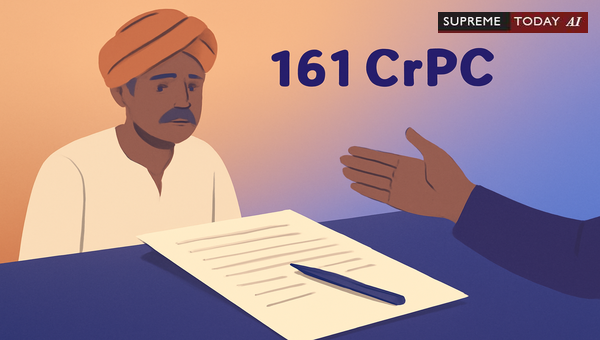
In criminal trials, witness testimonies form the backbone of . But what happens when a witness, particularly a rustic one from a rural background, provides their statement under for the first time before the court? The question often arises: Witness Deposed First Time before the Court 161 Crpc Statement Evidentiary Value. This blog post delves into this critical legal issue, examining how Indian courts evaluate such statements, especially from uneducated or socio-economically disadvantaged witnesses.
Understanding the nuances is essential for lawyers, litigants, and anyone navigating the Indian justice system. We'll explore key principles, judicial precedents, and practical insights while integrating relevant case law. Note that this is general information and not specific legal advice—consult a qualified lawyer for your case.
empowers police officers to examine witnesses orally during investigations. These statements are not recorded verbatim but summarized and signed by the witness. Importantly, they are not in court but can be used for under . 2022 0 Supreme(Chh) 477
When a witness is deposed for the first time in court—meaning their chief examination occurs without a prior Section 161 statement—the evidentiary value hinges on the testimony's intrinsic reliability. For rustic witnesses, courts apply a nuanced approach, recognizing their unique challenges. 2023 7 Supreme 433
Rustic witnesses, often villagers with limited education, face scrutiny due to potential inconsistencies in recall. Courts, however, emphasize rather than nitpicking minor discrepancies. As noted in judicial observations, While appreciating the evidence of a witness, the approach must be whether the evidence of witness read as a whole appears to have a . 2022 0 Supreme(Chh) 477
In one case involving murder charges under , 34, and 324, the court held: This court cannot lose sight of fact that is rustic villagers and it cannot be expected from them to differentiate with kind of weapon used by appellants - Even if some variation is found, it would not make their credible statement incredible. 2022 0 Supreme(Chh) 477
Socio-Economic and Emotional Context: Lack of formal education and traumatic events, like witnessing a relative's death, impact recollection. Courts must consider this background: The court must consider the socio-economic background of rustic witnesses. 2023 7 Supreme 433 2023 0 Supreme(Pat) 350
Handling Discrepancies During : Prolonged questioning can lead to variances, but these shouldn't discredit the testimony outright. Such discrepancies should not be exaggerated or used to discredit their overall reliability. 2023 7 Supreme 433 2022 0 Supreme(Ori) 659
Judicial Precedents on Reliability: The advises against dismissing rustic witnesses lightly, urging evaluation in the context of village life. 2023 7 Supreme 433 2021 0 Supreme(All) 1710
Relatedly, for , who often overlap with rustic profiles: The evidence of injured witness has greater evidentiary value and unless compelling reasons exist, their statements are not to be discarded lightly. 2025 0 Supreme(All) 2324
Rustic witnesses are frequently relatives of victims, raising bias concerns. However, law doesn't presume untruthfulness: There is no proposition in law that relatives are to be treated as untruthful witnesses. 2022 0 Supreme(Chh) 477
In , Justice Vivian Bose observed: Testimony of related witness, if found to be truthful, can be the basis of conviction. 2020 6 Supreme 484
Another precedent reinforces: Fact of witness being related to victim or deceased does not by itself discredit evidence. Evidence of related witness is of evidentiary value. Court has to scrutinize evidence with care as a rule of prudence and not as a rule of law. 2019 0 Supreme(MP) 453 2018 0 Supreme(MP) 179
Even don't automatically undermine a case if core accounts hold: will not affect conviction of appellants. Seen in a murder case under , 302 r/w 149. 2020 6 Supreme 484
For Section 161 statements specifically, their trial value is limited but crucial for contradictions. In non-summary inquiries, prior statements can support deductions, though denials in court require careful weighing.
FERNANDO S.S. v. THE QUEEN
In a courtroom attempted murder case (), Sole testimony of injured witness sufficient for conviction, despite investigation defects. 2025 0 Supreme(All) 2324
Not all cases favor rustic witnesses. If prosecution fails beyond reasonable doubt, applies—as in a leading to acquittal. 2020 0 Supreme(All) 525
Courts demand consistency corroborated by . Minor omissions don't vitiate, but glaring ones might. 2019 0 Supreme(MP) 453
The evidentiary value of a rustic witness's first-time deposition under remains robust when viewed holistically. Courts prioritize context—socio-economic status, trauma, and rural realities—over isolated flaws. Precedents affirm that such testimonies can secure convictions, especially for injured or related witnesses, provided they ring true overall.
Key Takeaways:- Appreciate evidence wholly, not dissectively. 2023 7 Supreme 433- Related or rustic status doesn't presume bias. 2020 6 Supreme 484- Prepare for inconsistencies but leverage precedents for reliability.
References: 2023 7 Supreme 433 2022 0 Supreme(Ori) 655 2023 0 Supreme(Pat) 350 2021 0 Supreme(All) 1710 2022 0 Supreme(Ori) 659 2022 0 Supreme(Chh) 477
FERNANDO S.S. v. THE QUEEN
2025 0 Supreme(All) 2324 2020 6 Supreme 484 2019 0 Supreme(MP) 453 2018 0 Supreme(MP) 179This analysis underscores justice's balance: protecting the vulnerable while ensuring fairness. For tailored advice, seek professional legal counsel.
#CrPC161 #RusticWitness #EvidentiaryValue


We further find that only informant/victim (P.W.-5) is eye-witness and all other non-official witnesses are only hearsay witnesses and it is settled principle of law that hearsay evidence has no evidentiary value. ... Learned Trial Court has noted that the witness is illiterate and rustic and belongs to tribal community. She has deposed time and again that the appellant had raped her by lifting her pettic....

This Court is of the considered opinion that a statement under Section 164 Cr.P.C. has no evidentiary value as such. The proving or disproving of which, shall weigh in the decision making of the learned trial court. ... In a case where magistrate has to perform the duty of recording her statement under section 164 Cr.P.C., he is under an obligation to elicit all information which the witness wishes to disclose, as a witness#HL_END....

(c) The evidence of injured witness has greater evidentiary value and unless compelling reasons exist, their statements are not to be discarded lightly. ... (c) The evidence of injured witness has greater evidentiary value and unless compelling reasons exist, their statements are not to be discarded lightly. ... (2009) 9SCC 719 , the Supreme Court reiterated the special evid....

The rustic witness as compared to an educated witness is not expected to remember every small details of the incident and the manner in which the incident had happened more particularly when his evidence is recorded after a lapse of time. ... Time without number the Supreme Court in so many words observed that the basic principle of appreciation of evidence of a rustic witness, who is not educated and com....
Panadure, 24,458 Evidence-Indictable offence-Statement made by a witness at non-summary inquiry- Evidentiary value of it at trial. ... Notwithstanding this denial, which was the only evidence of the witness before Court, the contrary was sought to be established by drawing two deductions successively from the statement proved to have been made by the witness before the Magistrate. ... To put it a....

This sound rule which remains the bulwark of this system, and which determines the value of evidence derived from such sources, needs to be cautiously and carefully observed and enforced. ... While appreciating the evidence of a witness, the approach must be whether the evidence of witness read as a whole appears to have a ring of truth. ... A related witness would become an interested witness, only when ....
The evidence of injured witness has greater evidentiary value and unless compelling reasons exist, their statements are not to be discarded lightly. 26.4. ... (c) The evidence of injured witness has greater evidentiary value and unless compelling reasons exist, their statements are not to be discarded lightly. ... State of Punjab, (2009) 9SCC 719, the Supreme Court reiterated the speci....
Signs and gestures made by nods or head are admissible and such nods and gestures are not only admissible but possess evidentiary value. 28. Language is much more than words. ... [(1994) 4 SCC 182 : 1994 SCC (Cri) 838], this Court has considered the evidentiary value of a dying declaration recorded by means of signs and nods of a person who is not in a position to speak for any reason and held that the same amounts to a ve....

They are only hearsay witnesses and their evidence has no evidentiary value. There is also no evidence on record to show any common intention of the appellants to attract the mischief of Section 34 of the Indian Penal Code. 17. ... With regard to Inconsistency between Ocular and Medical Evidence, it is a settled principles of law that the evidentiary value of medical evidence is only corroborative and not conclusive and, h....

2024 INSC 393 , where in the evidentiary value of testimony of the hostile witnesses was considered by the Hon'ble supreme court, and it was held as under :- 9. A 3-Judge Bench of this Court in the case of Khujji @ Surendra Tiwari v. ... Cross examination is an unequal duel between a rustic and refined lawyer. ... We must also remember that the scene of the crime was in a rural area and the witness being rustic#H....

Let us now consider the law on evidentiary value of a related witness. Commenting on the aspect, Justice Vivian Bose in Dalip Singh & Ors. Vs. State of Punjab, AIR 1953 SC 364 rightly opined that; “25.

It simply means that meanwhile the accused was not present in Tanda. (21) Evidentiary value of witness who turned hostile:

Fact of witness being related to victim or deceased does not by itself discredit evidence.” “Evidence of related witness is of evidentiary value. Court has to scrutinize evidence with case as a rule of prudence and not as a rule of law. In case of Arjun vs. State of Chhattisgarh, 2017 (2) MPLJ (Cri.) 305, the Hon’ble Supreme Court has held as under:

In case of “Arjun vs. State of C.G. [2017 (2) MPLJ (Cri.) 305]”, the Hon'ble Supreme Court has held as under : Court has to scrutinize evidence with care as a rule of prudence and not as a rule of law. “Evidence of related witness is of evidentiary value. Fact of witness being related to victim or deceased does not by itself discredit evidence.”
“Evidence of related witness is of evidentiary value. Court has to scrutinize evidence with case as a rule of prudence and not as a rule of law. In case of Arjun vs. State of C.G. 2017 (2) MPLJ (Cri.) 305, the Hon'ble Supreme Court has held as under: Fact of witness being related to victim or deceased does not by itself discredit evidence.”


An indispensable Tool for Legal Professionals, Endorsed by Various High Court and Judicial Officers
Please visit our Training & Support
Center or Contact Us for assistance

Scan Me!
India’s Legal research and Law Firm App, Download now!


For Daily Legal Updates, Join us on :



 Back to top


