




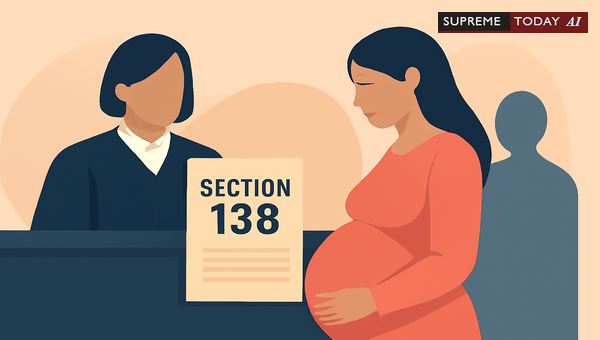
Pregnant Women Exemption in Section 138 NI Act Cases
Imagine a pregnant woman, navigating the challenges of impending motherhood, suddenly summoned to court for a under . Must she appear personally, risking her health? Or can courts grant exemption? This is a common concern for many facing such proceedings.
Even under Section 138 NI Act matters, the accused can be granted exemption from for pregnant women. Courts have consistently recognized this discretion, balancing justice with humanitarian considerations. In this post, we delve into the legal framework, key judgments, and practical guidance.
Understanding Section 138 NI Act and
Section 138 of the NI Act deals with cheque dishonour, a technical offence often resulting in . Under the , particularly Section 205, magistrates have discretion to exempt accused from , allowing representation by counsel.
Courts emphasize that isn't absolute in these cases. As noted in
, the discretion of the court to grant exemption from should be exercised only in rare instances with good reasons, and health or hardship are valid grounds.
This principle extends to various hardships, including health issues, old age, or distance
Arun D. Deshpande VS Vipin Oil Extraction (P) Ltd. - Dishonour Of Cheque (2002)
2001 1 Supreme 124.Courts' Discretion for Pregnant Women
Pregnancy qualifies as a significant health-related hardship. While no statutory provision explicitly lists it, judicial precedents support exemptions.
In a pivotal case
, the petitioner, a pregnant woman facing Section 138 charges, sought relief from a . The court held: The court clarified that ... of the accused is not always necessary in Section 138 cases, allowing for and application for exemption. It stayed the warrant, directing her to apply for exemption under Section 205 CrPC, recognizing pregnancy as a valid circumstance.
Similarly, 2022 0 Supreme(SC) 1683 acknowledged a woman's status, granting exemption considerations, indicating sensitivity towards women's special conditions, extendable to pregnancy.
Another judgment 2000 0 Supreme(Kar) 611 stressed a liberal and humane approach in granting exemption from personal attendance to women accused, considering social and religious factors. The court allowed exemption unless essential for justice.
Key Judicial Principles and Balancing Act
Courts balance accused rights with prosecution interests:- Discretion is Judicial: Exemptions aren't automatic but require good cause
.- No Prejudice to Prosecution: Ensure trials proceed smoothly 2011 1 Supreme 559.- Evidence Recording: Possible via counsel under , even for via 2011 0 Supreme(Ori) 25.
In 2015 0 Supreme(Mad) 2960, for busy businessmen in NI Act cases, the court dispensed with appearance, noting: the absence of the petitioners will not hamper the progress of the case, that too in 138 N.I. Act proceedings.
For women,
REP
referenced for dispensing in appropriate cases.Exceptions and Limitations
Exemptions have boundaries:- Not Routine: Must be judicious; courts may demand proof like medical certificates
.- Essential Stages: Personal presence may be required for or key hearings 2000 0 Supreme(Kar) 611.- Procedural Safeguards: Warrants can't be issued hastily; follow 2024 0 Supreme(Raj) 423.
In 2014 0 Supreme(Raj) 255, courts rejected exemptions without proof of ailments or distance, directing appearance.
2015 0 Supreme(Del) 3306 affirmed: granting of exemption from is the discretion of the Court.
Practical Recommendations for Pregnant Accused
If you're a pregnant woman facing Section 138 proceedings:1. File Prompt Application: Under Section 205 CrPC, supported by medical proof.2. Highlight Hardships: Emphasize pregnancy risks, travel difficulties.3. Engage Counsel: For representation and arguments.4. Seek Interim Relief: Stay warrants if needed, as in
.
Legal practitioners should cite precedents like health exemptions
Arun D. Deshpande VS Vipin Oil Extraction (P) Ltd. - Dishonour Of Cheque (2002)
and women's liberal approach 2000 0 Supreme(Kar) 611.Broader Context: Evolving Judicial Sensitivity
Indian courts increasingly adopt humane approaches in . Guidelines from cases like Bhaskar Industries (2001) stress avoiding harassment while preventing delays.
In NI Act trials, focus remains on complainant's burden, reducing accused presence needs 2015 0 Supreme(Mad) 2960.
Conclusion and Key Takeaways
Generally, courts may grant pregnant women exemption from in Section 138 NI Act cases, exercising discretion under CrPC provisions. This upholds justice without undue hardship.
Key Takeaways:- Pregnancy is a valid ground, akin to other health issues.- Back applications with evidence.- Exemptions balance both parties' interests.
This post provides general information based on judicial trends and is not legal advice. Consult a qualified lawyer for your specific situation.
References
- Discretion for exemptions on health grounds.
- 2011 1 Supreme 559 - Hardships permitting exemptions.
- Pregnancy-specific relief in NI Act case.
- 2022 0 Supreme(SC) 1683 - Consideration for women's status.
- 2000 0 Supreme(Kar) 611 - Humane approach for women.
Stay informed, and prioritize well-being amid legal challenges.
#Section138NIAct, #ChequeBounce, #PregnantAccused















