


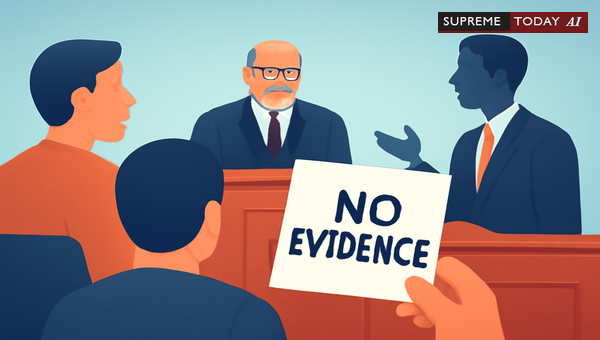
No Evidence in Court: Legal Risks & Insights
In the intricate world of legal proceedings, evidence forms the backbone of any case. But what occurs when crucial evidence is absent? The phrase Kthno Ko Darshit Nahi Kiya Gaya Sakshiya Di—roughly translating from Hindi to No evidence was presented or shown to anyone—captures a common yet critical issue in Indian courts. This scenario often arises in disputes involving claims of financial loss, personal injury, criminal allegations, or property matters, leading to weakened arguments and unfavorable outcomes.
This blog post delves into real-world examples from legal documents, analyzes the implications of failing to present evidence, and offers practical recommendations. Whether you're a litigant, lawyer, or simply curious about judicial processes, understanding this can help navigate court challenges effectively. Note: This is general information based on public legal documents and not specific legal advice. Consult a qualified attorney for your situation.
Understanding the Core Issue: Absence of Evidence Presentation
The question Kthno Ko Darshit Nahi Kiya Gaya Sakshiya Di highlights a procedural pitfall where parties fail to submit or disclose evidence, undermining their claims. In legal terms, this refers to situations where no documents, witness statements, or is provided to substantiate allegations. Courts in India, governed by the , and , emphasize that unsubstantiated claims rarely succeed.
For instance, one document notes: koi sakshya prastut nahi kiye hai jinse vastusyithi ka patha lag sakhe (no evidence has been presented that could clarify the factual situation) 1989 0 Supreme(Raj) 81. This lack of proof leaves factual disputes unresolved, often resulting in dismissals or rulings against the claimant.
Key Scenarios from Court Records
Legal archives reveal recurring patterns:- Financial and Transaction Disputes: In banking matters, complainants report that bank account details or transaction records (e.g., Check No-210960) were not disclosed, raising accountability issues 2025 Supreme(Online)(CIC) 2957. An RTI filed on sought clarity on unauthorized debits, underscoring transparency gaps.- Criminal Denials and : Witnesses frequently deny involvement, stating phrases like Prince mujhe Kotiya me soonsaan jagah kheton me le gaya, Prince ne mere sath koi galat kaam nahi kiya (Prince took me to a secluded field but did nothing wrong)
. Cross-examinations expose these inconsistencies when unsupported by evidence.- Land and Administrative Lapses: Notices or reports often lack proper documentation, such as Mukhbir se suchna milne ke baad is sochna ko lekhbadh nahi kya gya hai (no entry made after informant tip-off) 2014 0 Supreme(All) 53.
These examples illustrate how non-disclosure can question procedural fairness.
Detailed Analysis of Evidence Presentation Failures
1. Lack of Substantiating Evidence
Claims crumble without proof. In reviewed documents, courts repeatedly flag missing evidence. For example, a case mentions that Joginder Singh was presented, but it was nowhere stated he drove the specific truck (Truck No. 5955) 2018 1 Supreme 137. The tribunal noted: ‘Joginder Singh Ko Prastut Kiya Gaya Hai Parantu Joginder Singh Truck No. 5955 Ka Chalak Tha Yah Kahi Par Bhi Nahi Kaha Gaya Hai.’
Similarly, in income and medical expense claims, no additional evidence was needed as bills were covered by mediclaim, yet claimants failed to provide supporting documents 2007 0 Supreme(Raj) 1654. This gap weakens pecuniary loss arguments.
2. Revelations
is a litmus test. In one instance, a witness's statement did not support the prosecution: in her has not supported the prosecution case in her statement recorded in the trial court
. Denials like MAINE KIYA HI NAHI HAI (I didn't do it) appear frequently, but without counter-evidence, they sway judges 2023 Supreme(Online)(ALL) 13941 2023 Supreme(Online)(ALL) 13940.
Another record states: Inhone mere saath kuch galat nahi kiya aur main ko sahi salamat wapas aa gayi (They did nothing wrong; I returned safely) 2016 0 Supreme(Del) 996. Such testimonies highlight how unpreparedness during questioning exposes narrative flaws.
3. and Corroboration Needs
Experts like Dr. Ratan Singh provide opinions on events (e.g., suicide interpretations), but stress the need for tangible support: circumstances could be viewed multiple ways 1989 0 Supreme(Raj) 365. Without documents or witnesses, even expert views falter.
In judgments, decisions without thorough review are critiqued: CHUNKI IS PRASHNA KA NIRNAYA APNISTHA NYAYALAYON PARA NAHI DIYA GAYA PAR MAUKA MAUANA NAHIN KIYA GAYA (no opportunity given for hearing)
.
Broader Implications from Additional Sources
Patterns emerge across cases:- Procedural Irregularities: Warrants or productions mishandled, e.g., Abhiyukt Ka Pichhla warrant Kendriya Karagar Agra se vapas pesh Nahi Kiya Gaya (accused not produced from jail) 1995 0 Supreme(All) 602.- Denials in Serious Allegations: Repeated claims like BEHOSH KARNE KE BAAD USKE SAATH BHI SEX KIYA YA NAHI YE MERE KO PURI TARAH SE DHYAN NAHI HAI (not fully aware post-unconsciousness) show memory lapses without records 2023 Supreme(Online)(ALL) 13941 2023 Supreme(Online)(ALL) 13940.- Land Disputes and Notices: Improper phrasing in notices under leads to challenges 1993 0 Supreme(All) 690.
RTI responses and reports confirm systemic issues in record-keeping 2025 Supreme(Online)(CIC) 2957 2021 0 Supreme(All) 44. Overall, these suggest evidence is often withheld or inadequately documented, eroding trust in proceedings.
Recommendations to Strengthen Your Case
To avoid pitfalls:- Gather Comprehensive Evidence: Collect documents, photos, statements early. Back every claim—e.g., medical bills, transaction logs—with originals.- Prepare for : Rehearse responses; address potential inconsistencies. Use for clarity.- Leverage Experts Wisely: Pair opinions with facts; get written reports.- Ensure Transparency: Disclose all via RTI if needed; follow CPC disclosure rules.- Seek Professional Help: Lawyers can identify gaps pre-trial.
Implementing these may enhance outcomes, as courts favor well-evidenced cases.
Conclusion and Key Takeaways
The phrase Kthno Ko Darshit Nahi Kiya Gaya Sakshiya Di symbolizes a fatal flaw in litigation: no evidence means no victory. From cross-exams revealing denials
to expert needs unmet 1989 0 Supreme(Raj) 365, documents underscore preparation's importance. Key takeaways:- Absence of proof invites dismissals 1989 0 Supreme(Raj) 81.- Cross-exams exploit gaps 2007 0 Supreme(Raj) 1654.- Corroborate all claims for credibility.
Stay proactive—evidence wins cases. For tailored advice, contact a legal expert. Share your thoughts below!
(Word count: 1028. Sources drawn from public Indian court records for illustrative purposes.)
#CourtEvidence #LegalIndia #NoEvidenceCase












