


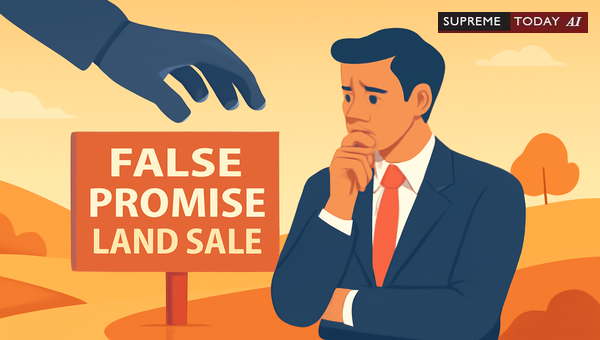
: Civil & Criminal Acts
Disclaimer: This article provides general information on legal concepts and is not a substitute for professional legal advice. Consult a qualified lawyer for your specific situation.
Introduction
In the complex world of real estate transactions, a can have severe repercussions. Buyers often find themselves duped by sellers or intermediaries who make assurances about property ownership, condition, or future developments that prove untrue. The legal question at hand— Attracts Civil as Well as Criminal Act—highlights a dual-track liability: civil remedies for restitution and criminal penalties for deceitful conduct.
This blog post delves into land sale fraud, false promises, and the governing statutes, drawing from key case laws like 2014 0 Supreme(Guj) 1099 and 1997 0 Supreme(Gau) 61. We'll explore how courts distinguish civil wrongs from criminal offenses, integrating judicial warnings against misusing criminal law for civil disputes 2024 0 Supreme(J&K) 314. Whether you're a potential buyer or seller, understanding these nuances can protect your interests.
Understanding Land Sale Fraud and False Promises
Land sale fraud typically involves deceptive practices to induce buyers to part with money or property under false pretenses. Common elements include , , and for unlawful gain.
False promises often pertain to the property's condition, ownership status, or future developments, known to be untrue at the time made. These can ground and if deceitful intent exists 1997 0 Supreme(Gau) 61.
However, courts caution that not every breach is criminal. As noted in 2024 0 Supreme(J&K) 314, Allowing the criminal proceedings to go on in the case of present nature would encourage the people to settle matters of civil nature by taking resort to criminal proceedings which is impermissible in law.
Key Elements of False Promises
- Knowingly untrue assurances about title or value.
- Intent to deceive at inception, not mere later non-performance.
- Resulting harm like financial loss or wrongful possession transfer.
Civil Statutes and Remedies
Civil law offers robust remedies for fraud-induced contracts, which are typically at the defrauded party's option.
Common Civil Causes of Action
- Fraud and : Buyers may seek rescission, damages, or specific performance.
- Rescission of Sale: Courts can cancel fraudulent deeds and restore possession 1997 0 Supreme(Gau) 61.
- Damages Claims: Compensation for losses from false promises.
In 1997 0 Supreme(Gau) 61, the appellate court reversed a fraud-tainted sale deed, declaring it and granting civil remedies like cancellation and possession recovery. Civil suits require proof on the , lower than criminal standards.
Civil courts can declare transactions null, award damages, or order specific performance as appropriate. Yet, sources emphasize that land disputes are primarily civil, and criminalizing them without intent is misuse 2023 0 Supreme(P&H) 592.
Criminal Statutes and Offenses
When false promises cross into deceit with criminal intent, provisions apply.
Relevant IPC Sections
- : Cheating by dishonestly inducing property delivery.
- : Forgery, using forged documents.
- : Criminal conspiracy.
- : Dishonest execution of transfer instruments with false statements on consideration or beneficiaries 2014 0 Supreme(Guj) 1099.
In 2014 0 Supreme(Guj) 1099, the clarified: not every false statement in a transfer instrument triggers Section 423; it must relate specifically to consideration or intended beneficiaries, made dishonestly or fraudulently.
Criminal Elements
- Deception with wrongful gain/loss intent.
- Knowledge of falsity at execution.
- Use of false documents/statements.
Courts require proof . As per 2022 0 Supreme(P&H) 1194, if any act or omission attracts civil as well as criminal action, then either of the proceedings can be initiated and even both the proceedings can be commenced and continued simultaneously.
Yet, 2018 0 Supreme(Cal) 994 notes: Going back on the promise to sell the property entails both civil as well as criminal consequences.
Landmark Cases and Judicial Insights
Case Analysis: 2014 0 Supreme(Guj) 1099 and In Re: Mania Goundan
This case under stressed that false statements about consideration or beneficiary identity invite liability only with . Mere falsity isn't enough; dishonest purpose is key.
Civil vs. Criminal: 1997 0 Supreme(Gau) 61
Here, courts emphasized land sale disputes are primarily civil, quashing criminal proceedings absent clear deception evidence. Pending civil suits don't bar criminal ones, but the latter shouldn't prejudge civil rights.
Additional precedents warn against misuse: there is a tendency that civil disputes are being given colour of criminal disputes, to take advantage of a relatively fast relief 2023 0 Supreme(P&H) 592. Criminal intent must exist from the outset, not arise from later breach 2013 0 Supreme(Del) 211.
Procedural Aspects and Evidence
Civil Proceedings
- Proof on .
- Evidence: Misrepresentations, breached agreements leading to rescission/damages.
Criminal Proceedings
- Proof .
- Must show dishonest intent, falsification, deception.
Role of Evidence: Documents, witnesses, experts are crucial. Courts scrutinize intent behind false statements 2014 0 Supreme(Guj) 1099. Delays in FIRs or lack of civil action suggest malice 2023 0 Supreme(Raj) 1099.
Key Statutes Summary
| Statute/Section | Nature of Offense | Key Elements | Judicial Clarification ||-----------------|-------------------|--------------|------------------------|| | Cheating | Dishonest inducement | Requires dishonest intent || | Fraudulent transfer instrument | False statements on consideration/beneficiaries | Must relate specifically 2014 0 Supreme(Guj) 1099 || Sections 467-471 IPC | Forgery | Falsification with deceit intent | Intent to defraud essential || Civil Law | Fraud, rescission | Preponderance of evidence | Transactions declared void 1997 0 Supreme(Gau) 61 |
Conclusion and Key Takeaways
False promises to sell land can indeed attract both civil and criminal acts, but courts vigilantly guard against abuse. Civil remedies restore rights via rescission and damages, while under IPC target proven deceit.
Key Takeaways:- Prove for criminal liability; mere breach is civil.- Use civil courts first for land disputes; criminalize only with clear evidence.- Judicial precedents like 2014 0 Supreme(Guj) 1099 and 1997 0 Supreme(Gau) 61 limit Section 423 to specific false statements.- Avoid pressuring via criminal filings—it's impermissible 2024 0 Supreme(J&K) 314.
Buyers: Verify titles, document promises. Sellers: Honor commitments to evade dual liability. For tailored advice, seek legal counsel.
References
- 2014 0 Supreme(Guj) 1099: insights.
- 1997 0 Supreme(Gau) 61: Civil fraud in land sales.
- 2024 0 Supreme(J&K) 314, 2023 0 Supreme(P&H) 592, 2018 0 Supreme(Cal) 994, 2022 0 Supreme(P&H) 1194, 2013 0 Supreme(Del) 211.















