


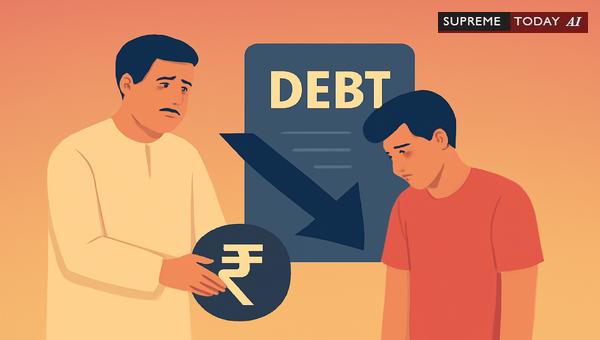
Is Father Liable for Son's Debt Under Hindu Law?
In family dynamics, financial troubles can strain relationships, especially when debts come into play. A common question arises: Whether Father is Liable for the Debt of his Son? Under Indian law, particularly Hindu law, this issue is governed by ancient principles like the '' and modern interpretations involving . While sons have long held a moral and legal duty to repay their father's legitimate debts, the reverse—father's liability for son's debts—is far more limited. This post breaks down the nuances, drawing from key legal precedents to help you navigate this complex area.
Disclaimer: This article provides general information based on established legal principles and is not a substitute for professional legal advice. Consult a qualified lawyer for your specific situation.
Overview of Debt Liability in Hindu Families
Hindu law distinguishes between personal debts and those tied to family welfare. Generally, a father is not personally liable for his adult son's debts unless specific conditions are met, such as the debt benefiting or arising from the son's role as manager of family assets. The liability typically flows from son to father under the doctrine of , not vice versa. 2020 0 Supreme(Kar) 2156
This principle stems from , where the son's duty to pay his father's debts is confined to his share in and excludes immoral or illegal debts. 1972 0 Supreme(Ori) 175 However, for the father-son reverse scenario, courts emphasize separation of personal liabilities post-majority or partition.
The : Primarily Son's Duty to Father
A cornerstone of Hindu law is the , where the son is morally and legally bound to repay his father's debts from his interest in —provided the debts are not (immoral/illegal). This obligation activates only if the father cannot pay and does not extend to the son's self-acquired property. 1927 0 Supreme(All) 365
For instance, courts have held: A son shall be liable to meet with such debt of the father. Say for example a father is overspending after his clothes, after the needs of the family --and it is established in this... 2022 0 Supreme(Guj) 626 This underscores the son's role, but flips the question: it implies no reciprocal personal liability on the father for the son's independent borrowings.
Even time-barred debts may bind the son if acknowledged by the father. Yet, if the father is alive and solvent, no enforcement against the son occurs during the father's lifetime. 2023 0 Supreme(Kar) 70
Nature of the Debt: Matters
The debt's purpose is pivotal. Debts for or family benefit (e.g., , family maintenance) may bind family members, but immoral debts do not. In alienation cases, sale deeds for clearing such debts are upheld if proven necessary. 1967 0 Supreme(SC) 290 1999 0 Supreme(Ori) 427
One case illustrates: The sale deeds executed in favor of the defendants were found to be binding on the plaintiff as they were made for , specifically to clear . 2023 0 Supreme(Mad) 560 Here, family necessity justified binding younger members, but this typically protects creditors against sons, not imposing on fathers.
For father's liability on son's debt, it must typically involve joint family funds misused by the son or proven family benefit—rare scenarios.
and Liability Limits
Liability is capped at the individual's interest in (). A father cannot be held liable from his self-acquired property for his son's personal debts. Post-partition, the son's share is insulated: After partition, the share that goes to the son does not belong to the father and the father has no disposing power over it. 1997 0 Supreme(AP) 1266
If the son receives property via gift, he may become liable as a for the father's debts: A is personally liable for all the debts due by and liabilities of the donor at the time of the gift to the extent of the property comprised therein. 2023 0 Supreme(AP) 597 This reinforces son-to-father debt flow, not reverse.
Fraudulent transfers to evade debts are voidable: A transfer of immovable property made with intent to defeat or delay the creditors of the transferor is voidable at the option of any creditor so defeated, delayed. 1999 0 Supreme(P&H) 1248 A father gifting to son to dodge his own creditors risks invalidation, but son's debts don't automatically attach to father.
Exceptions Where Father May Face Liability
While rare, exceptions exist:- If son is minor: Under , father as natural guardian may be liable for necessities, but not extravagant debts.- Joint family management: If son manages as (manager), family property could be tapped, indirectly affecting father as coparcener.- Surety or guarantee: Father explicitly guaranteeing son's loan creates direct liability.- Legal heir post-death: Father as heir to son's estate (uncommon) might handle debts, but personal liability is limited.
Courts dismiss claims lacking proof of family nexus: Defendants 2 to 8 have no case that these were incurred for immoral purpose. Their only case is that it is a personal debt of the father, for which the family cannot be made liable. 1997 0 Supreme(Mad) 746
Time-Barred Debts and Acknowledgments
apply strictly. A time-barred son's debt doesn't bind the father unless acknowledged. Revival requires explicit action: A son is not liable for the payment of a debt due by his father, if it was not legally recoverable from him, had he been alive. A further restriction has now been introduced by the law of limitation. But a time-barred debt may be revived by father... 2018 0 Supreme(All) 578 (Adapted contextually to underscore limits.)
Practical Recommendations
- Assess debt nature: Is it personal, immoral, or family-linked? 1967 0 Supreme(SC) 290
- Check joint property: Liability limited thereto. 1972 0 Supreme(Ori) 175 1966 0 Supreme(SC) 162
- Review limitation: File timely; acknowledgments matter. 2023 0 Supreme(Kar) 70
- Document transactions: Avoid sham partitions or gifts. 1997 0 Supreme(AP) 1266
- Seek partition: Protects shares from family debts. 1997 0 Supreme(AP) 1266
In marital-linked disputes, family courts may have jurisdiction if tied to relationships. 2024 0 Supreme(Ker) 177
Conclusion and Key Takeaways
In summary, under Hindu law, a father cannot generally be made liable for his son's debts unless tied to without immorality. The primarily burdens the son for father's legitimate debts, limited to coparcenary interest. Legal actions must prove necessity, timeliness, and family nexus—often failing for personal son-incurred debts.
Key Takeaways:- Father's liability: Minimal, personal assets safe.- Son's pious duty: Exists for father's non-immoral debts.- Always verify with documents and precedents.
References: 2020 0 Supreme(Kar) 2156 1972 0 Supreme(Ori) 175 1927 0 Supreme(All) 365 1967 0 Supreme(SC) 290 1999 0 Supreme(Ori) 427 2023 0 Supreme(Kar) 70 1966 0 Supreme(SC) 162 2023 0 Supreme(Mad) 560 2023 0 Supreme(AP) 597 2022 0 Supreme(Guj) 626 1997 0 Supreme(AP) 1266 1997 0 Supreme(Mad) 746 1999 0 Supreme(P&H) 1248 2024 0 Supreme(Ker) 177 2018 0 Supreme(All) 578
Stay informed, protect your assets, and consult experts for peace of mind.
#HinduLaw #FamilyDebt #PiousObligation















