Searching Case Laws & Precedent on Legal Query..!
Scanned Judgements…!



Searching Case Laws & Precedent on Legal Query..!
Scanned Judgements…!
BABUBHAI JAMNADAS PATEL vs BHARAT UMEDSANG THAKORE - Gujarat
"], ["2024 0 Supreme(Mad) 2304"], ["2025 0 Supreme(MP) 225"]).BABUBHAI JAMNADAS PATEL vs BHARAT UMEDSANG THAKORE - Gujarat
"]).The exercise of revision powers is discretionary and courts may decline amendments or revisions if barred by limitation or if procedural requirements are not met, but the presence of a valid POA generally supports the petitioner’s standing (e.g., ["2023 0 Supreme(AP) 1239"], ["2022 0 Supreme(Raj) 2621"]).
Analysis and Conclusion:
References:- ["2025 Supreme(Online)(Mad) 73865"], ["
BABUBHAI JAMNADAS PATEL vs BHARAT UMEDSANG THAKORE - Gujarat
"], ["2024 0 Supreme(Mad) 2304"], ["2022 0 Supreme(Raj) 2621"], ["2023 0 Supreme(AP) 1239"], ["2022 0 Supreme(All) 1365"], ["2025 Supreme(Online)(Mad) 63580"], ["2025 0 Supreme(MP) 225"]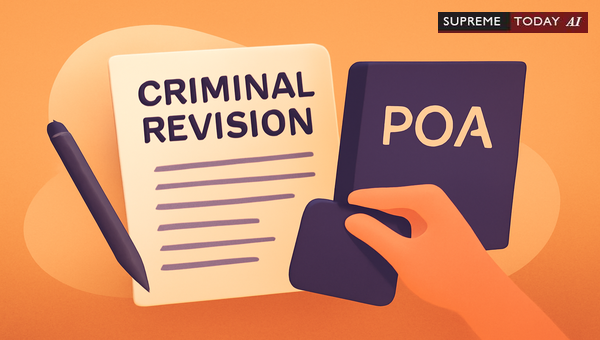
In the complex world of criminal law, procedural rules can make or break a case. One common query arises: In Criminal Proceedings, can an Applicant file a through ? This question often surfaces when parties seek to in filing criminal revisions under , especially if the applicant is unavailable. While (PoA) offers convenience, courts impose strict safeguards to ensure proper representation.
This post breaks down the legal framework, key precedents, and practical implications. Note: This is general information based on judicial rulings and not specific legal advice. Consult a qualified lawyer for your situation.
A under Sections 397 and 401 of the , allows higher courts to review lower court decisions for errors, illegality, or irregularity. It's not an appeal but a supervisory power. Limitation periods apply, typically 90 days from the , governed by .
Filing late requires a condonation application under , proving for delay. But who can file this? The party personally, an advocate, or a PoA holder?
Generally, an applicant cannot file a —or a related —through a PoA holder without explicit court permission. The law distinguishes between civil and criminal matters. In criminal cases, courts prioritize direct involvement or authorized legal representation to uphold procedural integrity.
Key principle: A PoA holder does not automatically become a . As held: An agent cannot become a '' for the party in criminal proceedings, unless the party secures permission from the court to appoint him to act in such proceedings.2022 0 Supreme(Raj) 2621 1999 0 Supreme(Ker) 149
This applies to filing revisions and ancillary applications like .
Mere PoA execution doesn't suffice; court scrutiny prevents misuse.
Courts consistently reinforce this. In one ruling: The appearance of the accused cannot be made through a holder. An agent cannot become a '' for the party in criminal proceedings unless the party secures permission from the court.2023 0 Supreme(Raj) 1415
A practical example: A criminal revision was filed through a PoA agent, but proceedings stalled when the agent died, and counsel withdrew. The court noted procedural lapses, underscoring risks of relying on unauthorized PoA. 2020 0 Supreme(Mad) 214
Contrast with civil contexts: PoA is more flexible, e.g., landlords filing eviction via PoA under rent laws. But criminal proceedings demand stricter oversight. 2018 0 Supreme(P&H) 3565
Limitation applications under Section 5, Limitation Act, accompany delayed revisions. Courts demand genuine reasons—vague claims like illness without proof fail.
In a case, a 327-day delay in criminal revision (under Sections 397/401 CrPC) was rejected: The applicant cited illness and certified copy delays, but explanations were unsubstantiated and casual. The court dismissed both the condonation and revision, stressing vigilance.2024 0 Supreme(All) 80
Another instance condoned delay due to medical treatment at , but only after scrutiny. 2012 0 Supreme(Pat) 1124
Can PoA file these? Same rule: No, without permission. Even if filed, courts verify authority, potentially dismissing for lack of standing.
Limited exceptions exist:- Court-Granted Permission: If satisfied with the PoA holder's ability, courts may allow. 2022 0 Supreme(Raj) 2621- : Preferred for revisions.- Emergencies: Rare, e.g., 's broad revision powers, but not automatic PoA endorsement.
In bail/revision contexts, absconding accused face warrants under , reinforcing personal appearance. 2017 0 Supreme(Guj) 118
Parties ignoring this risk dismissal, as in maintenance revisions where PoA issues complicated matters. 2020 0 Supreme(Mad) 214
| Aspect | Rule | Citation ||--------|------|----------|| PoA Filing Revision | Needs court permission | 2022 0 Supreme(Raj) 2621 1999 0 Supreme(Ker) 149 || Advocates | Automatic right | 1999 3 Supreme 308 || | required | 2024 0 Supreme(All) 80 || Appearance | Not via PoA without approval | 2023 0 Supreme(Raj) 1415 |
In summary, while PoA simplifies civil matters, criminal proceedings like revisions and limitation applications demand court-sanctioned representation. An applicant cannot generally file through PoA without permission, as precedents emphasize. This protects judicial process integrity.
Facing a similar issue? Review your options early. For tailored guidance, contact a criminal law expert. Stay informed—procedural missteps can bar remedies.
References:1. 2022 0 Supreme(Raj) 2621 – PoA as needs permission.2. 1999 0 Supreme(Ker) 149 – Agent limitations in criminal cases.3. 1999 3 Supreme 308 – Court verification for non-advocates.4. 2023 0 Supreme(Raj) 1415 – No automatic PoA appearance.5. 2024 0 Supreme(All) 80 – standards.6. 2020 0 Supreme(Mad) 214 – PoA issues in revision.
#CriminalRevision #PowerOfAttorney #CrPC


In the prayer portion, the amendment to cancel the Agreement of Sale-cum-General Power of Attorney, dtd. 4/3/2010 was sought. 6. ... The present Revision Petition is filed against the interlocutory order dtd. 3/2/2018 passed in I.A.No.943 of 2015 in O.S.No.1486 of 2012 on the file of the Court of the Learned III Additional Senior Civil Judge, Vijayawada, Krishna District. 2. ... The defendants filed their counter opposing the same and the primary objection taken by the defendants was that the amendment is barred by #HL_....

During the year 2003, petitioner had executed a Power of Attorney Deed in favour of his brother viz., Govardhan which was registered as Document No.16/IV/2003 on the file of Sub Registrar Office, Sriperumbudur. 3. ... However, the said property does not form part of the Power of Attorney Deed executed by petitioner. ... Aggrieved by the said order, petitioner has filed the present Criminal Revision Case. 5. ... It is submitted that in criminal law, ....

The matter comes upon an application under Section 5 of the Limitation Act for condoning the delay arises in filing the criminal revision petition. 2. Heard on application under Section 5 of the Limitation Act. ... For the reasons and grounds mentioned therein, the application seeking condonation of delay is allowed. Delay of 81 days in filing criminal revision petition is condoned. Let the revision petition be tre....
Acquittal-Refusal of Attorney-General to sanction an appeal -Application for revision-Powers of Supreme Court-Criminal Procedure Code, ss. 356 and 357. The Supreme Court has full powers of revision in all criminal cases. ... It appears to me that the language of that section invests the Supreme Court with full powers of revision in all criminal cases. I do not think that that power is at all limited to those cases in which either no appeal lie....

Sri Prabhat Kumar, learned counsel for the opposite party no. 2 has controverted the contention of the counsel for the applicant and submitted that it is wrong to say that the opposite party no.2 while filing the revision did not file the application for condonation of delay under Section 5 of the Limitation ... Instant application has been filed by the applicant, assailing the order dated 30.6.2016 passed by the Additional District and Sessions Judge, Court No.1, Dis....

present revision application. ... , 1908 (for short “the CPC”), the present revision application is filed. ... Learned advocate Mr.Parthiv Shah appearing for the applicant has submitted that the applicant filed an application under Order VII Rule 11 of the CPC below Exh.14 seeking rejection of the plaint, however, the same has been rejected by the court below, which has constrained the the applicant to file the ... basis of the said....

the Courts have no power to extend the period of limitation on equitable grounds. ... 10.Further more, the matter comes up for consideration of application under Section 5 of the Limitation Act with a prayer for condoning the delay of 833 days in filing the Criminal Revision Petitions. ... In the above circumstances, the petitioner was unable to file the present Criminal Revision Petitions within the stipulated time, resulting in....
This criminal revision has been filed with delay of 327 days. Issue notice to the respondent no. 2 returnable at an early date for hearing on delay condonation application filed under Section 5 Limitation Act. ... The revision was presented before the Section Officer, Stamp Reporter (Criminal) High Court, Allahabad on 12.04.2023 and was reported to be in limitation upto 29.05.2022 and thus beyond time by 318 days. ... That thereafter the Applicant d....
The Criminal Revision is directed against the order passed in Cr.M.P.No.103 of 2024 in M.C.No.207 of 2023 dated 23.05.2024 on the file of the Family Court, Madurai, allowing the application filed under Order 3 Rule 1 and 2 and Section 151 C.P.C. seeking permission to defend ... In the result, this Criminal Revision Petition is dismissed.Consequently, connected Miscellaneous Petition is closed. ... As already pointed out, the respondent has appointed his father as power#HL_E....

No.11554 of 2025 – an application under Section 5 of the LIMITATION ACT for condonation of delay in presentation of present criminal revision. ... No.11554 of 2025 – application under Section 5 of LIMITATION ACT seeking condonation of delay is hereby dismissed. Consequently, this Criminal Revision is also dismissed. No order as to costs. ... of 1074 days i.e. almost a period of two years and nine months caused in presentation of the rev....

1. The criminal revision petition is directed against the order dated 05.08.2013, passed in M.C.No.12/2011, on the file of the Chief Judicial Magistrate Court, Nagapattinam. In this matter, the criminal revision petitioner has filed the revision through his power of attorney agent Ziauddin Ahmed. At one stage of the matter, it was reported to this Court that the power of attorney agent had died. Further, the counsel who had filed vakalat for the power of attorney agent had withdrawn his appearance and after the same had been recorded by this Court, notice had been sent to t....

The landlord can file eviction petition through his/her Power of Attorney. 7. However, on consideration of the matter, I find no force in the contention raised by the learned counsel for the petitioner. The petition filed by the tenant was dismissed and it has been held that it was not necessary for the landlord to have given detailed reasons for seeking eviction in power of attorney. While referring to the judgment of Hon'ble the Supreme Court in a case of Baldev Singh Bajwa v. Monish Saini , (2005) 12 JT 442, this Court observed as under:-

But due to impugned order, the applicants are deprived their rights for remedy available under the law. Therefore, the applicants are constrained to file present Criminal Revision Application. He also submitted that the present applicants have right to obtain remedy by resorting legal recourse in accordance with law. He further submitted that the present applicants have preferred bail applications before the trial Court and the bail application of the applicant No. 3 was rejected on 23.7.2016 and during the adjudication of bail application preferred by the applicant No. 3, ....

It is made clear that no interference is called for in former order dated 17.09.2012, passed by learned Sessions Judge, whereby the application under Section 5 of the Limitation Act was allowed, in as much as mere technicality should not be allowed to come in the way in deciding some important matter on merits. It is only after allowing application under Section 5 of the Limitation Act that the revision court proceeded to hear criminal revision no.

The limitation in filing the main criminal revision application is condoned. 2 to 6 that the delay has not been properly explained, yet for the reasons disclosed in this interlocutory application that the petitioner was undergoing treatment at AIIMS, New Delhi, prayer for condonation of delay is hereby allowed.


An indispensable Tool for Legal Professionals, Endorsed by Various High Court and Judicial Officers
Please visit our Training & Support
Center or Contact Us for assistance

Scan Me!
India’s Legal research and Law Firm App, Download now!


For Daily Legal Updates, Join us on :



 Back to top


