


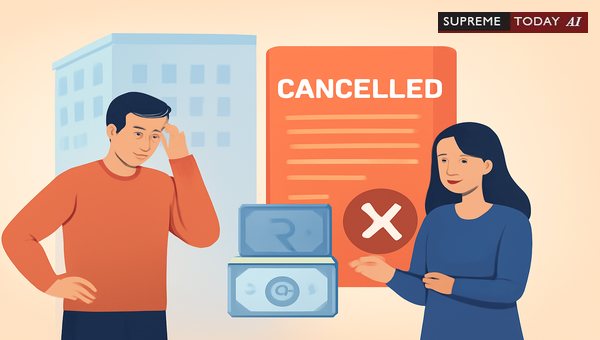
Flat Booking Cancellation: Non-Refund Not ?
In the bustling real estate market of India, disputes over flat bookings are common. Imagine this: a buyer books a flat, pays an advance, then cancels due to personal reasons or project delays, only to demand a full refund. When the builder withholds part of the amount citing , the buyer accuses them of . But is non-payment of refund money upon cancellation really under Indian law?
The question at hand is: Cancellation of Flat Booking Non Payment of Refund Money is Not Amounting to . Generally speaking, the answer is yes—this does not automatically constitute , absent evidence of or deception from the outset. This blog post dives deep into the legal nuances, drawing from judicial precedents and consumer protection orders to clarify this for homebuyers, developers, and legal enthusiasts.
Main Legal Finding
Non-payment of refund money by a builder or developer upon cancellation of a flat booking does not automatically amount to under Indian law, provided there is no evidence of , deception, or at the time of entering into the agreement. Typically, contractual clauses and legal principles recognize that cancellation and forfeiture of amounts are permissible if they are clearly stipulated and do not involve fraudulent conduct.
SHIPRA ESTATES LTD. VS NARESH CHAND SETH - Consumer (2013)
This stance is echoed across multiple rulings, emphasizing that mere does not elevate to .
Key Points to Understand
- Cancellation and non-refund alone isn't : Under Indian law, simply cancelling a flat booking and not refunding the full amount does not constitute .
Harbinder Pal Singh VS Angel Infrastructure Pvt. Ltd. - Consumer (2018)
- requires initial deception: demands dishonest intent or deception at the transaction's inception, not just later non-performance. 2021 0 Supreme(Jhk) 535
- are enforceable if fair: Consumer protection orders uphold clear forfeiture terms, ruling them as contractual rights, not fraud.
SHIPRA ESTATES LTD. VS NARESH CHAND SETH - Consumer (2013)
- Distinction between civil and criminal: Without fraud at booking, issues remain like .
Satish Chandra VS Lotus Green Developers Pvt. Ltd. - Consumer (2022)
Detailed Analysis: Nature of Cancellation and Refunds in Real Estate
Real estate agreements often include clauses making booking amounts non-refundable or subject to forfeiture upon cancellation. Courts have consistently held that such provisions do not amount to if transparently stated.
For instance, in
SHIPRA ESTATES LTD. VS NARESH CHAND SETH - Consumer (2013)
, it's noted that are void only in certain circumstances (e.g., prior to construction), but generally, if the agreement explicitly states that the booking amount is non-refundable or subject to forfeiture, then non-refund does not amount to .Similarly,
Harbinder Pal Singh VS Angel Infrastructure Pvt. Ltd. - Consumer (2018)
clarifies: when a builder cancels a project due to unavoidable circumstances and informs the buyer, refusal to refund the amount (if stipulated as non-refundable) does not constitute but rather a contractual breach or cancellation based on agreed terms.From additional cases, cancellation due to non-payment by the buyer is a common scenario. Builders issue reminders before acting. In 2025 0 Supreme(Pat) 204, The another intimation was made on as to clear dues within next 15 days, failing which the booking of flat may lead to its cancellation... Subsequently, final reminder was also issued... on . This shows procedural fairness, reinforcing that such cancellations stem from breach, not deceit. 2023 Supreme(Online)(Del) 18851
Under Section 420 IPC: What It Really Means
defines as to deliver property through deception. Key elements include:
- Deception or dishonest intent at inception.
- Inducement to part with money or property.
The in
Mayur VS Radhakrishna Buildtech Pvt. Ltd. - Consumer (2021)
states: there is nothing to show that at the very inception there was any intention on behalf of the accused persons to cheat. Mere non-refund post-cancellation lacks this initial fraud. 2021 0 Supreme(Jhk) 535 further emphasizes: not every amounts to ; there must be deception or dishonesty from the outset.In ,
Shekhar Rijhwani VS Era Realtors Pvt. Ltd. - Consumer (2022)
observes: inordinate delay or non-refund, without , is but not .Judicial Precedents and Consumer Orders
Several orders highlight this:
Indswift Infrastructure and Development Ltd. VS Ranjit Singh - Consumer (2008)
: if the terms specify that amounts are non-refundable, withholding refunds does not amount to , especially when the buyer voluntarily agrees to such clauses.Satish Chandra VS Lotus Green Developers Pvt. Ltd. - Consumer (2022)
: the complaint does not disclose any criminal offence at all and that the allegations in the complaint disclose civil wrong only.SHIPRA ESTATES LTD. VS NARESH CHAND SETH - Consumer (2013)
: Forfeiture upheld unless unfair.
Other sources align: In 2024 Supreme(JK) 510, the petitioner had filed the present case simply to claim the refund of the ... and has not questioned the cancellation of his allotment order and forfeiture of the . This shows acceptance of terms. 2022 Supreme(Online)(Del) 7245 upheld forfeiture not exceeding 10%, ordering refund after deductions per contract.
Even in buyer-default cases, like 2023 Supreme(Online)(Del) 18169, developers refunded partially post-cancellation, and courts viewed it as lawful: The Opposite Parties while cancelling the booking, made payment for refund as well as compensation... which is not denied.
Exceptions: When It Might Cross into
While generally not , exceptions exist:
- at booking: Deliberate deception, false promises, or concealment elevates it.
Mayur VS Radhakrishna Buildtech Pvt. Ltd. - Consumer (2021)
- Unfair or vague clauses: If terms are deceptive, it could be , though not always criminal.
- : Evidence of lies about project viability at agreement time.
In
M3M India Pvt. Ltd. VS R. Ramesh - Consumer
, allegations of cancellation without refund were tied to no flat buyer agreement, but still framed as contractual, not criminal.Practical Insights from Cases
- Buyer-initiated cancellation: 2021 Supreme(Online)(Del) 4583 notes complainants cancelled via letter and demanded refund with interest per supplementary agreement.
- No automatic full refund: Developers can deduct as per terms. 2023 0 Supreme(Kar) 15: After cancellation of booking he has returned the money without any interest.
- Non-payment by allottee: Leads to lawful cancellation.
M. K. Developers VS Ashok Kumar - Consumer
: Cancellation Booking of flat for non-payment... The flat was cancelled on .
These illustrate that actions are contractual, not .
Recommendations for Buyers and Builders
- Buyers: Scrutinize refund clauses before signing. Gather evidence of any initial deception for stronger claims. Approach via for civil remedies first.
- Builders: Use clear, fair language in agreements. Issue notices for non-payment to document compliance. 2025 0 Supreme(Pat) 204
- General: Treat non-refund as breach/, not IPC 420, unless fraud proven.
Prem Kumar Chaudhary VS Bestech India Pvt. Ltd. - Consumer
This is general information based on precedents and not specific legal advice. Consult a lawyer for your case.
Conclusion and Key Takeaways
In summary, cancellation of a flat booking and non-payment of refund money does not amount to under Indian law without evidence of at inception. Cases like
Mayur VS Radhakrishna Buildtech Pvt. Ltd. - Consumer (2021)
,Satish Chandra VS Lotus Green Developers Pvt. Ltd. - Consumer (2022)
, and 2023 Supreme(Online)(Del) 18851 consistently distinguish from criminal acts. , when fair, protect developers while holding buyers accountable.Key Takeaways:- No initial fraud = No .- Contractual rights prevail in cancellations.- Seek consumer redressal for refunds, not police for .
Stay informed, read agreements carefully, and navigate real estate wisely.
References
SHIPRA ESTATES LTD. VS NARESH CHAND SETH - Consumer (2013)
Mayur VS Radhakrishna Buildtech Pvt. Ltd. - Consumer (2021)
Satish Chandra VS Lotus Green Developers Pvt. Ltd. - Consumer (2022)
- 2021 0 Supreme(Jhk) 535
Harbinder Pal Singh VS Angel Infrastructure Pvt. Ltd. - Consumer (2018)
- 2023 Supreme(Online)(Del) 18851
- 2022 Supreme(Online)(Del) 7245















