


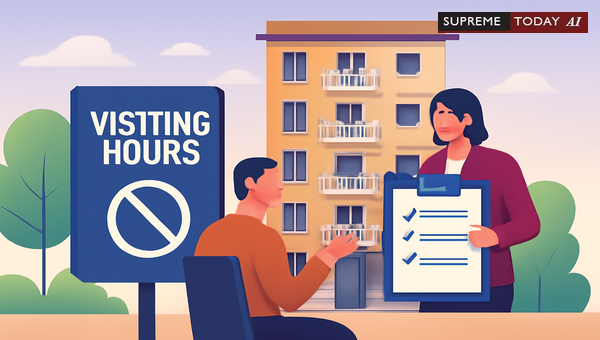
Can Housing Societies Enforce Visiting Hours on Tenants?
Imagine coming home to your apartment in a bustling housing society, only to find a notice from the committee restricting visitors to specific hours. As a tenant, you wonder: Can a Housing Society Committee Members Enforce Visiting Hours to a Tenant? This common dispute arises frequently in cooperative housing societies across India, particularly in urban areas like Maharashtra. While societies aim to maintain peace and order, tenants' rights to privacy and social interactions are protected under law.
In this post, we'll break down the legal framework, committee powers, limitations, and judicial insights. Note: This is general information based on legal principles and precedents, not specific legal advice. Consult a lawyer for your situation.
Legal Framework Governing Housing Societies
Cooperative housing societies operate under statutes like the (or equivalent state laws), and their registered . Members—typically flat owners—enjoy rights related to possession, occupancy, and transfer of flats. However, the society's authority is limited to enforcing for mutual obligations and property management, not micromanaging personal lives. 2012 0 Supreme(Kar) 601 1980 0 Supreme(Bom) 45
Tenants, as occupants under a member (landlord), are bound by society rules to the extent specified in . But the society cannot arbitrarily control visitors unless explicitly authorized. Members of cooperative housing societies hold rights primarily related to possession, transfer, and occupancy, as defined in the and governed by the . 2012 0 Supreme(Kar) 601
Disputes over possession fall under the or , but visitor restrictions like visiting hours are outside eviction scopes. 1980 0 Supreme(Bom) 45
Key Principles of Society Authority
- as the Foundation: Society rules derive from , binding on members and invitees (including tenants' visitors) only if clearly stated.
- : Any rule must be fair, non-arbitrary, and not infringe like privacy ().
- No Blanket Control: Societies regulate conduct within common areas, not inside individual flats. 2014 0 Supreme(Del) 2634
Can Committees Enforce Visiting Hours?
The short answer: Only if explicitly provided in the society's , and even then, restrictions must be reasonable.
Authority of Society Committees
Committee members manage society affairs, enforce , and regulate premises conduct. They can impose visitor restrictions if incorporate them, such as limiting noisy gatherings or security concerns. The committee's role includes managing the society’s affairs, enforcing , and regulating conduct within the premises, including restrictions on visitors if such restrictions are incorporated into the . 2014 0 Supreme(Del) 2634
However, enforcement must align with fairness. In , members own their flats outright, and societies have minimal say over internal use. This society being a Tenant-Ownership Society, the member is an owner of the house and the society has nothing to do with ownership of bungalow. 2007 0 Supreme(Bom) 966
Limitations on Enforcement
- No Arbitrary Imposition: Without bye-law backing, visiting hours are unlawful. They cannot infringe tenants' or visitors' rights.
- Tenant-Specific Rights: Tenants derive rights from landlords but enjoy occupancy protections. Societies cannot treat tenants as lesser members without basis.
- Reasonable Scope: Rules should target common area harmony, not personal visits inside flats. The society cannot impose arbitrary or unreasonable visiting hours that infringe upon the of tenants or visitors, especially if such restrictions are not explicitly provided for in the . 2014 0 Supreme(Del) 2634
If challenged, courts scrutinize for overreach. For instance, in cases involving alternative accommodations or society permissions, courts emphasize bye-law limits. 2024 0 Supreme(Guj) 2195
Judicial Precedents and Interpretations
Courts consistently limit society powers to bye-law confines, stressing reasonableness.
Bye-law Dependency: Courts have emphasized that the authority of society committees is limited to enforcing and cannot extend to arbitrary restrictions on visitors unless specifically authorized. 2014 0 Supreme(Del) 2634 The , reinforce that decisions like visiting hours must not violate rights or be unreasonable. 2014 0 Supreme(Del) 2634
Visitor Rights in Analogous Contexts: In a temple premises case, stipulated visiting hours for public devotees were upheld for convenience, but only because tied to the site's nature: Since the occupants of the premises are ordained priests, the members of the public including lay devotees are bound to meet them. Of course, for the convenience of the occupants, visiting hours had been stipulated. 2023 Supreme(Online)(Mad) 78122 This highlights contextual reasonableness, applicable to societies.
Prison and Family Visitation Insights: Courts protect visitation rights, modifying terms for welfare. In custody battles, visiting hours are adjusted but not curtailed arbitrarily: Terms and conditions to exercise visitation rights contained in clause 9 can be varied... but frequency of visitation cannot be less than four. 2021 0 Supreme(HP) 219 Similarly, electronic visits substitute physical ones during lockdowns, prioritizing access. 2021 0 Supreme(HP) 219
Society Membership and Rights: Non-members (like prospective tenants) cannot enforce rights without formal admission. Unless the petitioners are admitted as members into the society they cannot enforce any right or interest vis-a-vis the society. 2001 0 Supreme(AP) 1165 Tenants must check via landlords.
Committee Accountability: Committee members act as in some contexts, bound by fairness. 2002 0 Supreme(Kar) 240
In eviction disputes, alternative accommodations or limitations bar claims if time-barred, underscoring procedural rigor. 2024 0 Supreme(Guj) 2195
Practical Recommendations for Tenants and Societies
For Tenants:
- Review : Obtain a copy from the society or landlord to check visitor clauses.
- Challenge Unreasonable Rules: If absent or excessive, approach the Deputy Registrar of Cooperatives or civil court.
- Document Interactions: Keep records of notices and communications.
For Societies:
- Adopt Clear : Amend via general body for explicit, reasonable visitor policies.
- Enforce Uniformly: Avoid selective application to prevent bias claims.
- Prioritize Dialogue: Resolve via meetings before escalation.
Peace committees have resolved community disputes effectively: Court instructed authorities to conduct a peace committee meeting regarding social boycott issues. 2025 Supreme(Online)(Mad) 55424
Key Takeaways
- Housing society committees can enforce visiting hours only if explicitly in and reasonably applied. 1980 0 Supreme(Bom) 45
- Absent provisions, such rules are challengeable as infringing rights.
- Always prioritize bye-law review and legal consultation.
Housing societies foster community, but balance with individual freedoms is key. Stay informed, communicate openly, and respect mutual rights for harmonious living.
Disclaimer: This article provides general insights based on legal documents and precedents. Laws vary by state and facts; seek professional advice.
#HousingSociety #TenantRights #CoopLaws












