
Searching Case Laws & Precedent on Legal Query..!
Scanned Judgements…!
Searching Case Laws & Precedent on Legal Query..!
Scanned Judgements…!
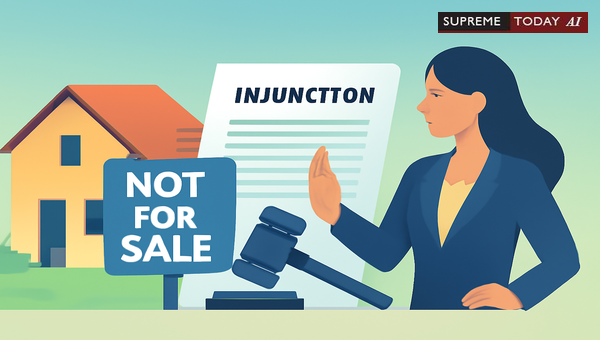
Not for Sale Restriction - The court explicitly restrained the plaintiff from selling his undivided 1/8 share in the suit property without prior leave of the Court. The plaintiff was also directed to convert the property from leasehold to freehold, with the defendant required to give No Objection Certificate (NOC), sign an indemnity bond, and contribute to conversion charges ["2024 Supreme(Online)(DEL) 6593"].
Property Conversion & Share Rights - The property bearing No. A-3/26, Janakpuri, New Delhi, was to be converted from leasehold to freehold, with the defendant consenting to the restriction on sale during the pendency of the suit ["2024 Supreme(Online)(DEL) 6593"]].
Sale and Transfer Disputes - Several cases highlight disputes over sale legality and property rights. For instance, defendants sold parts of the property (e.g., 2H 39R + Potkharaba 17.5R) to third parties, despite claims of ownership and agreements to sell. Courts questioned whether the sale deeds were valid, especially when the seller lacked authority or had not executed proper sale deeds, rendering some transfers illegal ["MALAN PANDURANG LANDE vs RAMESH DAYARAM SHITOLE AND ORS - Bombay"], ["2023 Supreme(Online)(MAD) 28044"], ["2022 Supreme(Online)(Guj) 10544"], ["
Harish Ambalal Choksi VS Narendra Ambalal Choksi - Current Civil Cases
"].Agreement to Sell & Authority Issues - Many cases involve agreements to sell where the defendants lacked proper authority, such as absent powers of attorney or unexecuted sale deeds. Courts emphasized that an agreement to sell does not create title or authority to transfer property unless properly executed, and that Power of Attorney must explicitly authorize sale transactions. When such authority was absent, courts refused to recognize the sale or upheld the plaintiff’s claim of illegal transfer ["2023 Supreme(Online)(MAD) 28044"], ["2022 Supreme(Online)(Guj) 10544"], ["2022 0 Supreme(Guj) 1534"], ["2023 0 Supreme(UK) 244"].
Injunctions & Status Quo - Courts granted interim injunctions restraining defendants from alienating, transferring, or creating third-party rights in the disputed properties during ongoing litigation, based on the principles that pendente lite transfers are generally restricted unless explicitly permitted ["2025 0 Supreme(All) 3439"]. The courts exercised discretion considering prima facie rights, the likelihood of irreparable harm, and preservation of status quo ["2025 Supreme(Online)(All) 1532"], ["MALAN PANDURANG LANDE vs RAMESH DAYARAM SHITOLE AND ORS - Bombay"].
Specific Performance & Title Disputes - Several judgments involve claims for specific performance of agreements to sell, with courts scrutinizing whether the agreements were valid, whether possession was transferred, and if the sale was executed lawfully. When agreements lacked proper authority or were executed without proper documentation, courts dismissed or refused specific performance, emphasizing the importance of clear title and valid authority ["2023 0 Supreme(Del) 5756"], ["2023 0 Supreme(Chh) 198"], ["2022 0 Supreme(Guj) 1534"].
Court Discretion & Legal Principles - Courts consistently exercised discretion in granting or denying injunctions, considering factors like prima facie case, balance of convenience, and irreparable hardship. They also clarified that mere possession or partial payments do not establish ownership rights, especially when sale deeds are not executed or authority is lacking ["2022 0 Supreme(Guj) 1785"], ["2022 Supreme(Online)(Mad) 100585"].
Analysis and Conclusion:The overarching theme across these cases is that courts are cautious in permitting property transfers or granting injunctions without clear legal authority, proper documentation, and adherence to statutory procedures. Restrictions on sale during litigation are common to preserve the rights of parties and prevent illegal transfers. Agreements to sell require explicit authority—such as valid Power of Attorney—and proper execution of sale deeds to be enforceable. Courts emphasize the importance of establishing valid ownership, authority, and compliance with legal formalities before permitting property transactions, especially in the context of ongoing disputes involving share rights, title, and unauthorized sales ["2024 Supreme(Online)(DEL) 6593"] ["MALAN PANDURANG LANDE vs RAMESH DAYARAM SHITOLE AND ORS - Bombay"] ["2023 Supreme(Online)(MAD) 28044"].
In property disputes, one common concern arises: Can a court under CPC Order 39 Rules 1 & 2 grant an injunction to prevent the sale or transfer of property that's explicitly not for sale? This question, often phrased as CPC O 39 R 1 2 Not for Sell Property Grant Injunction, touches on critical aspects of interim relief in civil litigation. Property owners, buyers, and litigants frequently seek such protections to maintain the status quo amid ongoing suits.
This blog post breaks down the legal principles, conditions, limitations, and judicial trends governing these injunctions. While courts have broad powers to prevent irreparable harm, statutory restrictions and factual circumstances play a pivotal role. Note: This is general information based on legal precedents and not specific legal advice. Consult a qualified lawyer for your case.
CPC Order 39 Rules 1 and 2 empower civil courts to issue temporary injunctions. These are interim orders designed to preserve the status quo or avert irreparable injury during the pendency of a suit. Courts typically assess three key factors:
These rules apply broadly, including to disputes over trust property, sale of property, or property rights, provided the above tests are met. 2002 5 Supreme 525 1999 5 Supreme 561
Courts often grant injunctions to halt property alienation, especially when a significant portion has been sold or possession transferred. For instance, orders may prevent further sales, transfers, or construction, with conditions to protect all parties' interests. 2002 5 Supreme 525
However, limitations exist:- Statutory bar under Order 39 Rule 2(f): No injunction can restrain government auctions or statutory sales unless specific conditions are fulfilled. 1985 0 Supreme(All) 40- In cases like government-allotted land or trust properties, courts scrutinize legality closely.
When property is not intended for sale or the sale is not imminent, courts exercise caution. Injunctions are less likely if:- The sale is authorized by law or statutory authority.- No clear threat of irreparable harm exists.
The primary aim is to prevent harm, not disrupt lawful transactions. Courts have refused relief where sales are lawful and non-imminent, or prohibited by statute. 1985 0 Supreme(All) 40
Yet, injunctions may issue against unlawful alienation, breach of trust, or fraudulent transfers, particularly involving substantial rights. 2002 5 Supreme 525 1999 5 Supreme 561
To secure an injunction:1. Demonstrate a prima facie case with strong evidence of rights.2. Prove irreparable injury – e.g., permanent loss of property rights.3. Show balance of convenience tilts in your favor. 2006 7 Supreme 289 2002 5 Supreme 525
Procedural mandates are strict, especially for ex parte (without notice) injunctions under Order 39 Rule 3. Courts must record reasons and typically issue notice to the opposite party. Non-compliance leads to vacating the order. As noted: Ex parte injunctions must comply with mandatory procedural requirements, including giving notice to the opposing party. Non-compliance mandates vacating the injunction. 2025 0 Supreme(SC) 1189
Statutory contexts further limit relief:- Trust properties require court permission for sales under CPC Section 92(1)(f). Unauthorized sales may invite injunctions, but appeals test locus standi. 2008 4 Supreme 153- Fraud vitiates transactions: Fraud vitiates all transactions; unregistered agreements do not confer title or interest in property. High Courts can quash fraudulent decrees under Article 227. 2025 0 Supreme(Kar) 1137
Indian courts have shaped these principles through diverse cases:
Allotment and Unauthorized Sales: In a case involving allotted land, defendants sold portions despite restrictions. The court noted: 2H 39R + Potkharaba 17.5R of the eastern side suit property has been allotted in favour of Defendant Nos. 1 and 2 and the same has been sold by Defendant No. 1 and 2 to Defendant No. 3. Such actions often justify injunctions if breaching allotment terms. 2023 Supreme(Online)(Bom) 10301
Consent Agreements and Locus: Permissions to sell suit property were challenged, with applications under Order 39 dismissed. This consent agreement has been executed, whereby permission has been granted to respondent no. 2 to sell the suit property. Courts probe locus standi rigorously. 2025 Supreme(Online)(MP) 8434
Construction and Measurement Disputes: Plaintiffs sought permanent injunctions against construction. The appellant/plaintiff has filed a suit... seeking permanent injunction against the defendant for putting up any construction in the Item No.1 of the suit property. Advocate Commissioners often measure boundaries. 2022 Supreme(Online)(MAD) 21446
2021 BEFORE THE MADURAI BENCH OF MADRAS HIGH COURT Date
Fraudulent Transactions: Therefore, it was on the face of it, a fraud played by respondents 1 and 2 hawking on the property of the petitioner. Unregistered agreements confer no title, enabling injunctions or quashing. 2025 0 Supreme(Kar) 1137
Tenancy Violations: Sales without permission under Bombay Tenancy Act led to confiscation. The respondent No. 2 should have applied for grant of permission to purchase and the respondent No. 1 should have applied for permission to sell the land. Courts decry such above law conduct. 2007 0 Supreme(Guj) 188 2007 0 Supreme(Guj) 189
Notice and Procedural Fairness: Prayer for injunction prohibiting from alienation of property was not granted... Notice must be served on the counsel. Non-service prejudices parties. 1999 0 Supreme(Mad) 733
Trust Permissions: District Judges grant sale permissions under CPC Section 92, but appeals assess public interest and constructions already raised. 2008 4 Supreme 153
These cases illustrate that while injunctions are tools for justice, they demand strict compliance and evidence.
In summary: Under CPC Order 39 Rules 1 & 2, injunctions restraining property sales are viable when justified by facts, law, and harm potential, but statutory limits and property nature constrain them. 2002 5 Supreme 525 1999 5 Supreme 561
If facing a property dispute, early legal consultation can clarify injunction prospects. This overview draws from precedents and is for informational purposes only – seek professional advice tailored to your situation.
#CPCInjunction #PropertyLawIndia #LegalInjunction
Mainee, learned counsel on instructions states that the plaintiff shall not sell his undivided 1/8 share in the suit property without leave of the Court. 12. Let the plaintiff take steps to convert the property from leasehold to freehold. 13. ... Sehgal, learned counsel for the defendant has no objection provided the plaintiff makes a statement that they will not sell their undivided share in the property. 11. Mr. ... The amended memo of parties ....
Thus, all the Defendants by fling common written statement have come up with the case that 2H 39R + Potkharaba 17.5R of the eastern side suit property has been allotted in favour of Defendant Nos. 1 and 2 and the same has been sold by Defendant No. 1 and 2 to Defendant No. 3. ... In the registered agreement, it is specifcally mentioned that 1/2 share of the Defendant No. 1 and 2 is 2H and #....
This consent agreement has been executed, whereby permission has been granted to respondent no. 2 to sell the suit property. ... 1 and 2 and Order XXXIX Rule 4 of the Code of Civil Procedure for grant of temporary injunction have been dismissed. ... It has been submitted during the course of arguments that respondent no. 2 has no locus to execute any agreement to sell regarding the suit property. ... The record of the case revels th....
The appellant/plaintiff has filed a suit in O.S.No.374 of 2006 before the District Munsif Court, Thoothukudi, seeking permanant injuction against the defendant for putting up any construction in the Item No.1 of the suit property. ... Pending appeal suit, the appellant/defendant has filed I.A.No.1 of 2019 for appointment of Advocate Commissioner to measure the property from the survey stone instead of cadel stone and to remeasure the property by observing that assistance of the Surveyo....
floor and third floor of the property in question, in favour of the Defendants No. 1 and 2, as provided under ATS 1 and ATS 2. ... 2.3 An Agreement to Sell dated 29thAugust, 2017 [hereinafter 'ATS 2'] was entered into between the Plaintiffs and Defendants No.1 and 2. ... After negotiations, Plaintiffs entered into an Agreement to Sell dated 26thJune, 2017 [hereinafter 'ATS 1'] w....
1. The Clear cut boundary of the Suit Property/Land is to be mentioned in the Report. 2. ... The agreement to sell does not even record that the respondents are being put in possession in pursuance to the agreement to sell so as to enable the respondents to claim the benefit flowing from Section 53A of Transfer of Property Act. ... Gata/Land No.634 Rakba 0.304 Hectre with a Total Area of 5 Kita Rakba 0.985 Hectre, which is situated at Village-Kurouli, Pargana Tehsil-Nawabganj, Dist- B....
It also emerges from the record that defendant No.1 has not executed sale deed in favour of the plaintiff and has now soled the property in question to defendant Nos. 2 to 5 by registered sale deed. ... Trusha Patel, learned advocate for respondent Nos. 2 to 5, who are the purchasers of the land in question from defendant No.1, has vehemently argued that as per the agreement to sell only Rs. 1 Lakh has been paid to the defendant No.1#HL_END....
Therefore, it was on the face of it, a fraud played by respondents 1 and 2 hawking on the property of the petitioner. 10.1. ... 2. Fact, in brief, germane are as follows: - 2.1. The petitioner purchases schedule property by way of a registered sale deed on 14-02-1991. Pursuant thereto, she has been put in possession of the property. ... Moreover, Respondent No. 1 has not filed any suit for specif....
filed by him, the land in survey No.195/1B in item No.1 is shedule property, for which the plaintiff has sought for the relief of permanant injuction. ... The appellant/plaintiff has filed a suit in O.S.No.374 of 2006 before the District Munsif Court, Thoothukudi, seeking permanant injuction against the defendant for putting up any construction in the Item No.1 of the suit property ... The title and the owership of the suit property was #....
A large number of depositors invested their amounts by way of deposits in the CPCO Bank. 2. "The Chalisgaon Peoples Cooperative Bank Limited" (for short, "CPCO Bank") is a Co-operative Bank. The vehicle was not hypothicated with the CPCO Bank. The CPCO Bank was under management of a Board of Directors. Likewise, petitioner Iqbal Khan (Cri.W.P. No.87/2009) availed loan facility to the tune of rupees five (5) lacs for purchasing of a vehicle. No vehicle was actually purchased by utilizing the loan amount.
No objection having been received, permission as sought for was granted by the learned District Judge by an order dated 13.10.1992. Out of the said amount Rs.33,00,000/- was paid in advance. An application for grant of permission to sell the said property was filed on 02.07.1990.
Unfortunately, each of the respondent being above law, did not make such application and entered into the transaction of sale of 15 Acres of land. The respondent No. 2 should have applied for grant of permission to purchase and the respondent No. 1 should have applied for permission to sell the land. The argument of the learned counsel for the respondents is that all this was bona fide. Once an order of confiscation was already made, then it should have worked as an eye opener for the respondents.
The argument of the learned counsel for the respondents is that all this was bona fide. Once an order of confiscation was already made, then it should have worked as an eye opener for the respondents. The respondent No. 2 should have applied for grant of permission to purchase and the respondent No. 1 should have applied for permission to sell the land. Unfortunately, each of the respondent being above law, did not make such application and entered into the transaction of sale of 15 Acres of land.
Prayer for injuction prohibiting from alienation of property was not granted. The said order is under challenging in this revision petition. It declared that service to petitioners is sufficient and since they are not represented by any counsel not they have presented themselves before court, injunction application was heard. But, petitioners were prohibited from putting up any construction in the plaint property till disposal of CMA.
Login now and unlock free premium legal research
Login to SupremeToday AI and access free legal analysis, AI highlights, and smart tools.
Login
now!
India’s Legal research and Law Firm App, Download now!
Copyright © 2023 Vikas Info Solution Pvt Ltd. All Rights Reserved.







