


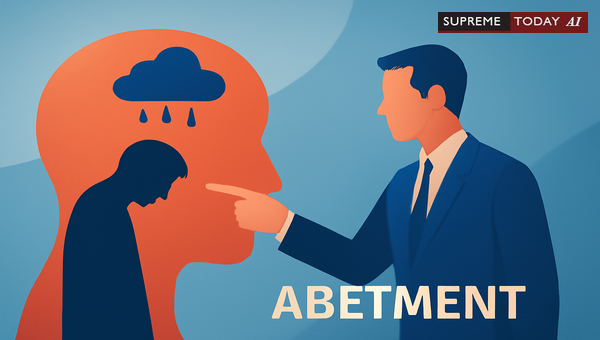
Essential Ingredients of Under IPC Explained
In the realm of criminal law, few concepts carry as much weight as . Whether it's a high-profile case of of suicide or a crime, understanding what constitutes is crucial for legal professionals, accused individuals, and the general public alike. But what exactly are the essential ingredients for ? This blog post dives deep into Sections 107 and 109 of the , with a special focus on of suicide under , drawing from judicial precedents and legal analyses.
Note: This article provides general information based on established legal principles and is not a substitute for professional legal advice. Consult a qualified lawyer for case-specific guidance.
Overview of in Indian Law
under Indian law is primarily governed by . Section 107 defines , while Section 109 prescribes punishment for abetting an offense. To establish , prosecutors must prove specific elements beyond a reasonable doubt. These ingredients ensure that mere association or passive involvement does not lead to liability—active participation with intent is key. 2020 0 Supreme(HP) 333
The question at the heart of many cases is: What are the essential ingredients for ? Let's break them down systematically.
Key Ingredients of Under
outlines three primary modes of : , , and . Each requires distinct proof, coupled with (guilty mind) and the actual commission of the principal offense. Here's a detailed look:
: A person must instigate another to commit the act. This involves urging, provoking, or encouraging the individual, often through words, gestures, or conduct. As defined, means to promote, 'to urge on' or 'to bring about' any persuasion to do any thing. 2019 0 Supreme(Jhk) 1720 2020 0 Supreme(HP) 333 1994 0 Supreme(MP) 377
: The accused engages with one or more persons in a , requiring an agreement or understanding to commit the offense. This is not mere knowledge but a shared criminal intent. 2020 0 Supreme(HP) 333 2015 0 Supreme(MP) 554
: The accused intentionally aids through an act or illegal omission, providing tangible assistance that facilitates the crime. 2020 0 Supreme(HP) 333 1994 0 Supreme(MP) 377
(): A cornerstone element, there must be clear behind the actions. The essential ingredients to be fulfilled in order to bring a case under , IPC are: i. the ; ii. the of the accused to aid or instigate or abet the deceased to commit suicide. 2025 1 Supreme 762 The prosecution bears the burden to prove this mental state. 2020 0 Supreme(HP) 333 1994 0 Supreme(MP) 377
: Critically, the abetted offense must actually occur as a result of the . Without this, fails. 2023 0 Supreme(Cal) 1106
These elements align with judicial interpretations: The essential ingredients of as stated in Section 107 of the Indian Penal Code reads thus... 2022 0 Supreme(Guj) 1413 Failure to prove any one can lead to acquittal.
Specific Context: of Suicide Under IPC
of suicide, punishable under IPC, demands heightened scrutiny. Courts emphasize that it is imperative that it must satisfy the ingredients of S. 107 of IPC. 2021 0 Supreme(MP) 493 Here are the tailored ingredients:
Direct or Indirect Acts of Incitement: Evidence of acts that provoke suicide is essential. Mere harassment or cruelty allegations fall short without proof of . 2007 4 Supreme 674 2009 0 Supreme(SC) 1432
Evidence of Intent: Prosecutors must show the accused intended to drive the deceased to suicide. Insulting language or mere disagreements do not constitute sufficient grounds for . 2023 0 Supreme(P&H) 311 1994 0 Supreme(MP) 377
Additional judicially recognized elements include:
Core: Active , instigating, or encouraging via Section 107 modes. 2025 5 Supreme 536 2025 0 Supreme(Guj) 1669 2024 0 Supreme(Ker) 1484 2023 0 Supreme(Jhk) 650 2024 0 Supreme(UK) 409
: A close temporal and causal link between the abettor's conduct and the suicide. Absence weakens the case. 2025 5 Supreme 536 2022 0 Supreme(Bom) 1977
or Evidence: If present, it should link the accused's role; vague references are insufficient. In one case, In the , except referring to the name of the appellant... there is no reference of any act or incidence whereby the appellant... is alleged to have committed any wilful act or omission. 2016 0 Supreme(Pat) 1264
: To provoke, incite, urge, or persuade. 2025 0 Supreme(Guj) 1669 2024 0 Supreme(Ker) 1491
Courts consistently hold: Without a charge of the substantive offence, no offence of can be made out. Further the necessary ingredients of an overt act or essential for are absent. 2012 0 Supreme(Del) 2344
Judicial Precedents and Common Pitfalls
Indian courts have clarified these ingredients across cases. For instance, mere suspicion or emotional disputes do not suffice—concrete evidence of active role, intent, and causation is mandatory. 2025 5 Supreme 536 2024 0 Supreme(Ker) 1484 2024 0 Supreme(UK) 409 2023 0 Supreme(Jhk) 650 2024 0 Supreme(Bom) 179
Common defenses succeed when:- No direct exists.- Intent is unproven.- The suicide stems from other causes.
Prosecutors must gather testimonies, documents, and forensic evidence to substantiate claims.
Recommendations for Legal Proceedings
To build a strong case:- Document Intent and Actions: Collect evidence clearly showing , , or aid.- Establish Causation: Prove the principal act resulted directly from .- Counter Defenses: Address arguments of passive involvement or lack of .
For the accused, highlight gaps in these ingredients early, such as via discharge applications under . 2025 1 Supreme 762
Conclusion and Key Takeaways
Proving under IPC requires demonstrating , , or , coupled with intent and the commission of the principal offense. In of suicide cases, courts demand irrefutable evidence of incitement and causation—mere allegations rarely prevail.
Key Takeaways:- All Section 107 elements must be proven. 2022 0 Supreme(Guj) 1413- Intent is non-negotiable. 2025 1 Supreme 762- Focus on direct evidence over suspicion. 2023 0 Supreme(Jhk) 650
Understanding these essential ingredients for empowers better navigation of legal challenges. Stay informed, but always seek expert counsel.
#AbetmentIPC, #Section306IPC, #IndianPenalCode












