


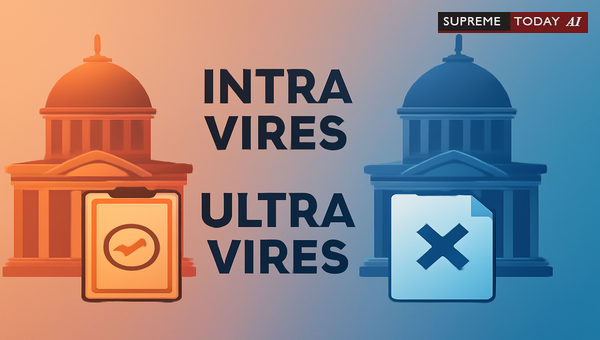
vs : Key Legal Differences
In the realm of administrative and constitutional law, understanding the boundaries of legal authority is essential. Many individuals, businesses, and even government bodies grapple with a fundamental question: What is the difference between and ? These Latin terms determine whether an action, rule, or regulation is valid or void, impacting everything from policy enforcement to court challenges.
This blog post breaks down the concepts, highlights key distinctions, explores judicial interpretations, and provides practical examples. Whether you're a legal professional, business owner, or curious citizen, grasping these principles can help navigate legal landscapes effectively. Note that this is general information and not specific legal advice—consult a qualified attorney for your situation.
Definitions of and
What is ?
refers to actions taken within the legal authority or power granted to an individual or body. Such acts are typically valid and lawful. Courts often apply a , assuming a rule or action is unless proven otherwise. For instance, unless the Rules are declared to be specifically, the law presumes the Rules are 2025 Supreme(Online)(Cal) 1727. This presumption protects administrative efficiency while allowing challenges when necessary 2023 0 Supreme(Chh) 237 2022 0 Supreme(All) 958.
Examples include rules made by government bodies that align perfectly with enabling statutes 1987 0 Supreme(SC) 995. Courts have upheld various provisions as , such as those in the and cooperative society rules 2023 0 Supreme(Jhk) 382 2025 Supreme(SRI)(CA) 426 2025 Supreme(Online)(Cal) 3143 2025 Supreme(Online)(Cal) 1869.
What is ?
Conversely, means beyond the powers or authority granted. An act exceeding the scope of conferred authority is void and unenforceable 2022 0 Supreme(Ori) 466 2007 0 Supreme(Pat) 1017. The doctrine splits into:- : Exceeds the scope of the parent statute 2023 0 Supreme(Kar) 215.- : Deviates from prescribed procedures 2023 0 Supreme(Kar) 215 2017 0 Supreme(Ori) 148.
Challenges often arise when rules conflict with constitutional articles or exceed delegated powers. For example, the declared certain rules 2025 Supreme(Online)(Cal) 1727 2025 Supreme(Online)(Cal) 3934 2024 2 Supreme 238.
Key Differences Between and
Here are the primary distinctions in a clear, comparative format:
- Authority Scope:
- : Within legal bounds—valid and enforceable.
: Exceeds authority—invalid and void.
:
- : Burden on challenger to prove otherwise 2000 0 Supreme(Raj) 233. In the absence of a specific declaration, law presumes rules are 2025 Supreme(Online)(Cal) 3143 2025 Supreme(Online)(Cal) 1869.
: Automatically void once proven; no .
Legal Consequences:
- : Courts uphold and enforce.
: Struck down; cannot be ratified easily.
Examples:
- : Regulations aligning with parent statutes, like upheld provisions in 2010 0 Supreme(UK) 62 or and , deemed not and 2005 0 Supreme(Raj) 779.
- : Imposing unauthorized taxes 1963 0 Supreme(SC) 93 or incompatible rules, as in cases where courts found disharmony without implied repeal 2018 0 Supreme(MP) 643 2001 0 Supreme(MP) 840.
| Aspect | | ||---------------------|--------------------------------------|--------------------------------------|| Validity | Presumed valid | || | On challenger | On authority once challenged || Court Action | Upheld | Quashed || Common in | Routine admin actions | Overreaching rules/regs |
Judicial Perspectives and Case Insights
Courts play a pivotal role in applying these doctrines, often using the '' principle to assess scope of power 2024 2 Supreme 238. If provisions read together are not , each is separately
.
- In one case, amendments to Development Officers Rules were challenged as , but presumption favored absent declaration 2025 Supreme(Online)(Cal) 1727 2025 Supreme(Online)(Cal) 3934.
- Another ruling affirmed: Regulations and and are not in contravention of the Constitution. These regulations are not said to be and are 2005 0 Supreme(Raj) 779.
- On : when both the provisions are in existence in the Statute book and there is no incompatibility... they have to be allowed their full play 2018 0 Supreme(MP) 643 2001 0 Supreme(MP) 840.
Varied judicial views exist; for instance, Rule 49(xii)(a) of was contested but affirmed 2025 Supreme(SRI)(CA) 426 2024 Supreme(SRI)(CA) 411. These decisions underscore that requires explicit proof, reinforcing the presumption.
Further, distinctions between void and voidable acts tie into jurisdiction: A further elaboration of the question of or on the subject of jurisdiction and illegality may confirm the results 1996 0 Supreme(AP) 115.
Practical Implications in Administrative Law
These concepts are vital for compliance. Businesses must ensure actions stay to avoid invalidation. Governments rely on the presumption to defend rules efficiently. Challengers must build compelling cases, often citing substantive or procedural flaws.
In modern contexts, like franchise acts or municipal by-laws, courts examine if notifications align with sections like 268(2)
. Understanding this prevents costly litigation.
Conclusion and Key Takeaways
In summary, actions stay within authority and enjoy validity presumption, while exceed limits and face nullification. Courts presume unless proven otherwise, balancing efficiency and accountability.
Key Takeaways:- Always check enabling statutes for authority scope.- Leverage presumption in defenses.- Seek judicial review for suspected acts.- Presumption holds: if both read together were not , then each separately is
.
This distinction is foundational in constitutional and administrative law. For specific applications, review cited documents or consult legal experts. Stay informed to operate confidently within legal bounds.
Word count: 1028. This post provides general insights; it is not legal advice.
#IntraVires, #UltraVires, #AdministrativeLaw















