


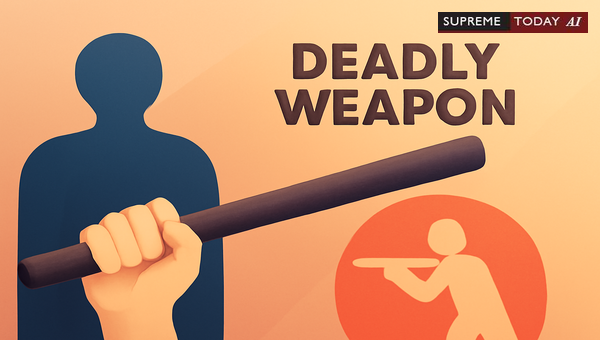
Is Iron Rod a Under ?
In the heat of an altercation, everyday objects like an iron rod can turn into instruments of serious harm. But does an iron rod automatically qualify as a under Section 326 of the Indian Penal Code (IPC)? This question often arises in assault cases involving , where the classification of the weapon determines the severity of charges—from lesser offences like to the more stringent Section 326.
Whether an iron rod is considered a under hinges on context, usage, and evidence. This blog post delves into judicial interpretations, key precedents, and practical considerations, drawing from court rulings to provide clarity. Note: This is general information based on case law and not specific legal advice. Consult a qualified lawyer for your situation.
Understanding : Legal Framework
punishes voluntarily causing by , with penalties up to life imprisonment. The crux lies in defining a deadly or dangerous weapon. Courts emphasize that this is not a fixed category but a factual determination based on:
- Nature of the object: Size, sharpness, and inherent danger.
- Manner of use: Force applied and intent.
- Resultant injuries: Whether (e.g., fracture, dislocation) was caused.
As noted in legal documents, the determination of its status as a is a factual question to be resolved based on the evidence presented during the trial 2022 0 Supreme(MP) 988.
Key Judicial Tests for Iron Rod as
Courts have repeatedly held that an iron rod isn't inherently deadly like a firearm but may qualify depending on circumstances. Here's a breakdown from precedents:
1. Context-Dependent Classification
In one ruling, an iron rod with a sharp edge was deemed a dangerous weapon under due to the grievous injuries inflicted, such as bleeding and fractures 2023 0 Supreme(P&H) 682. The court applied Section 326 because the rod's use caused severe harm.
Conversely, mere possession or use of an iron rod doesn't suffice. The mere use of an iron rod does not automatically classify it as a unless it is shown to be capable of causing death or 1959 0 Supreme(SC) 192. This underscores the need for evidence like medical reports.
2. Comparison with Other Objects
Judicial interpretation varies. For instance, human teeth were ruled out as deadly weapons under , highlighting context-dependency 2021 0 Supreme(Ker) 83 2017 0 Supreme(Raj) 1611. Similarly, for stones: One is with regard to the stone used by the appellant - accused to cause injury to PW1 and the stone is a handful stone cannot be termed as a 'dangerous weapon' to attract the offence under Sec. 326 of IPC 2023 0 Supreme(Kar) 1128.
Iron rods, being larger and potentially blunt or sharp, often fare differently. In cases like assaults with axes or stones alongside rods, courts invoked Section 326 when injuries warranted it, e.g., A1 assaulted him with like axe on the back of his head & caused bleeding injury & A3 assaulted him with like stone
.
3. Role of Medical Evidence and Injuries
requires specific injuries under , like bone fractures. Absence of X-rays or proof of fracture can downgrade charges: The Amicus Curiae also vehemently contended that though the prosecution invoked the offence under Sec. 326 of IPC, X-ray is not produced before the Court 2022 0 Supreme(Kar) 253.
In another case, Injury on PW1 is of dislocation of common bone which is grievous in nature... The wooden log/club is which attracts Section 326 of the I.P.C. 2019 0 Supreme(Kar) 1184. For iron rods, similar logic applies if medical evidence shows grievous impact.
Insights from Additional Case Law
Broader precedents reinforce that weapons like crowbars or spades can be deadly if used offensively: In , weapons like knife, hammer, crowbar and spades were held undoubtedly to be deadly weapons 2014 0 Supreme(Del) 2051. An iron rod aligns here if wielded aggressively.
However, downgrading occurs without sufficient danger: from Sec. 326 IPC to Sec. 324 IPC
. Courts also distinguish usage in Section 397 vs. 398 IPC: The word used in is ‘uses’ any and the word used in is 'offender is armed with any ' 2022 0 Supreme(Del) 1949 2022 1 Supreme 376.
In group assaults, Section 326 with 149 IPC applies if involves deadly means: For attacking the witnesses... the appellants were convicted... under Sec. 326 read with Sec. 149 IPC
.
Recent cases echo this: Anticipatory bail considerations under Section 326 for rod assaults 2022 0 Supreme(Bom) 1251, and appeals questioning charges 2023 Supreme(Online)(KAR) 2533 2023 0 Supreme(P&H) 682 2024 Supreme(Online)(Ker) 65799).
Strategic Considerations for Trials
- Prosecution Strategy: Gather medical reports, witness testimonies, and weapon recovery to prove deadliness. Highlight sharp edges or heavy blows [.
- Defense Strategy: Argue factual disputes, lack of grievous proof, or alternative sections like 324/325 IPC 1959 0 Supreme(SC) 192 2023 0 Supreme(Kar) 1128.
- Trial Court's Role: Resolves as a 2022 0 Supreme(MP) 988.
The absence of skull fracture merely negatives on the head injury; it does not detract from 2025 Supreme(Online)(Mad) 69078.
Conclusion and Key Takeaways
An iron rod may be classified as a under if evidence shows it caused through its nature or use. However, courts typically require case-specific proof, avoiding blanket categorizations. Precedents like those cited illustrate nuance—sharp or heavily wielded rods often qualify, while blunt, minor uses do not.
Key Takeaways:- Always contextual: Manner of use and injuries matter most.- Medical evidence is pivotal; X-rays bolster Section 326 claims.- Lesser sections (324/325) apply without deadliness proof.- Reference cases: 2022 0 Supreme(MP) 988 2023 0 Supreme(P&H) 682 1959 0 Supreme(SC) 192 2021 0 Supreme(Ker) 83 2017 0 Supreme(Raj) 1611 2023 0 Supreme(Kar) 1128 2025 Supreme(Online)(Mad) 69078.
For those facing such charges, early legal consultation is crucial. Stay informed, but seek professional advice tailored to your facts.
#Section326IPC, #DeadlyWeapon, #IPCIndia












