




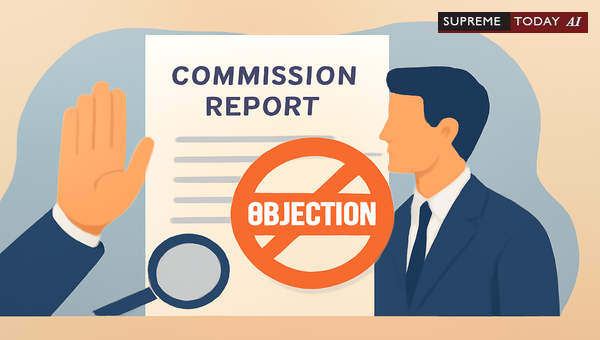
Is Objection to Commission Report a Prerequisite to Challenge?
In civil litigation, commission reports often play a pivotal role in resolving disputes involving , property boundaries, or factual assessments. But what if you disagree with the findings? A common question arises: is filing of objection to commission report a pre requisite to put question ? This query strikes at the heart of under the , particularly .
This blog post delves into Indian case law and legal principles to clarify whether objections are mandatory before challenging a report. While not always a strict prerequisite, failing to raise them can weaken your position. We'll explore key rulings, procedural nuances, and practical tips—remember, this is general information, not specific legal advice. Consult a lawyer for your case.
Understanding Commission Reports in Civil Suits
Under Rule 9, courts appoint commissioners for to clarify matters like property demarcation or site conditions that witnesses can't fully elucidate. The report, along with sketches or plans, becomes evidence upon filing. However, parties can challenge its accuracy, completeness, or methodology.
Courts typically admit these reports provisionally, subject to objections. As noted, the Court is satisfied that certain matters which are relevant for determining the issue in the suit can be obtained only by the local inspection by a Commissioner 2020 0 Supreme(Ker) 623. Yet, the report isn't sacrosanct—parties may impeach it, but procedure matters.
Is Filing an Objection a Strict Prerequisite?
No, filing an objection is not a strict prerequisite for challenging a commission report in court. Courts retain discretion to scrutinize reports at trial or appellate stages, even without prior objections. However, raising objections enhances your chances of success and ensures .
Key Legal Finding
Filing objections isn't mandatory beforehand, but courts must consider them if raised. Ignoring valid objections can undermine the report's admissibility or weight. For instance:- Courts have discretion to consider objections at various stages, including during trial or proceedings 2013 0 Supreme(Cal) 849.- Objections to the Commissioner’s report should have been raised before the , and if not, the subsequent failure to raise objections does not automatically bar the party from challenging the report 2024 0 Supreme(Ker) 970.- Failure to address objections, as in cases where the court below completely ignored the objections to the commission report and accepted the commission report, can lead to appellate interference 2011 0 Supreme(Ker) 1007.
This aligns with : courts can't capriciously dismiss challenges. The Court has discretion to examine or not to examine the Commissioner but it should be exercised legally and not capriciously 2013 0 Supreme(Cal) 849.
Effect of Not Filing Objections
Absence of objections doesn't immunize the report. Courts may still evaluate it independently, especially if deficiencies are evident. However, it may limit your arguments on appeal. In one ruling, reliance on an unsupervised surveyor's plan was deemed inadmissible without proper objections consideration 2011 0 Supreme(Ker) 1007.
Detailed Analysis from Case Law
Mandatory Consideration of Objections
Judgments emphasize that objections, if filed, must be examined. Objections, if filed, must be considered by the court, and failure to do so can be a ground for interference in appeal 2011 0 Supreme(Ker) 1007 2024 0 Supreme(Ker) 970. This prevents miscarriage of justice.
Challenging Without Prior Objections
Parties can impeach reports later, but courts prefer timely objections. In appellate contexts, fresh challenges succeed if prejudice is shown. For example, courts can for further inquiry if deficiencies persist 2024 0 Supreme(Ker) 970.
Second Commissions and Objections
Related rulings clarify limits on fresh commissions. A second commission generally requires setting aside the first report via objections or inquiry:- A court may appoint a second Commission without nullifying the first report only if deficiencies in the first report can be remedied without serious infirmities
.- A second advocate commission cannot be appointed without invalidating the first commission report, as per procedural law 2009 Supreme(Online)(KER) 17151.- However, exceptions exist: held that a second Commission to note details which have been omitted by Commission in his previous report is permissible even without setting aside earlier report 2021 0 Supreme(Ker) 721.
In property suits, courts quashed orders for new commissions without assessing prior reports, directing merits-based review
.
Court's Duty Irrespective of Objections
Even without objections, courts must ensure reports elucidate disputes: It is incumbent upon the Court to ensure that the Commission Report mentions the details necessary to elucidate the issue in dispute, for which the Commission was appointed, irrespective of whether the parties have filed any objection or not 2020 0 Supreme(Ker) 623. No executable decree can rely on deficient sketches 2020 0 Supreme(Ker) 623.
Practical Implications and Exceptions
Procedural rules under CPC are often directory, not mandatory, focusing on unless prejudice occurs. Key exceptions:- : Appellate courts intervene if ignored objections cause harm.- Appellate Stage: Challenges possible without trial-level objections, but evidence of flaws strengthens claims.- Other Contexts: Analogous to non-prerequisites like FIR for anticipatory bail (Filing of FIR is not a pre-requisite 1992 0 Supreme(AP) 356) or legal notices for suits (Legal notice is no pre requisite to filing a law suit 2022 0 Supreme(Del) 1885).
Recommendations for Litigants
To safeguard rights:- File Timely Objections: Articulate specific flaws (e.g., omissions, inaccuracies) post-report filing.- Document Everything: Ensure objections are heard; request commissioner examination if needed.- Seek Remittal: For deficiencies, pray for further inquiry rather than outright rejection.- Appeal Strategically: Highlight ignored objections as procedural errors.
Courts should: examine and decide on objections raised, rather than ignoring them, to uphold principles of 1978 0 Supreme(Ker) 205.
Conclusion and Key Takeaways
In summary, while filing an objection to a commission report is not an absolute prerequisite for , it's a vital step for fairness and success. Courts must address raised objections, and failure invites reversal. Litigants benefit from proactive objection-filing under CPC .
Key Takeaways:- Not mandatory, but highly advisable.- Courts' discretion must be judicial, not arbitrary 2013 0 Supreme(Cal) 849.- Second commissions need prior report scrutiny
.- Focus on prejudice for stronger challenges.
This analysis draws from precedents like 2011 0 Supreme(Ker) 1007, 2013 0 Supreme(Cal) 849, 2024 0 Supreme(Ker) 970, and others. For tailored advice, engage a legal professional—outcomes vary by facts and jurisdiction.
#CommissionReport #CPCLaw #LegalObjections















