Searching Case Laws & Precedent on Legal Query.....!
Analysing the retrieved Case Laws
Scanned Judgements…!



Searching Case Laws & Precedent on Legal Query.....!
Analysing the retrieved Case Laws
Scanned Judgements…!
Definition and Purpose of John Doe Orders - John Doe orders are injunctions issued against unknown defendants whose identities are not yet known at the time of the order. They serve to protect rights, particularly in intellectual property cases, by restraining unidentified infringers or malicious actors from continuing infringing activities ["2025 Supreme(Online)(Del) 10442"], ["2025 0 Supreme(Bom) 1682"], ["2023 Supreme(Online)(Mad) 92003"].
Legal Basis and Historical Context - The concept originates from English law under King Edward III, historically used to address unidentifiable defendants ["2017 Supreme(Online)(DEL) 934"], ["2017 0 Supreme(Del) 704"]. Courts have adopted this mechanism to prevent ongoing or future infringement when the infringer's identity is unknown, allowing for early intervention to safeguard rights.
Scope and Limitations - Orders against John Doe are personal to the unknown infringer and do not extend to the general public or future infringers beyond the scope of the specific case ["2025 0 Supreme(Bom) 1682"], ["2025 Supreme(Online)(Del) 10442"]. Courts typically grant ex parte ad interim injunctions against John Doe, but these are limited and require subsequent identification and service to enforce against specific entities ["2025 Supreme(Online)(Del) 10442"], ["JANUKI KUMARI J.B.RANA & ORS vs ASHOK KUMAR AND ORS - Delhi"]-77_2017).
Procedural Challenges and Conditions - Granting ex parte injunctions against unknown defendants raises questions about enforceability, as courts wonder how the order will be communicated or complied with ["JANUKI KUMARI J.B.RANA & ORS vs ASHOK KUMAR AND ORS - Delhi"]-77_2017), ["2017 0 Supreme(Del) 704"]. Courts generally require that the defendant's identity be ascertained within a reasonable period and that the order is specific enough to be enforceable once the defendant is identified.
Protection of Reputation and Identity Anonymity - In cases involving reputation, especially sensitive matters like sexual assault or defamation, courts have allowed plaintiffs to proceed under pseudonyms or as John Doe to protect their privacy ["2024 Supreme(US)(ca7) 323"], ["2024 Supreme(US)(ca7) 350"], ["2023 Supreme(US)(ca4) 281"]. These measures aim to balance the need for legal relief with privacy concerns.
Application in Digital and IP Cases - Courts have issued John Doe orders to restrain unknown online infringers, impersonators, or malicious actors misusing intellectual property or personal data ["2025 Supreme(Online)(Del) 10442"], ["2025 Supreme(Online)(Del) 46956"], ["2025 Supreme(Online)(Del) 1696"]. Such orders often include directions to ISPs or platform providers for takedown and blocking actions.
Main Points and Insights -
Privacy and reputation concerns justify the use of pseudonyms or anonymous proceedings in sensitive cases ["2024 Supreme(US)(ca7) 323"], ["2025 Supreme(Online)(Del) 10442"].
Conclusion - Courts worldwide acknowledge the utility of John Doe injunctions in safeguarding intellectual property, reputation, and online rights when the infringer's identity is unknown. However, such orders are inherently provisional, requiring follow-up steps to identify and serve the actual infringing parties to ensure enforceability and compliance ["2025 Supreme(Online)(Del) 10442"], ["2025 0 Supreme(Bom) 1682"], ["2023 Supreme(Online)(Mad) 92003"]. Proper procedural safeguards are essential to balance effective protection with fairness and enforceability.
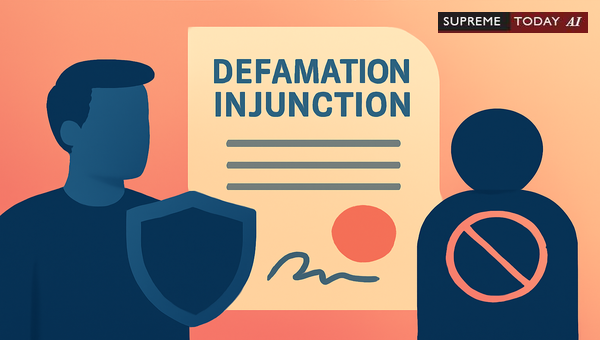
In today's digital age, defamatory statements often spread anonymously online, leaving victims struggling to identify perpetrators while their reputation suffers . A common question arises: Can an order of injunction protect a person's reputation when the defendant's identity remains unknown? This is where —also known as in India—come into play. These allow courts to restrain unknown parties from further disseminating harmful content, balancing the right to reputation with free speech.
This blog post delves into the Indian judiciary's approach, drawing from established legal principles and case law. While this provides general insights, it is not legal advice—consult a qualified lawyer for your specific situation.
target unidentified defendants, typically in scenarios involving anonymous online posts, emails, or publications. Courts recognize that defamation—imputations intended to harm reputation—can occur without revealing the source, necessitating swift action to prevent ongoing damage 2024 0 Supreme(Gau) 1099.
As defined in judicial precedents, is nothing but an injunction sought against the person or persons whose identity is not known at the time of issuance of the order JANUKI KUMARI J.B.RANA & ORS vs ASHOK KUMAR AND ORS-77_2017)
JANUKI KUMARI J.B.RANA & ORS vs ASHOK KUMAR AND ORS
. This mechanism extends to reputation protection, where plaintiffs demonstrate a of defamation and likely 2024 0 Supreme(All) 1984.Under Indian law, defamation involves statements made with intent or knowledge that they will harm reputation, including electronic dissemination 2024 0 Supreme(Gau) 1099. Courts prioritize reputation as a fundamental right, often invoking (right to life and personal liberty, encompassing privacy and dignity) alongside .
In cases of anonymous speech, courts grant ex parte or interim injunctions against unknown defendants to halt imminent harm 2024 0 Supreme(Gau) 1099. For instance, plaintiffs have successfully restrained unidentified internet users from further publication of defamatory content 2024 0 Supreme(Gau) 1099.
Courts do not issue these orders lightly. The plaintiff must typically satisfy a three-pronged test:
Even against unknown parties, orders are interim, paving the way for identification via platforms like social media intermediaries 2024 Supreme(Online)(DEL) 7340. One case noted, The main unknown defendant no. 1 / John Doe(s) behind the said fraudulent E-mails, cannot give any plausible explanation for the use of the plaintiff’s name, marks and identity 2024 Supreme(Online)(DEL) 7340.
Indian courts meticulously balance (freedom of speech) with reputation protections under . Anonymous speech enjoys safeguards but is not absolute—remedies exist for victims, including disclosure orders from platforms 2024 0 Supreme(Gau) 1099.
In a defamation suit involving online content, courts have granted against specific defendants for per se defamatory statements while emphasizing privacy intrusions 2021 0 Supreme(Bom) 1203. Similarly, in privacy-focused cases, injunctions against John Doe entities prevent unauthorized use of likeness or identity 2021 0 Supreme(Del) 348.
However, caution prevails. Ex parte orders against unknowns require justification to avoid overreach. As observed, An injunctive order in a defamation action cannot, I imagine, be made against an unknown party in certain contexts, underscoring the need for specificity 2021 0 Supreme(Bom) 1203.
originated in intellectual property but extend to defamation and personality rights:
These examples illustrate courts' willingness to adapt for reputation harms, provided procedural rigor is met JANUKI KUMARI J.B.RANA & ORS vs ASHOK KUMAR AND ORS-77_2017).
Not all cases qualify:
Courts remain vigilant against misuse, as in cases questioning fulfillment of notice conditions post ex parte orders
JANUKI KUMARI J.B.RANA & ORS vs ASHOK KUMAR AND ORS
.If facing anonymous defamation:
Defendants, once identified, can challenge via .
In summary, while anonymity poses challenges, judicial tools like empower victims to seek swift protection. Stay informed, act decisively, and seek professional guidance to navigate these complexities.
This post is for informational purposes only and does not constitute legal advice.
#JohnDoeOrder, #DefamationLawIndia, #ReputationProtection


Defendant No. 17 is an unknown entity-John Doe, as Plaintiff has sought relief against the unknown entities. ... (f) In addition, Defendant No. 7 is directed to take down the infringing URLs of John Doe entities enlisted at Annexure A attached to this order. ... (h)In addition, Defendant No. 12 is directed to take down the infringing URLs of John Doe entities enlisted at Annexu....

He submitted that it was only because, at the stage of institution of such suits, the identity of the infringers was unknown that such suits were instituted by arraying the infringers as 'John Doe/Ashok Kumar'. ... It would imply that a single ‘John Doe’ order could operate in perpetuity, binding all infringers known or unknown, present or future, without notice or opportunity of hearing. ... He submitted that the First Suit had been filed against #H....

He submitted that it was only because, at the stage of institution of such suits, the identity of the infringers was unknown that such suits were instituted by arraying the infringers as 'John Doe/Ashok Kumar'. ... It would imply that a single ‘John Doe’ order could operate in perpetuity, binding all infringers known or unknown, present or future, without notice or opportunity of hearing. ... He submitted that the First Suit had been filed against #H....

The main unknown defendant no. 1 / John Doe(s) behind the said fraudulent E-mails, cannot give any plausible explanation for the use of the plaintiff’s name, marks and identity. 39. ... The unknown main defendant no. 1 / John Doe(s) are hiding behind the walls of anonymity on the internet and impersonating as the Plaintiff and its Managing Partner Mr. ... It is submitted that the persons / entities who have received the fraudulent e....
John Doe orders is nothing but an injunction sought against the person or persons whose identity is not known at the time of issuance of the order. ... On an ex-parte ad interim injunction being granted against John Doe or Ashok Kumar i.e. unknown defendant, this Court wonders how the applicant would fulfill the conditions of this provision ... This Court has thus passed the permanent injun....
John Doe orders is nothing but an injunction sought against the person or persons whose identity is not known at the time of issuance of the order. ... On an ex-parte ad interim injunction being granted against John Doe or Ashok Kumar i.e. unknown defendant, this Court wonders how the applicant would fulfill the conditions 2017:DHC:1197 against the definite defendant nos....
John Doe orders is nothing but an injunction sought against the person or persons whose identity is not known at the time of issuance of the order. ... On an ex-parte ad interim injunction being granted against John Doe or Ashok Kumar i.e. unknown defendant, this Court wonders how the applicant would fulfill the conditions 2017:DHC:1197 against the definite defendant nos....
He states since the details of the said individuals/entities is unknown, they have been arrayed as ‘Ashok Kumar/John Doe’ i.e., Defendant No. 1 herein. Infringement by unknown entities/persons through online marketplaces 27.1. ... Defendant No. 11 is Ashok Kumar/John Doe entity. Directions have been issued to the proforma Defendants for furnishing BSI details within three [3] weeks. ... The Plaintiff has therefore, made out a case for ex- parte ad-in....

John Doe orders is nothing but an injunction sought against the person or persons whose identity is not known at the time of issuance of the order. John Doe has its origin under reign of England’s King Edward III when the orders were used to refer to unidentifiable defendants. ... John Doe. ... The Court heard the arguments on two count i.e. maintainability of the suit in the present form and also grant of ex-parte ad interim #HL_ST....
John Doe orders is nothing but an injunction sought against the person or persons whose identity is not known at the time of issuance of the order. John Doe has its origin under reign of England’s King Edward III when the orders were used to refer to unidentifiable defendants. ... John Doe. ... The Court heard the arguments on two count i.e. maintainability of the suit in the present form and also grant of ex-parte ad interim #HL_ST....
Among the others, there are some publications and some individuals said to be associated with those publications. An injunctive order in a defamation action cannot, I imagine, be made against an unknown party. The 29th Defendant is a 'John Doe / Ashok Kumar' entity, name and address unknown.
Defendant No. 9 is a John Doe/Ashok Kumar impleadment of unknown persons, against whom a relief of the same nature is sought, by way of a pre-emptive measure. Similarly, Defendant No. 5 and 6 (M/S VSG Binge and Vijay Shekhar Gupta) are making a movie titled ‘Suicide or Murder: A star was lost’, Defendants No. 7 (Sanoj Mishra) is making a movie titled ‘Shashank’ and Defendant No. 8 (Nikhil Anand) is making a crowd-funded movie which as yet is untitled. In this background, Plaintiff has filed the present suit seeking enforcement of John Doe orders against known Defendants No.....
Upon being reminded that the law provides a recourse thereto by impleading the unknown person as John Doe / Ashok Kumar and by seeking disclosure of identity thereof from the electronic platforms, it was stated that the steps in that regard will be taken. Moreover, it is not the function of the Court to make out a case for the plaintiff. The counsel for the plaintiff, being unable to reply to the aforesaid, during the hearing on 27th February, 2019 stated that the person who morphed, forged and fabricated the photographs was not impleaded because his/her identity was not kn....
The details of registrants/ operators of these websites are unknown and therefore the plaintiffs have arrayed them as 'John Doe' defendants. In some cases, the names of these websites are very similar to the blocked websites, enabling and encouraging easy identification and access.


An indispensable Tool for Legal Professionals, Endorsed by Various High Court and Judicial Officers
Please visit our Training & Support
Center or Contact Us for assistance

Scan Me!
India’s Legal research and Law Firm App, Download now!


For Daily Legal Updates, Join us on :



 Back to top


